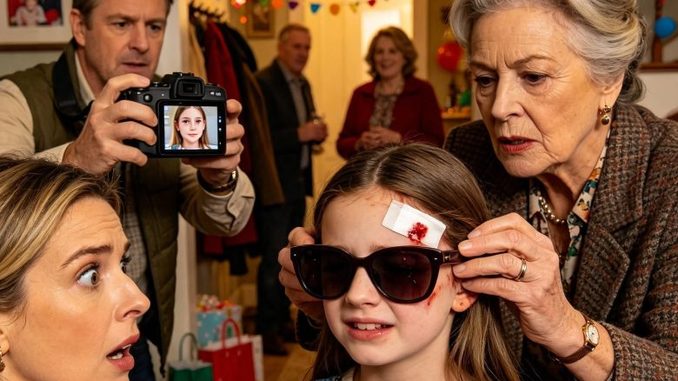
As we were almost at the front door, my daughter lifted her hand toward another image on the back of the camera, and the photographer froze before swiping past it.
Her finger hovered with the certainty only a scared child has when she knows the truth is sitting right in front of everyone and is still somehow being ignored.
My arm was around her shoulders.
My husband had her jacket in one hand.
His mother was two steps behind us, still trying to keep control of the room with her voice.
The photographer angled the screen so all three of us could see it.
The photo had been taken from the foyer.
Two cousins were blurred in the foreground, but in the background, near the stairs, my mother-in-law had her hand wrapped around my daughter’s wrist.
In her other hand was a sparkly ivory headband.
My daughter’s ponytail was half loosened.
Her body was angled backward.
Her face was turned away.
There was no swelling around her eye yet.
No gauze.
No sunglasses.
That image did not show an accident.
It showed intention.
It showed a reason for taking her upstairs.
It showed my mother-in-law leading her there before anything happened.
I felt my stomach drop in a new way.
Up to that point, I had already heard three different explanations in under a minute for why my nine-year-old was suddenly standing beside me with one swollen eye and a small blood-spotted gauze pad near her brow.
First, she had tripped.
Then maybe she had hit the edge of some furniture.
Then my mother-in-law said she had not actually seen the exact second because she was in another room.
But the photographer had already shown us the earlier picture from 43 minutes before, the one where my daughter was smiling near the bottom of the stairs, completely fine.
Now he had shown us the reason she had been taken upstairs in the first place.
My husband leaned in so close I could hear his breathing change.
His mother started to say that she was only holding her hand.
Before she got another sentence out, my daughter said, very softly, “No, you weren’t.”
Nobody in the room moved.
She pressed herself tighter against my side.
Her voice was small, but not uncertain.
She said Grandma got mad about her hair.
That was when the noise from the next room, the laughter and serving spoons and people calling everyone over for pictures, started to sound far away.
My daughter said Grandma had told her the ponytail I did looked sloppy for family photos.
She said Grandma pulled out the elastic at the stairs and told her they needed to fix it upstairs before the photographer gathered everyone.
She had asked for me.
Grandma told her not to make a scene.
The photographer swiped again.
The next image looked accidental, the kind of candid shot that catches more than the person behind the lens even realizes.
He had been photographing kids running through the foyer.
At the top of the stairs, through the open guest-room door, my mother-in-law was visible in the background.
She was standing over my daughter near the vanity.
A hairbrush was in one hand.
The headband was in the other.
My daughter’s chin was tucked down.
Her arms were lifted halfway, not like she was fighting, but like she was trying to protect her head.
My husband stared at that frame for a long time.
My mother-in-law said it looked worse than it was.
Then she said my daughter was being dramatic.
Then she said kids twist away all the time when you’re helping them.
My daughter did not look at her.
She kept staring at the screen.
She said the brush hurt.
She said Grandma kept telling her to stop squirming.
She said the headband was tight and scratched behind her ears.
She said she asked again for Mom.
My mother-in-law snapped that there was no reason to bother me over a hairstyle.
I could picture the whole thing too clearly.
The upstairs guest room with the overstuffed chair in the corner.
The vanity with the sharp wooden edge.
The urgency of a woman who cared more about a perfect family portrait than a child who was uncomfortable.
The photographer swiped one more time.
That was the image my daughter had pointed to.
It showed my mother-in-law stepping out of the guest room with a white first-aid tin in one hand and my daughter’s pink sunglasses in the other.
My daughter was behind her.
Her face was turned partly down.
A square of gauze was pressed near her brow.
Even from the small screen, I could see the skin around her eye had started to puff.
My mother-in-law made a frustrated sound.
She said none of us knew what we were looking at.
My husband finally turned to her.
He asked what happened.
Not what she wanted us to think happened.
What actually happened.
The room stayed silent long enough that my daughter answered before Grandma did.
She said Grandma tried to put the headband on.
She said it hurt.
She stepped away.
Grandma grabbed her wrist and told her to hold still.
She pulled back because she wanted me.
When Grandma yanked her toward the vanity, she hit the corner with her face.
No one interrupted her that time.
Not even the people who had drifted over from the dining room and were suddenly pretending not to listen.
My mother-in-law said that was not what happened.
My daughter did something that broke my heart and made me proud of her at the same time.
She repeated the story exactly the same way.
Same order.
Same details.
Same frightened steadiness.
Then she added the part that made my husband close his eyes for a second.
She said Grandma cleaned the cut and told her to stop crying because everyone was downstairs.
She said Grandma put the sunglasses on her and told her to say she was sensitive to light.
She said Grandma told her not to ruin the evening over a little accident.
There it was.
The same phrase my mother-in-law had used on me minutes earlier.
Only now it sounded even uglier coming out of a child’s mouth.
My husband opened his eyes and took one step back from his mother.
It was a small movement.
It felt enormous.
He thanked the photographer for speaking up.
Then he told his mother not to touch our daughter again.
She tried once more to frame herself as the reasonable one.
She said I was poisoning the family.
She said this was being blown out of proportion.
She said she was only trying to make sure our daughter looked nice for pictures.
My husband said, very evenly, that a nice picture was not worth a child being hurt and then coached into hiding it.
For the first time all evening, his mother had no quick answer.
We left.
No group photos.
No goodbyes.
No apology accepted because none had actually been given.
My daughter sat in the back seat of our SUV with an ice pack wrapped in a dish towel.
I turned around every few seconds to look at her.
My husband drove with both hands locked so tight on the wheel his knuckles went pale.
No one talked for the first five minutes.
Then my daughter asked if she was in trouble.
That question hurt more than the sight of the bruise.
I told her no.
I told her she had done exactly the right thing by telling the truth.
My husband said the same thing, but his voice caught halfway through it.
She asked if Grandma was mad.
He took a breath before answering.
He said Grandma could manage her own feelings.
What mattered was that our daughter was safe.
We took her to pediatric urgent care.
The nurse at intake looked at the swelling, the gauze, and then at us.
She asked what happened.
I started to answer, but the nurse gently asked my daughter if she wanted to tell it herself.
My daughter did.
She told the same story she had given downstairs.
Grandma did not like her hair.
Grandma took her upstairs.
Grandma pulled her arm when she tried to get away.
She hit the corner of the vanity.
Grandma put sunglasses on her and told her not to say more until pictures were over.
The nurse wrote everything down.
The doctor examined the cut and the swelling carefully.
The good news was that the cut was shallow.
The bad news was that the bruising around the eye was significant enough that they wanted to check her vision and make sure there were no signs of deeper injury.
While we waited, my husband called the photographer.
He asked if he would send every image from that stretch of time, with the original timestamps intact.
The photographer said yes immediately.
He sounded relieved to be useful.
He also sounded shaken.
He told my husband he had hesitated because he did not want to insert himself into family business, but once he heard three changing stories and saw our daughter’s face, he knew something was wrong.
My husband thanked him again.
He said that if he had stayed quiet, we might still have left the party with only a lie.
The doctor came back and said my daughter’s eye itself looked okay.
There were no signs of a fracture.
The cut did not need stitches.
She would be sore.
She would have a bruise for a while.
We were given instructions for ice, rest, and what symptoms to watch overnight.
Then the doctor asked if the person who caused the injury lived in our home.
I said no.
He asked if our daughter would have any contact with that person before we were ready.
My husband said no again, this time with more force than the question required.
The doctor nodded and documented everything.
He said that because an adult had injured a child during forceful handling and then instructed the child to conceal it, he was required to note the circumstances very clearly.
He also told us to save every photograph.
We did.
By the time we got home, my husband’s phone was full of messages.
His mother had apparently told relatives that I had stormed out over a minor bump and humiliated her in front of everyone.
A few messages urged him to smooth things over.
A couple said accidents happen.
One aunt wrote that family should stay together and not let an outsider with a camera stir up drama.
That one made my husband laugh once, but not in a kind way.
The outsider with the camera had told more truth in ten seconds than most of the family had managed all evening.
He did not answer anyone that night.
Our daughter fell asleep on the couch with a fresh bandage and children’s ibuprofen in her system.
I sat beside her.
My husband sat on the floor in front of the coffee table with the photographer’s email open.
There were seven images in the sequence.
The first was the healthy picture near the stairs.
The second showed his mother taking our daughter upstairs with the headband.
The third showed them in the guest room doorway.
The fourth was blurry but still useful, a flash of my mother-in-law leaning in while my daughter twisted sideways.
The fifth showed the first-aid tin and sunglasses.
The sixth showed them re-entering the downstairs hallway.
The seventh was the moment I had found her.
It was not the injury itself caught cleanly on camera.
It was something more believable than that.
A whole chain of ordinary moments that, taken together, made the lie impossible.
My husband stared at those frames for a long time.
Then he said the part he had not wanted to admit earlier.
He said if the photographer had not spoken, he might have believed his mother’s first version because he had spent his whole life being trained to believe her fast explanations before his own instincts.
That was one of the most honest things I had ever heard him say.
I asked what he wanted to do.
He said he wanted one last chance to hear the truth from her mouth.
He called the next morning.
He put the call on speaker.
His mother sounded offended before he had even asked a question.
She said she could not believe we had dragged a child to urgent care over a bump.
He told her the doctor visit was not the issue.
The issue was that she had hurt our daughter, hidden it, and lied repeatedly.
She insisted she had not lied.
She said our daughter moved suddenly.
She said the headband was only for one photo.
She said the cut looked worse than it was.
She said I had always disliked her.
She said none of this would have happened if I had known how to dress a girl properly for a family party.
That last line ended any chance she had of sounding accidental.
It laid the whole ugly motive bare.
Control.
Appearance.
Punishing resistance.
My husband asked her whether she told our daughter to say she was sensitive to light.
She was quiet for a second.
Then she said she was just trying to avoid upsetting everyone.
He asked whether she told her not to ruin the evening.
Another pause.
Then she said she was trying to calm her down.
That was enough.
He told her she would not be seeing our daughter for the foreseeable future.
No visits.
No drop-ins.
No private calls.
No gifts delivered to the house.
He said if she wanted to speak to him, she could do it in writing.
He said the decision was not up for debate.
She cried then.
Or at least she made crying sounds.
She said I was turning him against his own family.
He said the family problem started when she chose a photo over a child.
Then he ended the call.
I wish I could say everything became simple after that.
It did not.
Families built on appearances do not give up their stories easily.
Within hours, my husband’s sister called privately.
She apologized.
She said she had noticed their mother could get obsessive before holidays and photos, especially when she felt everyone was slipping outside the version of family she wanted to present.
She said she had seen her hiss at kids to stand still, smooth down shirts too roughly, and once make a cousin cry over a crooked bow.
She also said she had never seen it go this far.
I believed her.
Patterns matter.
So do thresholds.
Sometimes the worst thing is not that one person becomes someone new.
It is that they keep being exactly who they have always been until the damage finally becomes too obvious to dismiss.
My husband sent one message to the extended family group.
He kept it short.
He said our daughter had been physically injured while being forced upstairs to change her appearance for photos.
He said there were timestamped images documenting the sequence before and after.
He said a doctor had examined her.
He said any future discussion should center on our daughter’s well-being, not his mother’s embarrassment.
He said there would be no further contact for now.
Several relatives went silent.
A few sent private apologies.
Two still defended his mother by calling it an accident.
He answered both the same way.
He said the bruise may have come from a sudden impact, but the lying, coaching, and concealment were choices.
That distinction mattered.
It still does.
Our daughter stayed home from school the next day because the swelling was worse in the morning.
The bruise had spread in soft purple and yellow around the outer corner of her eye.
She looked older somehow.
Not because of the injury itself.
Because of the caution.
The watchfulness.
She asked me if telling the truth had made the family mad at her.
I told her that when adults get angry at the truth, the truth is usually still doing its job.
She thought about that.
Then she asked if Grandma had loved her hair before she got mad.
I said Grandma loved control more than she loved being corrected, and that was not a burden my daughter was meant to carry.
My husband sat down beside us.
He told her none of it was her fault.
He told her he was sorry he had not gotten to her faster.
That was the moment she finally cried.
Not at the party.
Not at the clinic.
Not during the drive home.
Only then, when she realized the grown-ups around her were no longer asking her to absorb someone else’s version of events.
She climbed into his lap despite being big enough to insist she was too old for that most days.
He held her and cried too.
A week later, the photographer mailed us one print at his own expense.
It was the image from before everything changed.
My daughter near the bottom of the stairs.
Smiling at something outside the frame.
No gauze.
No sunglasses.
No bruise.
On the back he wrote one sentence.
He said every kid deserves at least one picture from a day like that that still belongs to them.
I kept that note.
So did my husband.
When the next family holiday invitation came, it was addressed as if nothing had happened.
A cheerful group text.
A casserole emoji.
A time.
A reminder about pictures before dinner.
My husband typed the reply without asking me what would keep the peace.
He said we would not be attending.
He said our boundary remained the same.
He said trust is not restored by pretending.
There was outrage.
There was guilt.
There was a long message from his mother about how one mistake should not cost her a relationship with her granddaughter.
He did not answer immediately.
Later that night, he wrote back with more calm than she deserved.
He said the injury was one thing.
The pressure on a child to hide it was another.
The campaign to rewrite the story afterward was a third.
He said relationships survive mistakes when the person who made them tells the truth and makes repair.
She had done neither.
Months passed.
The bruise faded.
The cut healed into a thin line near the brow that only showed if the light hit sideways.
What took longer was my daughter’s willingness to relax when anyone reached toward her hair.
So we changed how we did things.
We asked before touching.
We let her choose styles.
We made brushing part of a conversation instead of a chore performed on her.
It sounds small.
It was not small.
Control and care can look similar from far away.
Up close, one asks.
The other takes.
On school picture day that fall, she sat on the bathroom counter in her socks and handed me a plain blue scrunchie.
She said she wanted a ponytail.
Just a ponytail.
Nothing fancy.
I asked if she was sure.
She smiled in the mirror and said yes.
Then she added that if anyone wanted something different, they could take their own picture.
I laughed.
My husband laughed from the doorway.
And for the first time since that party, my daughter laughed without checking the room first.
I did her hair exactly the way she wanted it.
No headband.
No pressure.
No woman waiting upstairs with a story ready.
When we took her photo on the front porch before the school bus came, she did not need sunglasses.
She did not need an excuse.
She just looked like herself.
That turned out to be more than enough.
Leave a Reply