At 2:18 a.m., Officer Kline set a clear evidence sleeve containing a tiny memory card across my open palm, and the next move belonged to me.
I knew the card before he explained it.
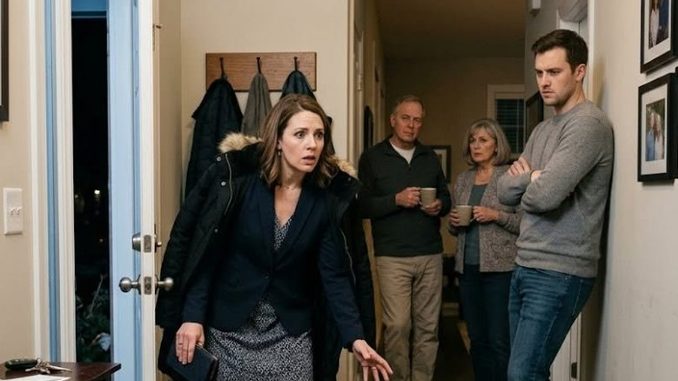
Three months earlier, after two packages vanished from our porch, I had mounted a cheap entryway camera above the coat hooks and stopped thinking about it once the deliveries stopped disappearing.
Ryan had noticed it.
Apparently, he had remembered it that night too.
While I rode with Eli to the hospital, Officer Kline had called and asked whether anything inside the house recorded video, so I told him about the camera and gave him permission to look for its base unit.
He found the router unplugged.
He found the camera dark.
He found the memory card still inside.
Ryan had killed the internet connection, but the camera saved motion clips locally before sending them anywhere else.
He had stopped one copy.
Not both.
Kline asked whether I would authorize them to preserve the card and review everything from that evening as part of the investigation.
My mother had already called me twice from an unknown number because I had blocked hers while sitting beside Eli’s hospital bed.
My father had left a voicemail telling me not to ‘destroy the family over one bad night.’
I looked at the card.
‘Use it.’
Kline took it back, sealed the sleeve completely, and wrote the time across the label while I rubbed the place where the plastic edge had pressed into my palm.
The emergency department was cold enough that I still had my coat on, although the paper coffee cup from the banquet hall had gone lukewarm hours earlier and was sitting untouched beside the sink.
Eli was awake by then.
Barely.
A nurse named Denise had dimmed the lights because his head hurt, and every few minutes he opened his eyes long enough to check whether I was still in the chair beside him.
I was.
I stayed there.
I answered questions when he could not, stopped when the doctor needed silence, and signed the forms they placed in front of me without pretending I understood every line the first time I read it.
The doctor documented bruising along Eli’s jaw, swelling near his cheek, tenderness at the back of his head, and symptoms consistent with a concussion, then ordered more imaging because he had lost consciousness.
That changed the tone again.
Ryan had called it discipline.
My mother had called it deserved.
The chart called it an injury requiring treatment after loss of consciousness.
Plain words.
Useful words.
Sometime before dawn, the paramedic who had recognized Ryan came into the room after finishing paperwork downstairs.
His name was Marcus Hale, and without showing me protected details from anyone else’s medical record, he explained why Ryan’s face had stopped him in the hallway.
Months earlier, Marcus had responded to another residence where a child had been injured while Ryan was present.
The circumstances had been disputed.
The adults had minimized what happened.
The child had still gone to the hospital.
Marcus had completed the required patient-care documentation and filed the safety concern through the channels his department used when a child’s injuries did not match the explanation given at the scene.
Ryan apparently believed that because no dramatic public case followed, the incident had vanished.
It had not.
Records do not need an audience to exist.
Marcus did not tell me Ryan was guilty of that earlier injury, and I did not ask him to.
I only asked whether the earlier call was why he had recognized him.
‘Yes.’
Then I asked whether Officer Kline knew.
‘He does now.’
That was enough.
Around four that morning, my father left another voicemail.
This one sounded different.
He did not defend Ryan directly.
He defended the family.
He said everybody was exhausted, everybody had reacted badly, and the smartest thing would be for me to tell police that I had arrived upset after drinking at a company party and might have misunderstood what I saw.
I replayed that part twice.
Then I stopped.
My company badge was still around my neck.
I had forgotten it was there.
The plastic edge had been digging into my collarbone for hours, so I unclipped it and put it on the hospital tray beside Eli’s water cup.
On the back was the parking access sticker for our office garage.
Our company required badge entry after 6:00 p.m. and logged every gate movement automatically.
I opened the employee app.
My exit from the year-end party garage showed 11:12 p.m.
The coffee receipt in my coat pocket showed 11:19.
My phone’s emergency call showed 11:46.
And the dispatcher had already recorded me saying that I had just arrived home and found my son on the floor.
I did not need those records to know where I had been.
Someone else might.
I emailed the badge-log request to our facilities manager before my father could finish rewriting the night.
By midmorning, Officer Kline had it.
My father had guessed wrong about one thing.
He thought the party weakened me.
It gave me a timestamp.
The first footage from the memory card was less satisfying than I expected.
That mattered.
The camera did not point directly at the entire hallway because I had mounted it for packages, not people, and the angle cut off the section where Ryan said the confrontation began.
For almost eight minutes, there was only the entryway, the lower stairs, a strip of hallway, and the front edge of the living room.
A winter coat hung crooked on one hook.
Eli’s sneakers were under the bench.
Someone had left a grocery circular open on the floor.
Nothing happened.
Then Ryan crossed the frame.
He was carrying Eli’s game controller.
A few seconds later, Eli followed him.
There was no sound on the first recovered clip because the file header had been damaged when the camera lost power.
Kline warned me not to build a conclusion from fragments.
I nodded.
I hated him for being right for about five seconds.
Then I was grateful.
The second clip showed my mother entering the hallway.
The third showed my father.
The fourth would not open.
The fifth showed Eli already on the tile.
That gap was everything Ryan needed.
By noon, his lawyer was telling police that Eli had slipped while backing away during an argument and that Ryan had used the word ‘disciplined’ because he meant he had taken away privileges afterward.
My parents supported him.
Of course they did.
My mother claimed she had walked in only after Eli fell.
My father said he had been upstairs.
Ryan said nobody struck anyone.
Three versions.
Same house.
I read the summary.
I read it again.
I read the line where my mother said she had not seen Eli injured until moments before I came home.
Then I put the paper down.
Officer Kline asked whether I wanted a break.
‘No.’
I wanted the investigators to have my 911 recording before anyone interviewed me again, so I signed the release they needed and gave them the contact information for my employer’s facilities office.
That afternoon, the investigation moved sideways instead of forward.
The hospital would not release Eli until his symptoms settled enough for the doctor to be comfortable sending him home, child protective services wanted separate interviews, and Ryan had not yet been charged with anything that guaranteed he would remain away indefinitely.
For a few hours, every piece of certainty I thought I had gained seemed to shrink back into paperwork.
The camera had a gap.
The earlier incident involved another family.
Eli was exhausted.
My parents were cooperating with Ryan.
I had not eaten since a miniature crab cake at the company party sometime that evening, and when Denise brought me crackers, I opened them and forgot to take the first bite.
Then Eli woke up.
He looked at the hospital bracelet around his wrist and asked me where his backpack was.
I told him it was safe.
He asked whether Uncle Ryan was still at our house.
I said no.
He asked if Grandma was angry with him.
I pulled my chair closer.
‘You don’t have to answer questions about them right now.’
He stared at the blanket.
‘I told him to give it back.’
I did not ask what he meant until the child interviewer arrived later and told me to let Eli explain things in his own order.
That instruction was harder than it sounded.
I followed it.
Eli said Ryan had taken his game controller after accusing him of ignoring instructions.
Eli had reached for it.
Ryan had moved it behind his back.
Eli told him to stop touching his things.
Then the argument moved toward the entryway.
Eli remembered my mother saying, ‘Don’t talk to him like that.’
He remembered Ryan grabbing his shoulder.
After that, his memory broke into pieces.
The interviewer did not push.
Neither did I.
That was the moment the family’s version lost one convenient excuse but not all of them, because Eli could place everyone in the hallway but could not clearly describe the instant he was hurt.
Ryan’s lawyer emphasized that immediately.
My father repeated it.
My mother called Eli confused.
I blocked another number.
The next reversal came from someone I did not expect.
Our neighbor, Kara Benton, contacted police after seeing an ambulance outside overnight and hearing from my mother that there had been a ‘family misunderstanding.’
Kara said she had taken her trash bins out around 10:17 p.m. and heard Ryan shouting through our closed front door.
Her time was wrong.
She was sure of it anyway.
Kline wrote it down without correcting her because the important part was not her clock.
It was what she remembered hearing.
Ryan had shouted, ‘You think your mother makes the rules because she pays for this house?’
That sentence matched something Eli had told the interviewer almost word for word.
Kara had not spoken to Eli.
Eli had not spoken to Kara.
For the first time, someone outside the family had independently placed the argument before I arrived.
Still, it was not enough to show exactly what happened on the tile.
The damaged file remained damaged.
Until it didn’t.
Two days later, while Eli slept on our couch with a bowl of soup cooling beside him, Officer Kline called and asked me to come to the station with a victim advocate.
The air outside was sharp and dry, and I stood in the kitchen for several seconds looking at an unopened stack of holiday mail before I put on my shoes.
Nothing dangerous happened during those seconds.
I needed them anyway.
At the station, Kline explained that the camera had not created five separate recordings the way its phone app displayed them.
The memory card held a longer continuous video segment underneath the damaged index, and a technician had recovered most of the missing section without altering the original card.
He did not promise me a miracle.
He pressed play.
I watched Ryan take Eli’s controller.
I watched Eli follow him.
I watched my mother enter the hall before Eli was injured, not after.
I watched my father appear at the stairs.
The camera angle still missed part of Ryan’s upper body when he stepped toward Eli, but it caught Eli being forced backward, striking the edge of the wall, and dropping hard onto the tile.
Then it caught Ryan standing over him.
Eli did not get up.
My mother moved closer.
My father came down two steps.
Nobody called for help.
Nobody checked the time.
Nobody went for a phone.
Ryan bent toward Eli and said, ‘Now maybe you’ll listen.’
My mother answered, ‘He has to learn.’
My father said nothing for several seconds, then asked whether they should move Eli before I got home.
That was the line that ended all three versions at once.
Not because it explained every motive.
It proved sequence.
My mother had been there.
My father had been there.
Ryan knew Eli was down.
And all of it happened before my badge logged me out of a garage miles away, before my coffee receipt, before my drive home, before 11:43 p.m., and before my 911 call at 11:46.
The story inside that house no longer depended on which relative spoke loudest.
It had a timeline.
Kline stopped the video.
I asked him to play the final minute once more.
He did.
I watched my father look toward the camera.
I watched Ryan notice it too.
Then the video ended when someone disconnected the router and camera power.
That was why the last cloud copy had never completed.
It was also why the local recording remained behind.
Ryan had interrupted the upload after the camera had already written the footage to its card.
He had tried to erase the witness he could see and missed the storage he could not.
I did not smile.
Kline did not either.
The consequences came in smaller steps than television makes people expect.
There was no instant courtroom.
No dramatic sentence by sunset.
Police submitted the recovered footage, the 911 recording, the hospital documentation, Kara’s statement, my badge records, and the information connecting Ryan to the earlier EMS incident for review through the appropriate agencies.
A judge approved temporary no-contact conditions while the case proceeded.
Child protective services separately documented that my parents were not approved caregivers for Eli because they had witnessed his injury, failed to summon help, and then provided accounts contradicted by the recording.
I removed them from his school pickup list that afternoon.
I changed the door code.
I changed the locks.
I changed the emergency contacts.
My father came to the house once while Eli was staying with a friend and stood on the porch holding the spare key I had forgotten he possessed.
He said he wanted five minutes.
I stayed behind the closed door.
He said Ryan had made a terrible mistake.
He said my mother had panicked.
He said families survive things by leaving room for people to come back.
I said nothing.
He kept talking.
He kept talking.
He kept talking until the porch light switched itself off and his voice sounded smaller through the door.
Then I told him to leave the key on the mat.
He did.
When I opened the door later, the key was lying beside the same spot where I had found Eli.
I picked it up with two fingers and put it in the kitchen drawer until the locksmith finished replacing everything the next morning.
My mother sent a letter through a relative about a week later.
I did not give it to Eli.
I read it once, handed it to the victim advocate, and kept the envelope because it had the return address investigators had asked me to preserve.
My mother wrote mostly about intention.
She had intended to calm Ryan.
She had intended to check Eli.
She had intended to call me.
I had video of what she did.
That difference became enough for me.
Eli returned to school slowly.
The headaches faded first.
Then his appetite came back.
For a while he slept with his bedroom door open, so I moved a chair into the hallway and answered emails there after he went to bed.
One night he came out for water and noticed my old company lanyard on the counter.
The badge was still attached.
He touched it and asked whether that was what proved I was not home when he got hurt.
I told him it helped prove when I left work.
He nodded.
Then he asked the question I had been avoiding since the hospital.
‘Did Grandma see me on the floor?’
I put the glass down.
‘Yes.’
He looked toward the hallway.
‘Did Grandpa?’
‘Yes.’
He did not ask why they stayed there.
I did not invent an answer for them.
He drank his water, left half of it in the sink, and went back to bed.
Months later, the legal case was still moving through the process, but the part of our lives I could control had already changed.
Ryan had no access to Eli.
My parents had no pickup authority, no door code, and no spare key.
School staff had copies of the current contact restrictions.
The pediatrician had the hospital records.
The camera footage remained preserved with the case instead of sitting in my house where somebody could unplug it again.
I eventually returned to the office and wore the company badge for work until our security team replaced it during a routine access update.
When the old badge came off its blue lanyard, I did not throw the lanyard away.
I clipped Eli’s new house key to it instead.
He keeps that key in the blue pocket of his backpack.
Leave a Reply