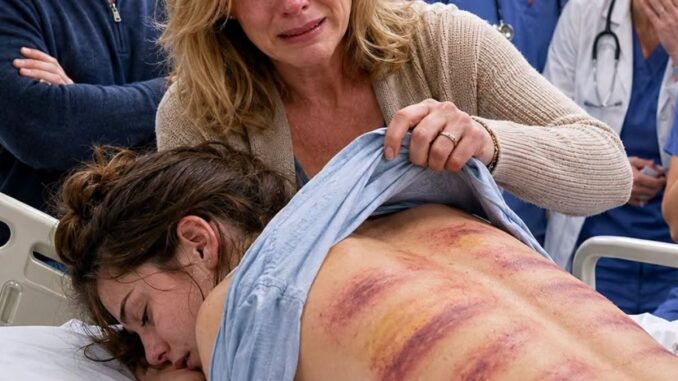
The first thing Mara Hale saw was blood on Sophie’s sock.
Not the bruises.
Not Daniel’s smile.
The sock.
White cotton with a small pink stripe at the ankle, stained red near the heel where it hung half off Sophie’s foot under the trauma sheet.
Mara had bought those socks in a three-pack at a pharmacy after Sophie complained that hospital floors always made her feet cold.
That memory struck before the medical training did.
Then the rest of the room arrived.
White trauma lights.
Monitor beeps.
Antiseptic.
Blood.
A cracked shoe on the floor.
A girl too still for thirteen.
Mara was Chief Medical Officer of St. Catherine’s Hospital.
She had led emergency preparedness drills, chaired ethics reviews, disciplined surgeons twice her size, and once stood in front of a furious board explaining why patient safety mattered more than donor comfort.
People called her composed.
Precise.
Difficult to intimidate.
But when she saw Sophie on that trauma bed, all of that fell away.
She was not the CMO first.
She was the woman who had learned how Sophie liked her sandwiches cut.
The woman who braided her hair for debate tournaments.
The woman who kept granola bars in her car because Sophie forgot to eat when she was nervous.
The woman who signed adoption papers two years earlier while Sophie held her hand under the table.
The judge had asked Sophie whether she understood what adoption meant.
Sophie had looked at Mara and said, “It means I get to stay.”
Mara had cried afterward in the courthouse bathroom where Sophie could not see.
Now Sophie lay unconscious beneath trauma lights while Daniel Hale, her biological father and Mara’s almost-ex-husband, smiled at the doctor like truth was already dead.
“She’s clumsy,” Daniel told Dr. Patel. “She fell down the stairs again.”
Again.
That word should have stopped the room by itself.
Dr. Patel looked from Daniel to Sophie, then to Mara.
“Mara?”
“Full trauma workup,” Mara said. “And call pediatric safeguarding.”
The order came out of her before emotion could interfere.
CT.
Labs.
Imaging.
Injury documentation.
Safeguarding.
Evidence.
Process.
Process mattered when panic wanted to scream.
Daniel’s smile tightened.
“That’s unnecessary.”
Mara heard what he meant.
No witnesses.
No records.
No questions.
She stepped beside Sophie’s bed and lifted her sleeve with gloved fingers.
Purple bruises climbed Sophie’s arm.
Some were old.
Some new.
Some faded yellow at the edges.
A pattern of harm lived there, layered beneath skin.
Then Mara saw the mark near Sophie’s upper arm.
A square metal outline.
One chipped corner.
A distinct edge where pressure had forced shape into flesh.
Mara knew that shape.
Daniel’s belt buckle.
Her stomach went cold in a way no operating room had ever made it.
The trauma bay froze around her.
Nurse Elena stopped with a blood pressure cuff in her hands.
The respiratory therapist glanced at the mark and then at Daniel.
An orderly near the curtain looked down at the floor.
Dr. Patel’s face stayed controlled, but his jaw tightened.
Medical professionals learn to keep working when horror enters the room.
They also learn to recognize patterns.
Sophie had not fallen down stairs into a belt buckle.
Daniel leaned close enough for Mara to smell whiskey hidden under mint gum.
“She isn’t even your real daughter,” he whispered, “so stay out of it.”
Mara turned her head slightly.
Above the trauma bay, the black security dome sat in the corner of the ceiling.
After three nurses had been assaulted in the emergency department the previous winter, St. Catherine’s upgraded the system.
Every emergency room camera recorded audio when trauma bay sensors were active.
Signs were posted at every entrance.
Audio and video recording in progress for staff and patient safety.
Daniel had walked past three signs.
Arrogance often fails at reading.
“She became my daughter the day I adopted her,” Mara said. “And you just confessed in my hospital.”
For one second, fear flashed across his face.
Then he found the old mask.
“You think a bruise proves anything?” Daniel said. “I’m her biological father. Judges believe fathers before bitter ex-wives.”
That was Daniel’s first mistake.
Assuming Mara was bitter.
Bitterness was too messy.
Too unfocused.
Mara was patient.
His second mistake was forgetting why the divorce had taken eighteen months.
It was not the house.
Daniel wanted the house because he believed the person who kept the larger furniture had won.
Mara let him fight over furniture.
It was not money.
Daniel accused her of hiding assets, being controlling, trying to humiliate him.
Mara let him talk.
She fought for Sophie.
Sophie had been ten when Mara married Daniel.
A quiet girl with too-large eyes and a habit of asking permission before opening the refrigerator.
At first, Mara thought Sophie was shy.
Then she realized Sophie was monitoring the weather inside the room.
Daniel’s mood.
His footsteps.
His keys on the counter.
How hard he closed cabinet doors.
Whether he poured one drink or three.
Children raised around anger become meteorologists.
They learn storms before windows shake.
The first time Sophie called Mara Mom, she did it by accident.
She had a fever and was half asleep on the couch.
Mara placed a cool cloth on her forehead.
Sophie whispered, “Thanks, Mom.”
Then her eyes opened wide.
“I’m sorry.”
Mara’s heart cracked.
“Don’t apologize,” she said.
Sophie looked uncertain.
“Is it okay?”
“Yes,” Mara said. “Only if you want it to be.”
After that, the word appeared slowly.
Then often.
Daniel liked it at first.
He used it when it made him look generous.
Mara is basically her mother now.
Mara knows how to handle school forms.
Mara is good at that girl stuff.
But when the marriage broke, Daniel weaponized biology.
She’s not yours.
You don’t get a say.
Stop acting like a martyr.
During mediation, Sophie whispered to Mara that Daniel became “different” when angry.
Different.
That was the word children use when adults have trained them not to use the real ones.
Mara asked if he hurt her.
Leave a Reply