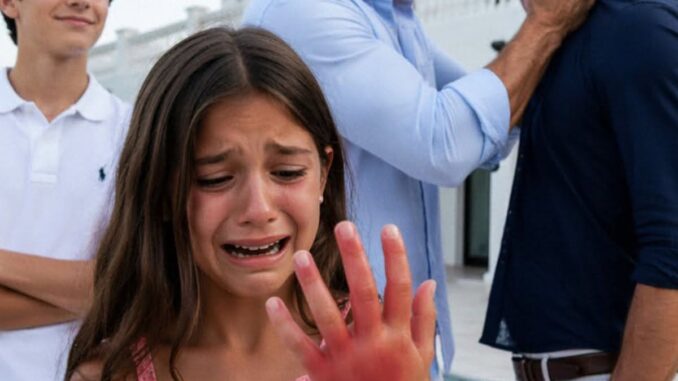
Sofía had never been the loud child in the family.
She was not the cousin who cannonballed into pools, climbed trees, interrupted adult conversations, or shouted across rooms for attention.
She was the child who sat near windows with colored pencils.
She was the child who asked if she could help set the table.
She was the child who apologized when someone else bumped into her.
At 11 years old, she already moved through family gatherings like a guest in a house where she was not sure she was welcome.
 May be an image of child and wrist watch
That is the part I still cannot forgive myself for missing.
Not that she was afraid.
I saw that.
What I missed was how carefully she had learned to hide the shape of her fear so the adults around her would not have to feel responsible for it.
My name is Daniel.
Sofía is my daughter.
Her mother, Valeria, used to say Sofía had piano hands.
Long fingers.
Careful wrists.
A gentle way of touching things as if everything in the world deserved to stay unbroken.
She painted flowers because she liked how petals folded over themselves.
She played soft pieces on the piano, never the loud ones, and when she made a mistake, she whispered sorry to the keys.
I used to think that tenderness was something the family would protect.
I know better now.
Family can be a shelter.
It can also be the first place a child learns that danger wears familiar faces.
Diego was 15, my sister Carmen’s son.
He was big for his age, broad from football training, and already treated by certain relatives as if he were a future legend instead of a teenage boy who needed limits.
Carmen posted every trophy.
Ricardo, his father, narrated every award like a sports documentary.
Scouts.
Scholarships.
Coaches.
Discipline.
A huge future.
Those were Ricardo’s favorite words.
He said them so often that the family began treating Diego’s cruelty as the price of greatness.
He shoved younger cousins and called it energy.
He took toys and called it teasing.
He squeezed arms until someone cried and called it strength.
When Sofía flinched around him, people said she was sensitive.
When she avoided the pool if Diego was there, people said she was dramatic.
When her drawings disappeared, people said she misplaced things.
The first time I confronted Carmen, I did it quietly.
That was another mistake.
We were standing in my parents’ kitchen after a birthday lunch in Mexico City, and Sofía had just come out of the bathroom with red eyes.
Diego had torn a watercolor page from her notebook.
A blue flower.
I still remember the torn edge because Sofía tried to smooth it with her thumb.
“Your son is bothering Sofía too much,” I told Carmen. “This isn’t a game.”
Carmen laughed.
Not a nervous laugh.
A dismissive one.
“Oh, Daniel, don’t exaggerate. Diego is intense, but he’s not a bad person. Sofía needs to learn to stand up for herself. Life isn’t going to be easy on her.”
Ricardo was sitting nearby with a beer.
He did not even look ashamed.
“Besides,” he said, “if your girl played a real sport instead of spending all her time glued to the piano, maybe she wouldn’t be so sensitive.”
I wanted to answer.
Sofía touched my sleeve.
Just once.
A small warning.
Please don’t.
Later, in the car, she begged me not to make a bigger scene.
“If you say anything, he’ll do worse,” she whispered.
That sentence should have ended every excuse in my head.
Instead, I told myself I could watch more closely.
I told myself I could manage it.
I began keeping notes on my phone.
April 3.
Braid pulled behind patio chairs.
May 12.
Watercolor sketch torn in half.
June 8.
Bruise on upper arm after Diego grabbed her during a game.
August 21.
Sofía refused to swim if Diego was in the pool.
September 4.
Notebook missing after family lunch.
I documented because I did not want to seem irrational.
That is one of the traps polite families set.
They make you collect evidence of harm everyone already sees.
By the time the barbecue happened at my parents’ house in Cuernavaca, I had become a guard at my own family gatherings.
My parents’ house was built for noise.
White walls.
Wide terrace.
Blue pool.
A jacaranda tree that shaded one corner of the patio.
A grill area where my father liked to stand with metal tongs in one hand and opinions in the other.
That Sunday, there were 18 relatives present.
Aunts.
Uncles.
Cousins.
My parents.
Carmen.
Ricardo.
Diego.
Valeria.
Sofía.
The younger children ran between the pool and the snack table.
Coolers sweated in the shade.
Tortillas warmed on the griddle.
Music played softly from a speaker near the sliding door.
The air smelled of chlorine, grilled meat, sunscreen, and lime.
It should have been ordinary.
Danger often hides best inside ordinary afternoons.
Ricardo arrived bragging before he even said hello.
Diego had won another award.
A coach had mentioned possibilities.
A scout might come to a future game.
Carmen beamed beside him.
Diego stood there with the lazy confidence of a boy who had never been made accountable in a room full of adults.
I looked at Sofía.
She looked at the pool.
“Stay near us,” I told her.
She nodded.
For the first hour, I kept her close.
She sat on the pool steps while Valeria chatted nearby.
She laughed once when a younger cousin splashed too hard and apologized with both hands over his mouth.
I remember that laugh because it was small and real.
I remember letting myself relax because of it.
Then my mother called from the kitchen.
“Daniel, can you bring more ice?”
I looked toward Sofía.
She was still in the shallow end.
Valeria was near the table folding towels.
Diego was talking to Ricardo near the grill.
I went inside.
I was gone less than four minutes.
I know because later, when the police asked, I checked the timestamp on the message I had answered in the kitchen.
Leave a Reply