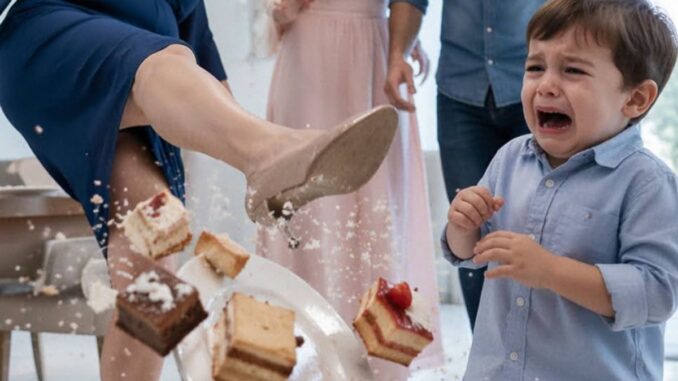
The first thing I remember after the plate shattered is the smell.
Piloncillo syrup.
Cinnamon.
Coffee from the clay pot.
Warm earth after the morning watering.
Those smells should have belonged to Holy Thursday, to family, to prayer, to the kind of afternoon children remember later as proof they were loved.
Instead, they mixed with my son’s crying.
Mateo was four years old.
He was wearing the white shirt his father had ironed for him, with the collar slightly crooked because he had insisted on buttoning the top button himself.
His hair was combed neatly to the side.
His hands had been small around the plate.
Then they were empty.
Doña Teresa had kicked the capirotada into the yard in front of 20 relatives, and my son stood there staring at the broken ceramic as if his little mind could not understand how love had turned into violence so quickly.
“Don’t you ever call me Grandma again,” she said. “You’re not a grandson of this family.”
The patio went silent.
It did not go quiet because people had nothing to say.
It went quiet because everyone had too much to say and no courage to spend on a child.
That silence is what I hear most when I think of that day.
Not the plate.
Not her voice.
The silence.
Holy Thursday at the Cárdenas home in Querétaro had started before sunrise.
I had woken while the streets were still blue and cool, while the neighbors’ dogs barked at the first delivery trucks and the church bells had not yet begun.
I prepared flowers.
I cleaned candleholders.
I brewed coffee.
I made hibiscus tea.
I sliced fruit.
I arranged sweet bread.
Then I started the capirotada.
Bolillo rolls toasted until their edges browned.
Piloncillo syrup darkened in the pot with cinnamon and cloves.
Raisins softened.
Peanuts gave off their warm smell.
A little fresh cheese waited on a plate near the stove.
It was the way Luis’s family made it every Holy Week, though nobody ever admitted I had learned the tradition well.
In the Cárdenas family, a daughter-in-law’s labor was expected to be invisible.
Visible enough to blame.
Invisible enough to thank.
I did not make the capirotada for Doña Teresa.
By then, I knew she would never like me.
I made it because my son Mateo loved family rituals.
He loved candles.
He loved setting napkins.
He loved asking why certain foods were eaten on certain days.
And most of all, he loved the idea of having a grandmother.
That was the cruelest part.
Doña Teresa had never behaved like one.
From the moment Mateo was born, she looked at him as if the nurse had handed Luis the wrong baby.
She never held him with softness.
She never kissed his forehead unless someone had a camera.
She never said “my love.”
She never kept his drawings on the refrigerator.
When he took his first steps, she said he walked late.
When he spoke early, she said children repeated anything.
When he ran toward her yelling “Grandma,” she adjusted her shawl and turned her face as if affection were an inconvenience.
Luis always tried to explain it away.
“She’s cold with everyone,” he said.
“She has trouble showing emotion,” he said.
“She needs time,” he said.
But four years is not time.
Four years is a childhood.
Mateo did not understand rejection as rejection.
Children translate cruelty into questions about themselves.
Maybe I was too loud.
Maybe I spilled something.
Maybe if I draw better.
Maybe if I bring dessert.
That morning, he climbed onto his little plastic stool beside me in the kitchen.
His white shirt was tucked unevenly into his pants.
His eyes were bright.
He watched me spoon the capirotada into the big tray as if we were preparing treasure.
“Can I taste it?” he asked.
“Just a little,” I said.
I blew on a spoonful so he would not burn his mouth.
He took it carefully.
Then he smiled in that full, open way children smile before the world teaches them to protect themselves.
“It’s delicious, Mommy,” he said. “Will Grandma like me now?”
I felt something close inside my throat.
I should have stopped the whole day there.
I should have told him that adults who make children audition for love do not deserve dessert or titles.
But mothers sometimes become cowards when the truth is too sharp for a child.
I touched his cheek.
“Just be polite, my love.”
By noon, the patio was full.
There were aunts, uncles, cousins, neighbors close enough to be treated like relatives, and children chasing each other between the chairs.
About 20 relatives gathered under the shade.
Candles flickered on the table.
Fresh flowers leaned toward the sun.
Coffee steamed.
Hibiscus tea glowed deep red in the pitcher.
Doña Teresa came out dressed in dark purple, her hair pulled back so tightly it sharpened her face.
Her gold earrings flashed when she moved.
She greeted guests with that grand warmth she reserved for witnesses.
With them, she was gracious.
With us, she was weather.
When she saw me, her mouth tightened.
When she saw Mateo, something colder passed across her face.
I pretended not to notice.
Pretending had become one of my survival skills in that family.
I placed the nicest plate of capirotada into Mateo’s hands.
The plate was white with a blue rim.
He held it with both hands, exactly the way I had shown him.
“Careful,” I whispered.
“I know,” he said, very serious.
“Tell her, ‘Grandma, I brought you capirotada.’”
He nodded.
Then he walked slowly through the adults.
Some smiled.
One aunt touched her chest.
A cousin whispered that he looked handsome.
For one brief second, I let myself hope embarrassment would protect him.
I thought Doña Teresa might not love him, but surely she would not humiliate him in front of everyone.
That is how people like her survive for so long.
They teach you to underestimate the cruelty they are willing to perform.
Leave a Reply