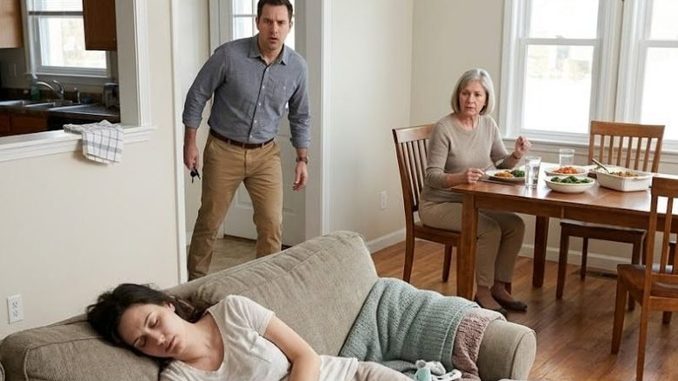
I stayed beside Clara while the paramedics finished checking her, but my attention kept returning to the same thing: every time she opened her eyes, she looked toward my mother before she looked at me.
That frightened me more than the collapse itself.
Clara swallowed and reached for my hand. Her fingers were weak, but her grip was deliberate.
“I didn’t want to tell you,” she whispered.
“Tell me now.”
She looked at Mom.
“She told me you would think I was exaggerating.”
Mom immediately stepped forward. “Daniel, she’s confused. She just woke up.”
Clara flinched.
That was enough.
“Mom, stay where you are.”
The paramedic glanced between us but continued working. Clara took a slow breath and began explaining what had been happening whenever I left for work.
It wasn’t one terrible incident. It was a pattern.
Mom would arrive early, complain that the house wasn’t clean enough, then criticize whatever Clara had managed to prepare. If Clara tried to rest while the baby slept, Mom would wake her and tell her that mothers didn’t get to be lazy. If Clara ordered food, Mom called it wasteful. If she admitted she was exhausted, Mom told her I would eventually get tired of coming home to a wife who couldn’t keep up.
Clara had kept most of it from me because she was afraid I would feel caught between them.
“I thought if I could just get through the first few weeks, it would stop,” she said.
My mother shook her head.
“That is not what happened.”
Clara looked at me again.
“Today I told her I couldn’t cook. I said I felt weak. She told me you were working all day and deserved a real dinner when you came home.”
I remembered the full plate on the table.
I remembered the smell of roasted chicken.
I remembered my mother eating while our newborn screamed.
Then Clara told me what happened next.
She had stood in the kitchen because she didn’t want another argument. She tried to prepare the meal, but her legs felt unsteady. She told Mom she needed to sit down.
Mom accused her of putting on an act.
Clara remembered making it to the sofa.
After that, everything went blank.
The room became painfully quiet.
My mother finally spoke.
“I was trying to motivate her.”
I turned toward her.
“You saw her collapse.”
“She was conscious when she sat down.”
“You didn’t check on her.”
“She was breathing.”
“You didn’t check on her.”
Mom’s mouth tightened.
“I knew she would wake up.”
That sentence changed everything.
Until then, some part of me had still been searching for an explanation that would let me keep thinking of her as the mother who had raised me. But there was no explanation that changed what she had chosen to do when Clara was helpless.
The paramedics finished their assessment and told us Clara needed further evaluation. I followed their instructions and stayed beside her.
Mom tried to come with us.
I stopped her at the doorway.
“You’re not coming.”
She stared at me.
“I am her mother-in-law.”
“And I’m her husband.”
For once, she didn’t have an immediate answer.
At the hospital, Clara was checked and monitored while I held our son and answered questions. Nothing about the experience felt dramatic anymore. It felt frighteningly ordinary: fluorescent lights, paperwork, a tired newborn, and my wife trying to understand how she had been pushed so far without anyone noticing.
Then Clara asked me something I hadn’t expected.
“Are you angry with me?”
I sat beside her.
“No.”
“I should have told you.”
“You shouldn’t have had to survive this quietly.”
She looked down at our son’s tiny hand wrapped around her finger.
“I was scared you wouldn’t believe me.”
That hurt more than anything my mother had said.
Not because Clara had doubted me, but because I realized how easy it had been for my mother to make herself the authority in our home whenever I wasn’t there.
When we returned home, my mother’s overnight bag was still beside the door.
She had waited for me.
“I think you’re making a terrible mistake,” she said.
I picked up the bag and handed it to her.
“No. The mistake was letting you believe being my mother gave you authority over my wife.”
Her expression hardened.
“She has turned you against me.”
“No one turned me against you.”
I pointed toward the kitchen.
“I saw you sitting there while she was unconscious.”
Then toward the living room.
“I heard what she told me.”
Finally, I pointed toward the front door.
“And I’m making my own decision now.”
Mom refused to leave at first. She demanded that I listen to her version. She said Clara had always been sensitive. She said new mothers were emotional. She said she had raised children herself and knew what exhaustion looked like.
I listened.
Then I told her the same thing each time.
“You don’t get to decide what happens to Clara anymore.”
That was the moment her anger disappeared and something else took its place.
Fear.
Not fear that she had hurt Clara.
Fear that she had lost control.
She left that night.
The next morning, I changed the locks.
I also sent her one message: she was not to come to the house without my agreement, and she would not be alone with Clara or our son.
She responded with paragraphs about family, respect, sacrifice, and everything she believed I owed her.
I didn’t argue.
I saved the messages.
Over the next few days, Clara slowly told me more.
There had been small moments I had missed because they were designed to disappear when I walked through the door. A comment here. A criticism there. A demand disguised as advice. An accusation followed by an apology that somehow made Clara feel guilty for being upset.
Then I found something that made the pattern impossible to ignore.
A list on Mom’s phone.
She had written down things she believed Clara needed to “fix”: the laundry, meals, the baby’s schedule, the condition of the kitchen, how often I ate at home, even how Clara spent time recovering.
There was nothing on that list about helping Clara.
It was a list of expectations.
I didn’t need another confrontation.
I showed it to Clara only because she deserved to know that what she had experienced was real.
She read it quietly and then put the phone down.
“I thought I was failing,” she said.
“You weren’t.”
“I kept trying harder.”
“I know.”
She leaned against me.
For the first time since our son was born, she didn’t apologize for being tired.
Weeks passed.
Mom kept asking for another chance. She offered explanations, then apologies, then explanations for the apologies. Eventually, she admitted that she believed Clara was changing me and that she was afraid of losing the place she had always had in my life.
I told her she could be my mother without controlling my marriage.
That was the boundary.
She could visit when we agreed. She could meet her grandson when Clara felt comfortable. She could offer help when it was actually help.
But she would never again be allowed to turn our home into a place where my wife was afraid to speak.
My mother didn’t like those terms.
She left anyway.
Months later, there was no dramatic reconciliation. No perfect apology erased what had happened. Trust had to be rebuilt slowly, and some things remained different.
But Clara changed too.
She started asking for help without apologizing.
She rested when she was tired.
She told me when something was wrong instead of trying to protect everyone else from her feelings.
And I learned something I should have understood much earlier: protecting my marriage didn’t mean choosing between my mother and my wife.
It meant refusing to let anyone make my wife feel alone inside her own home.
One evening, I found Clara asleep on the sofa with our son beside her, the television playing quietly in the background.
For a second, the sight took me back to the day I came home early.
But this time, the room was different.
There was no untouched plate on the table. No one demanding that Clara get up. No one telling her she was dramatic.
I picked up the blanket and covered her shoulders.
She opened her eyes.
“You’re home early,” she whispered.
“I am.”
She smiled faintly and closed her eyes again.
And for the first time, coming home early didn’t feel like discovering what had gone wrong.
It felt like finally understanding what my home was supposed to protect.
Leave a Reply