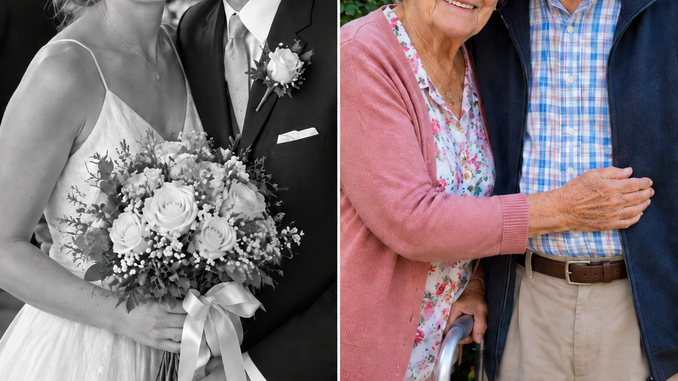
Part 1: After Sixty-Nine Years, He Left Me Nothing
For sixty-nine years, I believed I knew my husband better than anyone alive.
Walter and I met in college, raised three children, welcomed five grandchildren, survived illnesses and losses, and grew old beside each other. By ninety, I thought there couldn’t possibly be anything left for us to hide.
Then Walter died.
His final months were spent at home under hospice care, and I rarely left his side. Sometimes we talked about our children or remembered places we’d traveled; other days, I simply sat beside him reading while he slept, my hand resting over the same fingers I’d first held nearly seven decades earlier.
I thought I was watching my husband slowly say goodbye.
I didn’t know he was preparing for what would happen after he was gone.
Walter’s younger sister, Denise, began visiting more frequently during those final months. She brought casseroles, old photographs, and enough concern that I initially felt grateful to have another person helping me through the hardest period of my life.
One afternoon, Denise opened an old family album beside Walter’s bed. After showing me several photographs from their childhood, she paused on a picture of Walter standing outside his father’s house and casually asked whether our current home was still titled in both our names.
The question surprised me.
“I don’t know, sweetheart. Bennett handles all the legal paperwork.”
Denise smiled and changed the subject so naturally that I forgot about it.
A few days later, I overheard my youngest son, Roman, speaking on the phone in the hallway. He mentioned dropping off some bank statements for me, and instead of becoming suspicious, I smiled because I assumed my son was saving his elderly mother an unnecessary trip.
Everyone seemed to be helping.
That was what I believed.
Two weeks after Walter died, his attorney, Bennett, asked our entire family to gather at his office for the reading of the will. Denise sat beside me in the waiting room, repeatedly asking whether I’d eaten or slept and offering to speak for me if the meeting became overwhelming.
“I’m fine, sweetheart,” I assured her. “I can speak for myself.”
She smiled and squeezed my arm.
At the time, I thought she was being kind.
When Bennett finally called us inside, my three children gathered around me. Janet stayed close to my chair, Charlie remained unusually quiet, and Roman stood near the window with his hands buried in his pockets.
Bennett began reading.
Walter left fifty thousand dollars to the hospice foundation that had cared for him. Denise received the lakeside cabin and its contents, while our children and five grandchildren were given generous portions of several investment accounts.
I listened quietly.
Then Bennett paused.
“To my wife, Eleanor, I leave no assets under this will.”
For several seconds, I thought I’d misunderstood him.
“I’m sorry,” Janet said. “Could you read that again?”
Bennett did.
“To my wife, Eleanor, I leave no assets under this will.”
Nothing.
After sixty-nine years of marriage, Walter had apparently left me nothing.
I looked around the room, waiting for someone to explain what had to be a mistake. Instead, Janet stared at me with confusion before asking the question that hurt almost as much as the will itself.
“Mom, what did you do?”
I turned toward her.
“What did I do?”
“Dad wouldn’t have done something like this for no reason.”
Charlie quietly told his sister to stop, but the damage was already done. I had spent months caring for their father as he died, yet within minutes of hearing the will, my own daughter wondered whether I had somehow deserved to be abandoned.
Then I heard a small sound behind me.
Denise.
It wasn’t quite a gasp. It sounded more like someone releasing a breath she’d been holding for a very long time.
When I turned, her expression immediately softened.
“Eleanor, nobody is accusing you of anything,” she said, resting a hand on my shoulder. “Why don’t you stay with me until we understand what’s happening? You shouldn’t be alone in that big house.”
“I am perfectly comfortable in my own home.”
“Of course. I’m only trying to protect you.”
Soon my children were arguing over what Walter might have intended, and somehow the conversation became about what should happen to me. I sat there listening while people I’d raised discussed my future as though I were no longer capable of participating in it.
Finally, Bennett interrupted.
“If there’s nothing else, I’d like everyone to leave.”
My family slowly filed into the hallway. Denise squeezed my shoulder one last time before following them.
I reached for my purse.
“Eleanor,” Bennett said. “Not you.”
I stopped.
After the door closed, he moved from behind his desk and sat beside me. Then he took a sealed yellow envelope from a drawer and placed it carefully on my lap.
“Actually, Walter did leave something for you.”
My heart began pounding.
“What is this?”
“He instructed me to give it to you privately, immediately after the reading of the will.”
I broke the seal and recognized Walter’s handwriting before I’d even unfolded the page.
The first line made my hands tremble.
Eleanor, my love. If you’re reading this, everyone now believes I left you nothing. That’s exactly what I needed everyone to believe.
I stared at Bennett.
Then I forced myself to continue.
Near the bottom of the page was a warning from the man I’d trusted for almost seventy years.
I did leave you something. But whatever happens next, don’t trust my sister.
Part 2: The Warning Walter Left Behind
I read Walter’s warning twice before looking at Bennett.
“Don’t trust Denise?”
Bennett didn’t answer. He simply pointed toward the letter and told me Walter wanted me to read every word before asking questions.
My mind immediately raced toward the darkest possibilities. After sixty-nine years together, I wondered whether Walter had hidden another woman, another child, or some secret life that had existed beside our marriage without me ever seeing it.
But his next words pointed somewhere else entirely.
Walter explained that leaving me nothing in the will had been deliberate. He needed everyone in that office—especially Denise—to believe I had been financially abandoned.
According to him, Denise had spent his final months pressuring him to name her as trustee of his estate. She presented it as concern for me, insisting that someone younger should handle the complicated financial decisions after his death.
Walter hadn’t believed her motives were innocent.
He predicted that once he was gone, Denise would quickly offer to “help” me manage my finances and eventually try to gain legal control over them. The will Bennett had just read was designed to give her exactly the impression Walter wanted her to have.
There was almost nothing in it worth fighting over.
A will is easy to challenge, Eleanor. What I built for you isn’t.
I stopped reading.
Walter wrote that the real protection had been created long before his illness became serious. He deliberately kept me unaware because he knew I would never believe his sister—or one of our children—might interfere with my finances.
That sentence hurt.
One of our children?
I thought about Janet questioning me after the will, Charlie’s silence, and Roman standing near the window. Then I remembered overhearing Roman discussing my bank statements on the phone.
I forced myself to continue.
Walter didn’t accuse any of our children of deliberately betraying me. Instead, he warned that Denise was skilled at making control look like concern, and someone trying to help me might unknowingly give her exactly what she needed.
Then came his final instruction.
If Denise makes her move, go back to Bennett and ask for the second envelope. Do not ask for it before then. You’ll know when it’s time.
I lowered the letter.
“What does that mean?”
Bennett shook his head. “Walter instructed me not to explain until the condition he described has occurred.”
I wanted to argue, but I knew that stubborn precision was pure Walter. Even after death, my husband had somehow constructed rules around a conversation he could no longer participate in.
I drove myself home that afternoon.
All night, one sentence followed me through the empty rooms.
If Denise makes her move.
I didn’t have to wait long.
The next morning, Denise arrived carrying a folder beneath her arm and wearing the same gentle expression she’d worn at Bennett’s office.
“I know this is terrible timing,” she said as we sat at my kitchen table. “But we need to make sure nobody takes advantage of you.”
She opened the folder.
Inside was a power of attorney.
Denise explained that signing it would allow her to help with banks, bills, investments, and anything else that became confusing. She spoke slowly, almost as though I were already incapable of understanding ordinary English.
I picked up the first page.
“That’s thoughtful of you.”
Her shoulders relaxed.
I pretended to struggle with the small print, but at ninety, my eyesight was still good enough to notice the notary section near the bottom.
The document had already been stamped.
More importantly, it had been dated one week before Walter’s funeral.
During that entire week, I had been at home beside my dying husband.
I had never appeared before that notary.
My pulse quickened, but I kept my face calm.
“Denise, sweetheart, give me one day. I’m still too tired to sign anything important.”
Her jaw tightened for half a second before her phone buzzed. She excused herself and stepped into the hallway to answer it.
The moment she disappeared, I pulled out my phone.
My granddaughter had recently taught me how to photograph documents, so I photographed every page. Then I reached the final sheet and felt my stomach turn.
Attached to the power of attorney was a brokerage statement.
My brokerage statement.
Across the top was my account number.
Below it was the exact balance:
$482,316.
I had never given Denise that information.
Then I remembered Roman’s voice in the hallway weeks earlier.
I’ll just drop the statements off for Mom.
My own son had access to those records.
I photographed the page twice and returned everything exactly as I’d found it before Denise came back.
“I’ll return tomorrow,” she said, slipping the folder into her bag. “We really should get this signed.”
I smiled.
“Of course, dear.”
After she left, I locked the door and stared at the photographs on my phone.
Walter’s warning no longer seemed paranoid.
Denise had brought me a predated legal document and somehow obtained confidential information about nearly half a million dollars of my money.
She had made her move.
And now it was time for me to discover what Walter had hidden inside the second envelope.

Part 3: The Second Envelope
That afternoon, Roman came to my house still wearing his coat, his expression already tense before I opened the door. He told me Denise had called him because she was worried about me living alone, but I no longer heard concern the way I had the day before.
“And you’ve been giving her my bank statements?” I asked.
Roman’s face changed immediately. He admitted he’d shared some financial documents, but insisted he’d only done it because Denise said she needed them to help me after Walter’s death.
“I thought I was making things easier for you, Mom.”
Looking at him, I believed that part. Roman had always been eager to help, and Denise had apparently convinced him that handing over my private information was an act of kindness rather than something that could place me at risk.
I didn’t tell him about the power of attorney.
Instead, I nodded and allowed him to leave believing our conversation was finished. The moment the door closed, I returned to the photographs on my phone and studied the predated notary stamp again.
Walter’s warning was no longer mysterious.
Denise had made her move.
The next morning, I drove to Bennett’s office. He seemed almost relieved when I showed him the photographs and explained that Denise had brought me a power of attorney already stamped with a date from before Walter’s funeral.
Without another question, Bennett unlocked a cabinet.
He removed a sealed envelope and placed it in my hands.
“This is what Walter wanted you to receive.”
Inside were several legal documents bound together. Bennett explained that the most important was a recorded living trust created months before Walter became seriously ill.
I was named as its sole trustee and beneficiary.
I stared at him.
“So the will—”
“Was never the real protection.”
Bennett showed me another document, a physician’s attestation confirming that Walter had been mentally competent when the trust was signed. It had been prepared long before anyone could reasonably argue that illness or medication had affected his judgment.
Suddenly, Walter’s plan became clear.
The will everyone heard was only what he wanted Denise to see. If she challenged it, she would be fighting over a document that no longer controlled the assets Walter had actually intended to protect.
“He knew she’d try this?”
“He believed there was a significant possibility.”
Beneath the trust documents was one smaller envelope.
Inside, I found a photocopy of an old document and a short handwritten note from Walter explaining when he’d discovered it and why he’d kept it hidden. I didn’t understand every legal implication, but I recognized Denise’s handwriting and their father’s signature.
Whatever the document proved, Walter believed it was serious enough to stop his sister if she pushed too far.
I looked at Bennett.
“What exactly did Denise do?”
“Walter wanted that document used only if necessary,” he said. “His goal wasn’t to destroy his sister. It was to make sure she couldn’t destroy your independence.”
That sounded exactly like my husband.
Walter could be infuriatingly cautious, but he rarely prepared for only one outcome. While I had been sitting beside his hospice bed believing he was simply drifting toward the end of his life, he’d been quietly making sure nobody could take control of mine afterward.
I placed everything in my purse.
Then I went home and called my family.
“I want everyone here tomorrow morning.”
Janet immediately asked whether something was wrong, while Charlie simply agreed to come. Roman hesitated, and Denise tried to persuade me to let her visit privately that afternoon instead.
“No,” I said. “Tomorrow. Everyone together.”
The next morning, I sat at my dining room table with Bennett beside me when the family arrived.
Denise came prepared.
She placed several papers on the table, including an affidavit Roman had apparently signed. Then she produced a draft petition seeking guardianship over me.
I looked at my youngest son.
“Roman?”
He couldn’t meet my eyes.
“Mom, Aunt Denise thinks you shouldn’t be living alone.”
For one painful second, I wanted Bennett to handle everything. Then I remembered that everyone around me had spent days discussing what was best for me as though being ninety had somehow erased my right to decide.
So I spoke for myself.
“Before anyone signs another document, I think we should look at this.”
I placed Denise’s power of attorney on the table.
Then I pointed to the brokerage statement attached behind it.
“Denise knew this balance to the dollar.”
Roman finally looked up.
I moved my finger to the notary stamp.
“And this document claims I appeared before a notary one week before Walter’s funeral.”
Roman’s face went pale.
“I didn’t know that.”
“You gave her my statements.”
“I thought I was helping.”
Bennett leaned forward. “Roman, did you personally witness your mother being unable to manage her affairs?”
“No.”
“Then why did you sign an affidavit suggesting she couldn’t?”
Roman swallowed hard.
“Because Denise told me to.”
The room fell silent.
I reached into my purse and placed Walter’s recorded trust on the table, followed by the physician’s competency statement.
“The will you heard was a decoy,” I said. “Walter moved the real protection into this trust months before his final illness.”
Denise stared at the documents.
Then I added the sentence that finally wiped the confidence from her face.
“And Walter left me one more document.”
I reached into my purse for the old photocopy.
The moment Denise saw it, she stopped breathing.
Part 4: The Document Denise Never Expected to See
Denise stared at the photocopy in my hand, and for the first time since Walter’s death, she didn’t look concerned, sympathetic, or confident. She looked frightened.
I placed the document on the table and slid it toward her. It was decades old, bearing both her father’s signature and handwriting that unmistakably belonged to Denise.
She picked it up slowly.
“What is this supposed to prove?”
“You already know what it is.”
Her eyes moved across the page, but she said nothing. Walter’s note had explained that he’d discovered the document years earlier and kept it because exposing what Denise had done would have torn their family apart.
I still didn’t understand every detail behind the old dispute, and Walter hadn’t wanted me to. What mattered was that the document contradicted claims Denise had made years earlier concerning their father’s financial affairs and could seriously damage her credibility if she tried to accuse me of incompetence or financial misconduct.
Walter had never intended to use it for revenge.
He had kept it as protection.
Denise finally placed the photocopy back on the table.
“You have no idea what you’re talking about, Eleanor.”
“Perhaps not,” I said. “But Bennett does.”
Her eyes immediately shifted toward him.
Bennett calmly explained that Walter had instructed him to preserve the original document along with supporting records. If Denise proceeded with a guardianship petition or attempted to challenge the trust, those materials could become relevant to any legal dispute she initiated.
The room became completely silent.
Then Denise’s fear turned into anger.
“You’re all letting a ninety-year-old woman make decisions she doesn’t understand.”
Janet gasped, but I raised my hand before she could respond. After days of people speaking around me, for me, and about me, I wanted Denise to hear my answer directly.
“I understand exactly what’s happening.”
I placed the photographs from my phone beside the power of attorney.
“You brought a document into my home that was already notarized with a false date. You had my private brokerage information without my permission, and then you convinced my son to sign an affidavit questioning my ability to manage my own life.”
Roman lowered his head.
Denise immediately pointed toward him. “He was worried about you too.”
“I was,” Roman said quietly. “But I didn’t know what she was doing.”
His voice cracked as he admitted he’d signed papers without reading them carefully because Denise had told him they were necessary to protect me. He’d also given her my financial statements because she claimed she needed them to understand which bills and accounts might require attention after Walter’s death.
“I thought I was helping you, Mom.”
I believed him.
That didn’t erase what he’d done, but there was a difference between being manipulated and deliberately trying to take control of me. Walter had understood that difference too, which was why his letter warned that one of our children might unknowingly help Denise.
Denise pushed her chair back.
“This is ridiculous. I’ll tell the grandchildren what’s happening here.”
“You may tell them whatever you want.”
“I’ll tell them you’re confused.”
I looked directly at her.
“Then Bennett can show them the trust, and Dr. Halloran can show them the results of the cognitive evaluation I completed this week.”
Her expression changed again.
I had arranged the examination after seeing the guardianship papers because I knew exactly what Denise might claim. The results confirmed that I was fully capable of understanding my finances and making my own legal decisions.
There would be no easy argument that grief or age had made me incompetent.
I picked up Walter’s old document.
“He kept this quiet because he wanted to protect his family, Denise. I intend to do the same.”
She stared at me.
“So you’re threatening me?”
“No.”
I slid the photocopy back into its envelope.
“I’m telling you to stop.”
For several seconds, nobody moved. Then I gave my sister-in-law the only instruction that mattered.
“Go home, Denise.”
Her face tightened, but she must have understood that the situation had changed. The elderly widow she expected to control was sitting beside an attorney with a recorded trust, medical proof of competence, photographs of suspicious documents, and evidence Walter had preserved for exactly this moment.
Denise gathered her papers.
She didn’t apologize.
She didn’t look at Roman.
She simply walked out of my house and closed the door behind her.
The silence she left behind felt enormous.
Roman remained seated across from me, staring at his hands. Janet and Charlie moved closer, but I kept my attention on my youngest son.
“Mom, I’m sorry.”
I could see the shame on his face.
“I should’ve read everything. I should’ve asked you before giving her anything.”
“Yes,” I said. “You should have.”
He looked up, surprised by my answer.
I reached across the table and took his hand.
“But you can learn from it.”
Roman’s eyes filled with tears.
Janet came around the table next. Only days earlier, she’d asked what I had done to make Walter leave me nothing; now she wrapped her arms around me and whispered an apology against my shoulder.
Charlie joined us.
For the first time since Walter died, I allowed myself to breathe without wondering what disaster was waiting behind the next door.
But later that evening, after everyone had gone home, I returned to Walter’s first letter.
There was one paragraph I hadn’t fully understood before.
Walter hadn’t created his plan merely because he distrusted Denise.
He had done it because he knew me.
If I told you what I suspected while I was alive, you would have tried to keep the family together. You would have given everyone another chance, Eleanor—even if doing so put your own future at risk.
I pressed my fingers against his handwriting.
After sixty-nine years, Walter had known exactly what I would do.
And that was why he’d decided the only way to protect me was to keep the truth from me until he was gone.

Part 5: What Walter Really Left Me
I sat alone at the dining room table long after my children had gone home, reading Walter’s letter again. The house felt different without him, yet for the first time since his death, I understood that his final months had contained far more than the quiet decline I’d witnessed from beside his bed.
Walter had known Denise might come after my independence.
He had also known I would never believe him if he’d warned me directly. I had spent my entire life trying to keep peace in the family, forgiving people quickly and assuming concern came from a good place, especially when it came from someone I loved.
That was why he hadn’t told me.
If Walter had accused Denise while he was alive, I would have defended her. I probably would have told him illness was making him suspicious, and if he’d warned me that Roman might unknowingly help her, I would have insisted our son would never do anything that could harm me.
Walter knew that.
After sixty-nine years of marriage, he knew me well enough to understand that my greatest strength could also become my weakness.
So he created a plan that required me to see the truth for myself.
The will everyone heard in Bennett’s office had never been Walter’s real protection for me. It was a decoy designed to convince Denise that I had been left vulnerable enough for her to step forward and offer control disguised as help.
And she had done exactly that.
Within a day, she’d arrived at my kitchen table with a predated power of attorney. She already possessed my private financial information, had convinced Roman to share documents with her, and was preparing a guardianship petition that could have allowed her to challenge my ability to control my own affairs.
Walter had predicted almost every step.
But he hadn’t left me defenseless.
Months before his health deteriorated, he’d created and funded a living trust naming me as sole trustee and beneficiary. He had obtained medical documentation proving his competence at the time, protected the arrangement from the kind of attack Denise might attempt, and placed the old family document with Bennett as a final safeguard.
For one terrible afternoon, I believed my husband had left me nothing.
In reality, he had spent his final months protecting everything we’d built together.
The realization didn’t make losing him easier.
If anything, it made me miss him more.
A few days later, Roman came to see me alone. He apologized again for sharing my statements and signing Denise’s affidavit without reading it carefully.
“I thought I was protecting you,” he said.
“I know.”
“I should’ve asked you what you wanted.”
“Yes,” I replied. “You should have.”
He lowered his head, but I reached across the table and squeezed his hand. I didn’t want my husband’s final act to become the beginning of another family fracture.
Roman had made a serious mistake.
He would have to live with that and earn back my trust, but I wasn’t going to lose my son because Denise had manipulated his fear.
Janet apologized too.
She admitted that when Bennett read the will, she’d immediately assumed Walter must have discovered something terrible about me. Her question—What did you do?—had hurt more than she realized.
“I should’ve trusted you, Mom.”
I nodded.
“That would have been nice.”
She laughed through her tears and hugged me.
Charlie, as usual, needed fewer words. He simply kissed my forehead and told me that whatever I decided to do next, he would follow my lead.
Denise didn’t return.
Bennett handled the remaining legal matters, and the guardianship petition disappeared before it could go anywhere. I remained in my home, managed my own finances, and continued making my own decisions exactly as I had before everyone suddenly decided ninety years old meant I needed permission to live my life.
One evening, I walked into the bedroom Walter and I had shared for decades.
His side of the closet still held several jackets I hadn’t been ready to move. Near the back was an old brown coat that reminded me of the ridiculous jacket he’d worn constantly when we first met in college.
I touched the sleeve and smiled.
“You stubborn old man,” I whispered.
For nearly seventy years, Walter had been my husband, my best friend, and occasionally the most frustrating person I’d ever known. Even at the end, he’d managed to construct an elaborate plan instead of simply telling me what he was worried about.
But now I understood why.
He wasn’t protecting money.
He was protecting my right to remain myself.
He knew grief would make me vulnerable, that my age would give other people an excuse to question my judgment, and that my instinct to trust family could be used against me. So he left behind something stronger than a traditional inheritance.
He left me control.
He left me evidence.
Most importantly, he trusted that once I saw the truth, I would know what to do with it.
I had spent nearly seven decades believing there were no secrets left between Walter and me. In the end, I discovered that he’d hidden one final plan from me, but it wasn’t the betrayal I’d feared when I first unfolded his letter.
Walter hadn’t left me nothing.
He had made everyone believe he had so the person waiting to take advantage of me would reveal herself.
Then he left me everything I needed to protect the life we’d built together.
At ninety years old, after sixty-nine years of marriage, I finally understood what my husband’s final gift truly was.
It wasn’t the house, the trust, or the money.
It was the certainty that even after he was gone, Walter still believed I was capable of standing on my own.
Leave a Reply