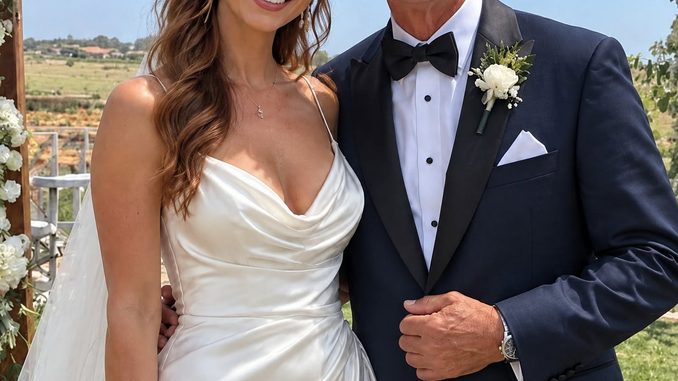
Part 1: I Married My Best Friend’s Wealthy Grandfather for His Money
On my wedding night, my seventy-six-year-old husband closed the bedroom door, looked directly into my eyes, and said something that made my blood run cold.
“Now that you’re my wife, Hannah, I can finally tell you the truth. It’s too late to walk away.”
I stood beside the enormous bed, still wearing my wedding dress, wondering whether I’d just made the worst mistake of my life. I’d married Arthur Sterling because I believed his fortune could rescue me from poverty, but the expression on his face suggested there was something about our marriage I didn’t understand.
To explain how I ended up there, I have to go back to the girl I used to be.
Growing up, I was never the pretty one. I had an awkward smile, an uncertain posture, and a habit of becoming quiet whenever people looked at me for too long.
At school, other girls seemed to make friends effortlessly, while I spent most of my time trying not to attract attention. By the time I reached high school, I’d convinced myself that nobody would ever choose me, especially not someone who could love me without wanting anything in return.
Then I met Chloe.
She was confident, beautiful, and came from a family with more money than I could imagine. Unlike the other students, she didn’t laugh at my appearance or make jokes about how uncomfortable I seemed around people.
We became friends, and for years, I believed she was the one person who genuinely cared about me.
After high school, we attended the same university and shared a small apartment. Chloe had expensive clothes, family connections, and a comfortable future waiting for her, while I worked part-time jobs and carefully calculated every expense.
I didn’t resent her advantages.
I was simply grateful that she wanted me around.
When we graduated, Chloe announced that she was moving back to her hometown. She spoke excitedly about her family’s estate, the opportunities waiting for her, and the comfortable life she intended to resume.
I listened with a smile, although the thought of losing her terrified me.
My own family had made it clear years earlier that I wasn’t welcome to return home. I had no savings worth mentioning, no relatives offering support, and no clear idea of what I wanted my future to become.
So I followed Chloe.
I found a modest job in her city and rented a small apartment nearby. I told myself I was moving for better opportunities, but the truth was that I couldn’t bear to lose the only friendship that had lasted through the most difficult years of my life.
That decision was how I met Arthur Sterling.
He was Chloe’s grandfather, a seventy-six-year-old widower who lived on an enormous estate surrounded by gardens and old trees. His family was known for its business interests and wealth, and everyone treated him with a mixture of respect and expectation.
I assumed he’d barely notice me.
Instead, during my first dinner at the estate, he asked about my work and listened carefully to my answers. When I mentioned a book I’d been reading, he surprised me by asking thoughtful questions rather than changing the subject.
Over the following months, our conversations became longer.
Sometimes we discussed books or business. Other evenings, Arthur asked about my childhood, my plans, and why I always seemed so uncomfortable accepting even the smallest kindness.
He never laughed when I struggled to explain myself.
For the first time, I felt that someone was interested in what I thought rather than how I looked.
Then, one evening, Arthur made an extraordinary proposal.
He asked me to marry him.
At first, I thought I’d misunderstood.
“Arthur, you’re serious?”
“Completely,” he replied.
I reminded him of our age difference and asked whether he understood how people would react. He said he knew perfectly well that the arrangement would attract criticism, but he wanted companionship and believed we could offer each other something valuable.
I should have asked more questions.
Instead, I thought about my overdue bills, my tiny apartment, and the years I’d spent worrying about money. Arthur was extraordinarily wealthy, or so everyone believed, and marriage to him seemed like a chance to escape the insecurity that had shaped my entire life.
I accepted.
When I told Chloe, her expression changed immediately.
“You’re marrying my grandfather?”
I nodded, trying to explain that Arthur had treated me with kindness and that we’d grown close over the past several months.
But Chloe wasn’t interested in hearing my reasons.
“I didn’t think you were that kind of person, Hannah.”
Her words stung.
“What kind of person?”
“Someone who would marry an old man for his inheritance.”
I wanted to deny it.
I wanted to tell her that Arthur’s money had nothing to do with my decision, but I couldn’t honestly say that. I cared about him, yet the promise of financial security had influenced me more than I wanted to admit.
Chloe ended our friendship that afternoon.
I went home devastated, but I didn’t cancel the engagement.
Several weeks later, Arthur and I married in a small, elegant ceremony attended by members of his family. The venue was beautiful, the flowers were expensive, and the guests watched me with expressions that ranged from curiosity to open disapproval.
Nobody came for me.
As I stood beside Arthur, I tried to ignore the whispers and concentrate on the future I’d chosen.
After the reception, we drove to his estate.
The enormous house was quiet when we arrived, and a member of the household staff showed me upstairs to the bedroom prepared for us. I stood near the window in my wedding dress, looking out at the gardens and trying to convince myself that I finally belonged somewhere.
Then Arthur entered.
He closed the door behind him and walked toward an old mahogany desk.
His expression was serious.
“Hannah,” he said, “there’s something I need to tell you before we begin our life together.”
I felt my stomach tighten.
He unlocked a small safe hidden behind a painting and removed a thick leather portfolio.
Then he turned toward me.
“Now that you’re my wife, I can finally tell you the truth.”
He placed the portfolio on the desk.
“And I’m afraid it changes everything you believe about my family, my fortune, and the reason I asked you to marry me.”
Part 2: The Secret My Husband Revealed on Our Wedding Night
Arthur placed the leather portfolio on the mahogany desk and looked at me with an expression I couldn’t read. Only a few hours earlier, I’d promised to spend my life with him, believing his enormous fortune would finally free me from years of financial insecurity.
Now I wondered what I’d agreed to.
“Please sit down, Hannah,” he said gently.
I remained standing.
“Arthur, you’re frightening me. What do you mean everything I believe about your family is wrong?”
He sighed and lowered himself into the armchair beside the fireplace.
“The first thing you need to understand is that I’m not nearly as wealthy as everyone thinks.”
I stared at him.
“What?”
“The Sterling family fortune is largely an illusion. The company is burdened with debt, several investments are worth far less than my family claims, and much of the lifestyle you’ve seen is being maintained with borrowed money.”
I slowly sat across from him.
The estate, the expensive cars, Chloe’s designer clothes, and the lavish dinners suddenly seemed different. I’d assumed those things were evidence of a family with unlimited resources, but Arthur was telling me they were concealing serious financial problems.
“How did that happen?”
He opened the portfolio and removed several reports.
“My son, Chloe’s father, made disastrous business decisions before he died five years ago. He borrowed heavily to keep failing ventures alive, and after his death, other family members continued pretending nothing had changed.”
Arthur showed me summaries of corporate liabilities and financial reviews. I didn’t understand every figure, but I could see that the debts were substantial and that several businesses associated with the family were in serious trouble.
“Why didn’t anyone tell me?” I whispered.
“Because appearances matter more to them than honesty.”
He turned another page.
“Some of them have also been moving money through questionable companies and offshore accounts. I’ve spent months arranging an independent review because I believe certain transactions may have been fraudulent.”
I looked toward the bedroom door.
“Does Chloe know?”
Arthur’s expression saddened.
“Chloe has benefited from the family’s arrangements. I can’t tell you how much she understands about every transaction, but she knows the lifestyle isn’t as secure as she pretends.”
My chest tightened.
I’d followed Chloe to this city because I believed she was the one person who had never looked down on me. Yet when I told her about Arthur’s proposal, she’d immediately accused me of being interested only in his inheritance.
Perhaps she had understood far more about the family’s finances than I did.
“Then why did you ask me to marry you?” I asked.
Arthur closed the reports.
“Because you were kind to me when you had no reason to expect anything in return.”
I looked away.
“That isn’t entirely true.”
“What do you mean?”
“I accepted your proposal because I thought you were rich.”
The confession came out more harshly than I’d intended. I felt ashamed, but after everything he’d revealed, I couldn’t bear the thought of beginning our marriage with another lie.
Arthur studied me quietly.
“I suspected financial security was part of your decision.”
“Part of it?” I gave a bitter little laugh. “Arthur, I’ve spent my entire adult life worrying about rent. I thought marrying you meant I’d never have to feel that frightened again.”
“And did you care about me at all?”
I met his eyes.
“Yes. I enjoyed our conversations, and I trusted you. But I would be lying if I said your money didn’t matter.”
He nodded.
“Then perhaps we’re both finally being honest.”
Arthur reached into the portfolio and removed another folder.
“The estate itself is paid off, and I still have personal assets that are separate from the struggling family businesses. They’re valuable, but nowhere near the fortune everyone expects me to leave behind.”
He explained that his estate planning documents had been updated with independent legal advice. Our marriage was part of a broader plan to protect his remaining assets, although he emphasized that marriage alone didn’t automatically transfer control of every account or company to me.
“Some arrangements require separate documents,” he said. “I’ve had those prepared so you can review them with an attorney of your own.”
I stared at the papers.
“Why would you trust me with something this important?”
“Because you’ve never treated me as though I were already dead.”
His voice grew quieter.
“For six months, you sat with me, asked about my day, and listened to stories my own family had stopped wanting to hear. You didn’t know the details of my estate then, Hannah.”
I remembered those evenings.
Sometimes Arthur had seemed lonely despite living in a house filled with staff and relatives. He’d told me stories about his late wife, the business he’d built, and the mistakes he wished he could undo.
I’d listened because I understood loneliness.
He reached for a medical envelope.
“There’s something else.”
I watched him unfold a letter from his physician.
“My health is deteriorating. The doctors believe I may have only six months left.”
For a moment, I couldn’t speak.
Arthur had seemed tired recently, but he’d never told me his condition was that serious.
“Why didn’t you tell me before the wedding?”
“Because I was afraid you’d leave.”
I looked at him in disbelief.
“You thought I might abandon you if I knew you were dying?”
“Yes. And I know that was unfair.”
He rested the medical letter on the desk.
“I should have given you the truth before you made your decision. I can’t change that, but I won’t pretend I handled it properly.”
The admission surprised me.
My entire life, people had hidden things from me and then acted as though I was unreasonable for being upset. Arthur was the first person I could remember who acknowledged that he’d denied me information I deserved.
“What do you want from me now?” I asked.
He glanced toward the portfolio.
“I want help making sure the family’s remaining legitimate assets are protected. I want the questionable transactions examined properly, and I want the money I can still control to serve a purpose after I’m gone.”
He paused.
“But I also want you to have a secure future, whether or not you decide to help with any of that.”
I looked at the documents again.
“You’re asking me to take on your family?”
“I’m asking you to understand what they’ve been doing. Any legal action would need to be handled by qualified professionals, and you shouldn’t sign anything without independent advice.”
I had entered that bedroom imagining a comfortable life in which money would solve every problem. Instead, I was sitting across from a dying man who wanted me to understand complicated financial records and help protect what remained of his life’s work.
Arthur slid a property document toward me.
“One proposal is to transfer a fifty-percent interest in this estate to you, subject to proper legal review and execution. It’s one way I can give you meaningful security now rather than leaving everything uncertain.”
I didn’t reach for the pen beside it.
“Why me?”
He looked directly at me.
“Because I believe you’re capable of far more than you’ve ever been allowed to believe about yourself.”
I felt tears gather in my eyes.
All my life, I’d assumed people saw me as the awkward girl who wasn’t pretty enough, confident enough, or important enough to deserve attention. Arthur was offering me responsibility instead of pity, and I wasn’t sure which frightened me more.
“I’m not a lawyer or a financial expert,” I whispered.
“I know. But you can learn, and you don’t have to do it alone.”
I looked at the medical letter, then at the portfolio filled with documents.
“How much time do we have?”
Arthur’s expression softened.
“Perhaps six months. Perhaps less.”
Outside, the estate gardens were dark and silent.
I had married Arthur Sterling hoping to inherit a fortune, only to discover that much of the fortune didn’t exist. The man I’d expected to provide an easy escape was asking me to help him confront the secrets his family had spent years hiding.
And the most frightening part was that I wanted to help him.
Arthur reached across the desk and placed one final folder in front of me.
“This contains the independent auditors’ preliminary findings,” he said. “There’s something about Chloe and her mother, Eleanor, that I think you deserve to know.”
I opened the folder.
At the top of the first page were two names I recognized immediately.
Chloe Sterling.
Eleanor Sterling.
And beside them were records of transfers from a fund Arthur had believed was being protected for his retirement.
I looked up at him.
“Arthur, are you saying they took money from you?”
He met my eyes.
“I’m saying the auditors found transactions they cannot justify. And when my family discovers I’ve changed my estate plans, I believe they’ll do everything they can to keep those records from becoming public.”

Part 3: My Husband’s Family Came for His Fortune Before He Was Gone
For the next four months, Arthur’s estate became a place of quiet preparation. Each morning, we ate breakfast together before reviewing financial documents, and each evening, I helped him settle into his favorite armchair when his strength began to fade.
The man I’d married for financial security was slowly becoming the person I trusted most.
Arthur never pretended that learning to manage his affairs would be easy. He introduced me to his attorneys, explained the purpose of the family trusts, and arranged meetings with independent accountants who were investigating the transactions involving Chloe and her mother, Eleanor.
At first, I struggled to follow their conversations.
I had no background in corporate finance, and the reports contained unfamiliar terms and complicated arrangements. Whenever I became frustrated, Arthur reminded me that understanding something difficult took time, not some special talent I lacked.
“You ask the right questions, Hannah,” he told me one afternoon. “That’s more important than pretending you already know the answers.”
Nobody had ever spoken to me that way before.
Growing up, I’d been praised for being quiet and criticized whenever I made a mistake. Arthur encouraged me to disagree, ask for explanations, and speak confidently even when experienced professionals were sitting across the table.
Slowly, I began to believe I was capable of more.
Meanwhile, his health continued to decline.
Some days, he could walk through the gardens with me and talk about the flowers his late wife had planted. Other days, he barely had the strength to leave his bedroom, and I spent hours sitting beside him while the nurses managed his care.
We spoke honestly about the strange beginning of our marriage.
“I know why you accepted my proposal,” Arthur said one evening.
I lowered my eyes.
“I wish I’d been a better person.”
He shook his head.
“You were frightened of being poor. That doesn’t make you incapable of loving someone.”
I looked at him.
“And what about you? You married me because you needed someone to protect your estate.”
“Yes,” he admitted. “We both entered this marriage hoping to gain something.”
He reached for my hand.
“But that doesn’t mean what we’ve built since then isn’t real.”
I squeezed his fingers.
By then, I no longer thought about the inheritance as the reason I stayed. I cared about whether Arthur had eaten, whether he was comfortable, and whether the pain medication was helping him rest.
I wanted more time with him.
Unfortunately, time was the one thing neither of us could purchase.
One rainy Tuesday morning, Arthur passed away peacefully in his sleep.
I was sitting beside him when the nurse confirmed that he was gone. For several minutes, I remained motionless, holding the hand of the man who had given me a kind of respect I’d never expected to experience.
I had known this day was coming.
Knowing didn’t make it easier.
The household staff helped me contact the necessary people, including Arthur’s physician and attorney. I was still trying to understand how to begin grieving when I heard raised voices downstairs.
Chloe had arrived.
She entered the house with her mother, Eleanor, and two attorneys. They hadn’t waited for the family to gather or for the arrangements following Arthur’s death to be completed.
By the time I reached the staircase, they were standing in the foyer.
Chloe looked up at me.
“Get your things and leave, Hannah.”
I stopped halfway down.
“Chloe, your grandfather just died.”
“I know. And your little performance is over.”
Eleanor stepped forward, holding a folder.
“This house belongs to the Sterling family. You married Arthur because you thought you could steal his money, but we’re not going to let that happen.”
I felt the familiar sting of humiliation.
For years, Chloe had been the person I trusted most. Now she was looking at me as though our friendship had never existed, and all she could see was someone standing between her and an inheritance.
“I haven’t stolen anything,” I said.
Chloe laughed.
“You’re a nobody who married a dying old man. Did you honestly think we’d let you keep his estate?”
I took a slow breath.
Arthur had warned me that his family might react this way. During our final months together, he’d made sure I knew where the important documents were kept and whom to contact if anyone attempted to pressure me.
“Arthur made his own decisions,” I replied.
Eleanor raised the folder.
“We have his will.”
I recognized the document immediately.
It was an older version of Arthur’s estate plan, prepared before our marriage and before the independent financial investigation. I’d seen it during one of our meetings with his attorney.
“That isn’t the current estate plan,” I said.
Chloe’s expression hardened.
“Don’t pretend you understand our family’s legal affairs.”
I walked downstairs carrying the leather portfolio Arthur had given me on our wedding night.
“I understand more than you think.”
Their lead attorney stepped forward.
“Mrs. Sterling, if you have documents relevant to the estate, I’d like to review them.”
I handed him a certified packet prepared by Arthur’s legal team.
He examined the first few pages, then paused.
His expression became noticeably more serious.
“These documents include a newer estate plan and trust arrangements,” he told Eleanor. “We need to review their execution and validity before making any claims about the property.”
Eleanor frowned.
“Arthur couldn’t have changed everything without telling us.”
“He was entitled to make decisions about his own estate,” the attorney replied.
Chloe grabbed her mother’s arm.
“She manipulated him. Grandpa was confused. He barely knew what he was doing.”
I felt anger rise in my chest.
Arthur had spent months carefully discussing his wishes with independent professionals. His physicians had documented his condition, and his attorneys had taken steps to establish that he understood the decisions he was making.
“He knew exactly what he wanted,” I said.
Eleanor pointed at me.
“You expect us to believe he trusted you more than his own family?”
I opened the portfolio again.
“Arthur wanted his wishes respected. He also wanted certain financial transactions investigated.”
Chloe’s expression changed.
“What transactions?”
I looked directly at her.
“The transfers from his private retirement-related funds into companies connected to you and your mother.”
For the first time since entering the house, Chloe stopped talking.
Eleanor recovered more quickly.
“You have no idea what you’re accusing us of.”
“I’m not making a final accusation,” I answered. “Independent auditors identified transactions that require explanation, and Arthur authorized them to continue reviewing the records.”
I placed another document on the table.
“The findings have been preserved, and his attorneys are handling the appropriate next steps.”
Their lawyer began reading.
The longer he studied the documents, the more carefully he chose his words.
“Mrs. Sterling,” he said to Eleanor, “we should stop discussing this in the foyer. These matters need proper legal review.”
Chloe looked between us.
“You can’t be serious. She’s threatening us with Grandpa’s own money!”
I shook my head.
“I’m not asking either of you for anything. I’m making sure Arthur’s instructions are followed.”
Eleanor turned toward her attorney.
“Tell her this marriage doesn’t give her the right to take everything.”
“Marriage alone doesn’t determine every property right,” he replied. “But these signed documents and the applicable trust arrangements must be evaluated. We cannot simply ignore them.”
I watched Eleanor’s confidence begin to falter.
For years, she’d lived as though the Sterling fortune belonged to her by default. She hadn’t expected Arthur to investigate the family’s finances, much less entrust his remaining assets to someone she’d dismissed as insignificant.
Chloe stepped closer.
“You planned this from the beginning, didn’t you?”
I met her eyes.
“No. When I married Arthur, I thought he was wealthy. I didn’t know about the debts or the investigation.”
“Then why did he choose you?”
I thought about our evenings in the library, the books we’d discussed, and the quiet mornings when he taught me to read financial reports.
“Because he wanted someone to listen to him.”
Chloe looked away.
For a moment, I remembered the girl who’d befriended me in school. I wondered whether she’d ever cared about me or whether she’d simply enjoyed having someone beside her who made her feel more important.
I didn’t know the answer.
But I no longer needed it to make my decisions.
Eleanor gathered her papers.
“This isn’t finished.”
“I know,” I replied. “Arthur made sure everything could be reviewed properly.”
Their attorney asked for copies of the relevant documents through the appropriate legal channels, and I directed him to Arthur’s estate lawyer.
As they prepared to leave, Chloe turned back.
“You think you’ve won because you have his house?”
I looked around the foyer.
Only months earlier, I’d entered this estate feeling like an outsider who had somehow tricked her way into a wealthy family. Now the enormous rooms seemed painfully empty without Arthur’s voice.
“No, Chloe,” I answered. “Your grandfather is gone. I haven’t won anything.”
She didn’t respond.
After they left, I returned to the library and placed Arthur’s portfolio on his desk.
I wanted to believe the worst was over, but I knew the family could challenge the documents and that the financial investigation might reveal more than Arthur had lived long enough to see.
Then his attorney called.
“Hannah, I’ve reviewed the latest correspondence from the auditors,” he said. “There’s something you need to know before Eleanor’s lawyers contact us again.”
I sat down.
“What is it?”
“The questionable transfers appear to be larger than we originally understood. And the auditors have found records connecting them to accounts that were supposed to remain protected.”
I looked at Arthur’s empty chair.
He had spent his final months trying to protect what remained of his estate.
Now it was my responsibility to make sure his wishes weren’t buried with him.
Part 4: The Fortune They Expected to Inherit Was Already Gone
The morning after Chloe and Eleanor stormed out of Arthur’s estate, I sat in his library with the leather portfolio open on the desk. His attorney, Daniel Mercer, had arranged a meeting with the independent auditors, and I was about to learn how much of the Sterling family’s supposed fortune had disappeared.
I had spent months preparing for this responsibility, but nothing could have prepared me for how empty the house felt without Arthur.
Daniel arrived carrying two folders and a laptop. He greeted me quietly, then waited until I was ready before explaining what the auditors had uncovered.
“The transfers Arthur questioned were not isolated incidents,” he said. “They appear to have continued over several years, through companies connected to Eleanor and Chloe.”
I looked at the financial summaries.
“How much money are we talking about?”
“The full amount is still being verified, but it’s substantial. Some transfers came from accounts that were supposed to be protected for Arthur’s retirement and personal expenses.”
I remembered Arthur sitting beside me, patiently explaining the difference between legitimate business losses and transactions that couldn’t be properly accounted for. He had never wanted me to accuse anyone without evidence, even when he suspected members of his own family.
“What happens now?” I asked.
“The auditors will complete their review, and the appropriate authorities can assess whether any laws were broken. Our responsibility is to preserve the records and make sure Arthur’s estate is administered correctly.”
I nodded, although my stomach tightened.
Arthur had trusted me to help protect what remained of his life’s work. I didn’t want grief or anger to make me careless with the responsibility he’d left behind.
Daniel opened the second folder.
“There’s also the question of Eleanor’s debts.”
He explained that several businesses connected to her had borrowed heavily against assets whose values had been exaggerated. Chloe had benefited from some of those arrangements, and both women had continued spending as though the Sterling family still possessed the wealth it once enjoyed.
The expensive cars, designer clothes, and extravagant vacations had concealed a frightening financial reality.
“They were living on borrowed money?” I asked.
“In large part, yes. Arthur had already separated his remaining personal assets from many of those liabilities, but his family kept behaving as though another rescue was guaranteed.”
I thought about Chloe’s expression when she’d entered the foyer after Arthur’s death.
She hadn’t asked whether I was grieving.
She’d ordered me to leave because she believed the house was hers.
“Does she know how serious this is?”
Daniel closed the folder.
“She may understand more once her own attorneys review the records.”
That afternoon, Chloe called.
I almost let the phone ring, but something made me answer.
“Hannah, we need to talk.”
Her voice was strained, and for a moment, she sounded like the friend I’d known during university.
“I’m listening.”
“My mother’s lawyer says Grandpa changed his estate plan before he died.”
“Yes.”
“And he transferred part of the house to you?”
“The property arrangements were completed with legal advice. Daniel can explain the relevant documents to your attorney.”
Chloe went silent.
“Do you realize what this means for us?”
I looked toward Arthur’s empty armchair.
“I know it means things aren’t going to happen the way you expected.”
“My mother could lose everything.”
I closed my eyes.
Months earlier, I’d worried about losing my apartment because I could barely afford the rent. Chloe had never seemed particularly concerned about that possibility, even when she knew how frightened I was.
Now she expected me to protect her from financial consequences I hadn’t created.
“Chloe, Arthur spent years trying to understand what happened to his money,” I said. “He asked for explanations, and he wanted the records reviewed.”
“You don’t understand how complicated our family businesses are.”
“Then your lawyers and accountants can explain the transactions.”
Her tone hardened.
“You’ve changed.”
I thought about how often I’d heard those words whenever I stopped behaving the way someone expected.
“Maybe I have.”
“You used to care about me.”
“I did, Chloe. I followed you to this city because I thought you were my best friend.”
She didn’t answer.
“When I told you Arthur had proposed, you called me a gold digger and stopped speaking to me. When he died, you came to his house and ordered me out before I’d even had time to grieve.”
“I was upset about Grandpa.”
“So was I.”
The silence stretched between us.
Then Chloe spoke more quietly.
“I didn’t think you really loved him.”
I looked at the framed photograph on Arthur’s desk.
“At first, I married him because I wanted financial security. I’ve never pretended otherwise. But I came to love him, and I stayed because he mattered to me.”
Chloe’s breathing changed.
“I don’t know what you want me to say.”
“I don’t need you to say anything right now.”
I ended the call without arguing further.
For the first time, I didn’t feel responsible for repairing our friendship simply because Chloe was unhappy.
Over the following weeks, the estate’s legal and financial matters continued moving forward. Eleanor’s attorneys reviewed the updated documents, and the auditors preserved the records connected to the disputed transfers.
There were disagreements, formal correspondence, and difficult meetings, but I refused to turn Arthur’s wishes into a personal battle.
I wanted the facts established.
I wanted the remaining assets protected.
And I wanted to understand how to manage the responsibilities Arthur had entrusted to me.
One evening, Daniel stayed after a meeting to discuss the estate’s long-term plans.
“Arthur left instructions about charitable giving,” he said. “He wanted you to have discretion over how some of the remaining assets could be used.”
I looked up.
“He mentioned that, but we never settled on a final project.”
Daniel smiled.
“He wrote that you would know what mattered most once you had time to think.”
I sat quietly.
Before meeting Arthur, I’d spent years believing that security meant having enough money that nobody could ever make me feel powerless again. I’d imagined a large house, expensive clothes, and a life in which I never needed to check my bank balance.
But living in Arthur’s estate had changed my understanding of wealth.
He’d given me more than financial stability.
He’d listened to me, encouraged me to learn, and treated my opinions as though they mattered. He’d made me believe that the awkward, insecure girl who’d spent her childhood hiding from judgment was capable of doing meaningful work.
“What if we used some of the estate to help students who don’t have family support?” I asked.
Daniel leaned forward.
“What kind of help?”
“University scholarships. Young women who are working hard but don’t have anyone to help them pay for school or living expenses.”
I thought about the years I’d spent balancing work and classes, terrified that one unexpected bill would force me to abandon my education.
“I know what it’s like to feel that nobody is coming to help,” I continued. “Arthur changed that for me. Maybe we could give someone else a similar opportunity.”
Daniel nodded thoughtfully.
“We can explore establishing a charitable foundation, provided the estate’s obligations are properly addressed first.”
For the first time since Arthur’s death, I felt a sense of direction.
I wasn’t trying to preserve the Sterling name for appearances.
I wanted to use what remained of Arthur’s resources to do something he would have been proud of.
Several months later, Eleanor and Chloe faced the consequences of their financial decisions. They began selling luxury vehicles and other personal assets to address their debts, while their attorneys worked through the remaining legal and financial issues.
I didn’t celebrate their difficulties.
I simply stopped believing it was my responsibility to prevent them.
Then Daniel called with news that made me sit upright.
“The preliminary plan for the scholarship foundation is ready,” he said. “If you approve the structure and funding arrangements, we can begin accepting applications.”
I looked toward Arthur’s photograph.
For months, I’d been surrounded by documents describing debts, disputed transfers, and the collapse of a family fortune.
Now, for the first time, I was looking at paperwork that could change someone’s future for the better.
“How many students could we help?” I asked.
Daniel paused.
“With the initial funding we’ve discussed, potentially twelve students in the first year.”
I felt tears gather in my eyes.
Twelve young women.
Twelve opportunities to build a life without the fear and loneliness I’d known so well.
I looked at the photograph of Arthur smiling beside me on our wedding night.
He had married me because he wanted someone to protect what remained of his estate.
But somewhere along the way, he’d given me something I hadn’t known I needed.
A reason to believe my life could matter beyond simply surviving.
“Then let’s do it,” I told Daniel.
And as I ended the call, I realized that the inheritance I’d once wanted for myself was about to become something far more meaningful.

Part 5: The Inheritance That Changed Twelve Young Women’s Lives
One year after Arthur Sterling’s death, I sat at his mahogany desk in the estate library, reviewing a report that would have made him smile.
Across the top of the first page were the words Arthur Sterling Foundation for Underprivileged Students. Beneath them were the names of twelve young women who had been selected to receive full university scholarships that fall.
I read every name twice.
A year earlier, I had been a frightened young woman who believed marrying a wealthy man was the only way to escape poverty. Now I was helping twelve students pursue their education without the constant fear of losing everything.
The transformation still seemed almost impossible.
Outside the library windows, sunlight stretched across the gardens Arthur had loved. The roses were blooming, and the enormous house was peaceful in a way it hadn’t been during the months following his death.
There had been difficult legal proceedings, financial investigations, and countless meetings with attorneys and accountants. I had spent more evenings reading documents than I could remember, determined to understand every decision I was being asked to make.
Arthur had taught me not to confuse wealth with wisdom.
I was finally beginning to understand why.
The Sterling family’s financial troubles had become impossible to conceal. Eleanor and Chloe had been forced to sell their expensive cars and other personal assets to address mounting debts, while their attorneys worked to resolve the consequences of the questionable financial transactions.
Their luxurious lifestyle had depended on money they couldn’t afford to spend.
The independent auditors’ findings had also been referred for appropriate legal review. I left those matters to the professionals rather than using the records to threaten anyone, because Arthur had wanted accountability, not another family feud.
Eventually, Chloe and Eleanor withdrew from the social circles where they’d once been treated as important figures.
I heard occasional updates through the attorneys, but I didn’t seek them out.
Chloe never contacted me again.
For a long time, I had expected her absence to hurt the way it once had. She’d been my closest friend since school, the person I’d followed to another city because I couldn’t imagine building a life without her.
But as the months passed, something changed.
I stopped wondering whether she’d call.
I stopped replaying our final conversations and searching for words that might have saved our friendship.
Instead, I began remembering things I’d overlooked when we were younger.
Chloe had often made decisions for both of us, choosing where we went and whom we spent time with. When people complimented her appearance, she accepted their praise easily, but whenever I received attention, she had a habit of making a small joke that left me feeling embarrassed.
I’d always dismissed those moments because she was the friend who stayed.
Now I wondered whether she’d enjoyed having someone beside her who never challenged her confidence.
I couldn’t know everything Chloe had felt about our friendship. But I knew that when I needed her understanding most, she’d chosen to judge me rather than listen.
Arthur had done the opposite.
He’d seen an awkward, insecure young woman and treated her as someone capable of learning, making decisions, and building a meaningful future.
That was the inheritance I valued most.
A gentle knock interrupted my thoughts.
“Come in,” I called.
Sarah, the estate manager, entered carrying a fresh cup of tea.
“The scholarship committee has finalized the first group of recipients, Mrs. Sterling,” she said with a smile. “All twelve have accepted their awards.”
I looked up.
“Every one of them?”
“Yes. The universities have confirmed their enrollment arrangements, and the foundation is coordinating the remaining expenses.”
I felt my throat tighten.
“That’s wonderful.”
Sarah placed the tea beside my papers.
“Would you like us to send the students a formal letter?”
“Yes, please. And I’d like each of them to receive a personal note from me.”
Sarah nodded.
“What would you like it to say?”
I considered the question.
There were so many things I wished someone had told me when I was younger. I wanted those students to know that their circumstances didn’t determine their worth and that needing help wasn’t something to be ashamed of.
“Tell them their achievements brought them here,” I said. “And that we believe in what they’re capable of accomplishing.”
Sarah smiled.
“I think Mr. Sterling would have liked that.”
After she left, I sat quietly for several minutes.
Then I opened the first student’s application.
She had grown up without reliable family support and worked evenings while maintaining excellent grades. Her personal statement described the fear of having to abandon university because she couldn’t afford tuition and housing.
I recognized that fear immediately.
I remembered sitting in my tiny apartment, calculating how much money would remain after paying rent. I remembered following Chloe to a new city because I was terrified of being alone, and accepting Arthur’s proposal because I thought money was the only thing that could make me safe.
If someone had offered me a scholarship and a little encouragement back then, my life might have taken a very different path.
I couldn’t change my own childhood.
But perhaps I could help someone else avoid carrying the same fears into adulthood.
That afternoon, I walked to the fireplace mantel where a photograph of Arthur stood beside a small brass clock.
It had been taken on our wedding night.
Arthur was sitting in his favorite armchair, wearing his dark suit and smiling warmly at the camera. I stood beside him in my wedding dress, looking nervous and uncertain.
I remembered exactly what happened after that photograph was taken.
He’d led me upstairs, opened his hidden safe, and revealed that the Sterling fortune was largely an illusion.
At the time, I’d believed my future had collapsed.
I’d married him expecting financial security, only to discover that his family was drowning in debt and that he had very little time left to live.
I hadn’t understood why he’d chosen me.
Now, looking at his photograph, I finally did.
Arthur hadn’t needed someone who admired his wealth.
He’d needed someone willing to listen, learn, and respect the work he’d spent his life building.
And perhaps he’d recognized something in me that I couldn’t see in myself.
I touched the edge of the photograph.
“I hope I’m doing this right,” I whispered.
There was no answer, of course.
But I imagined Arthur sitting in his chair, smiling patiently as he waited for me to stop doubting myself.
I returned to the desk and opened the foundation’s financial report.
The remaining estate assets were being managed carefully, with professional oversight and a long-term plan to support future scholarship recipients. I had no intention of repeating the reckless spending that had damaged Arthur’s family.
For the first time, I understood that financial security wasn’t simply about having money.
It was about making thoughtful decisions, accepting responsibility, and knowing that my worth didn’t depend on the balance in an account.
I no longer needed expensive clothes to feel important.
I didn’t need Chloe’s approval to feel accepted.
And I didn’t need to marry another wealthy man to believe I deserved a future.
I had a home, meaningful work, and people who respected me for the decisions I made.
Most importantly, I had begun respecting myself.
Later that evening, I drafted the letters for the twelve scholarship recipients.
I congratulated each young woman on her achievements and explained that the foundation had been created in memory of a man who believed education and opportunity could change a person’s life.
I told them that difficult beginnings didn’t have to determine their endings.
When I finished the final letter, I placed my pen beside Arthur’s photograph and looked out at the fading sunlight.
I thought about the young woman who had entered this house wearing a wedding dress, convinced she’d secured a fortune through a marriage of convenience.
She’d been ashamed of her appearance, frightened of poverty, and desperate to be chosen by someone.
Arthur had left her something far more valuable than the luxurious life she’d imagined.
He’d given her the opportunity to discover who she could become.
The following morning, Sarah brought me the completed scholarship documents for my signature.
I reviewed each page carefully before signing my name.
Hannah Sterling.
For a moment, I stared at the signature.
It was the same name I’d written on my marriage certificate, back when I believed becoming Arthur’s wife would finally make me someone important.
But I understood now that a name, a fortune, or a grand estate couldn’t give me the self-worth I’d spent my life searching for.
Arthur had opened a door.
I was the one who had chosen to walk through it.
I gathered the scholarship letters, placed them neatly inside their envelopes, and handed them to Sarah.
“Please make sure these go out today.”
“Of course, Mrs. Sterling.”
After she left, I returned to Arthur’s desk and began reviewing the next set of applications.
There was still work to do.
And for the first time in my life, I wasn’t waiting for someone else to give me a future.
I was building one myself—and helping twelve other young women build theirs.
Leave a Reply