Part 1: The Call That Changed Thanksgiving
The phone rang at 5:02 on Thanksgiving morning, shattering the quiet that had settled over my house before sunrise. I had been in the kitchen baking pumpkin pies, surrounded by the comforting smells of cinnamon, coffee, and melting butter, trying to convince myself that spending the holiday with my daughter would make the house feel full again. Outside, freezing rain tapped against the windows while the American flag my late husband had hung years earlier snapped sharply in the wind.
Fear has a strange way of preserving details that seem completely unimportant. I can still remember the pie knife lying beside the sink, the soaked newspaper across the street, and the warmth of the oven against my hands. Those ordinary things stayed with me because they existed only moments before my entire world changed.
My daughter, Chloe, was supposed to arrive around noon carrying sweet potatoes because she loved teasing me about always overcooking them. She was twenty-eight, an engineer, and the kind of woman who quietly solved problems instead of complaining about them. Even after losing her father at nineteen, she had spent more time taking care of me than grieving herself, and throughout her life she had never asked for help unless she truly had no other choice.
When I looked at my phone and saw my son-in-law’s name, an uneasy feeling settled over me immediately. Marcus never called early, and he certainly never called just to be kind. Successful in his career and endlessly proud of it, he carried himself like a man who believed wealth entitled him to respect, while his mother Sylvia had spent years reinforcing the idea that everyone else existed somewhere beneath them.
For three years, I had watched them slowly chip away at Chloe’s confidence without ever raising a hand. They criticized her cooking, her clothes, her work schedule, even the way she laughed. If she worked too much, she was selfish. If she rested, she lacked ambition. They had perfected the kind of cruelty that convinces someone they can never do anything right.
Neither Marcus nor Sylvia had ever shown much interest in my own life. To them, I was simply Eleanor, a widowed retiree living quietly in a modest house, driving an aging SUV and clipping grocery coupons. They saw flour on my sleeves every Thanksgiving and assumed they knew everything there was to know about me, never once asking what I had actually retired from.
I answered the phone.
There wasn’t even a greeting.
“Come pick up your garbage.”
For a second, I couldn’t speak. I rested my hand against the kitchen counter until I trusted my voice again.
“Marcus,” I said, “where is Chloe?”
“Downtown bus terminal.”
His tone unsettled me more than his words. He wasn’t angry or panicked. He sounded completely bored, as though abandoning his wife before sunrise was merely another unpleasant chore on his schedule.
“Your daughter decided last night was the perfect time to have a hysterical meltdown,” he continued. “I’m hosting my CEO for Thanksgiving dinner today, and I don’t have time for trash in my house.”
Before I could respond, Sylvia’s voice echoed from somewhere in the background.
“Tell her to take that pathetic girl back where she came from,” she called out loudly. “And tell her I expect payment for my five-thousand-dollar Persian rug. That brat ruined it.”
Her concern wasn’t my daughter’s condition. It was an expensive rug.
“What happened?” I asked.
Marcus sighed impatiently.
“Go get her, Eleanor. The caterers arrive in four hours. Do not bring her back here.”
Then the line went dead.
For one brief moment, anger tempted me to call him back and scream every thought running through my head. Instead, I reminded myself of something I had learned long ago: rage burns quickly, but evidence lasts forever.
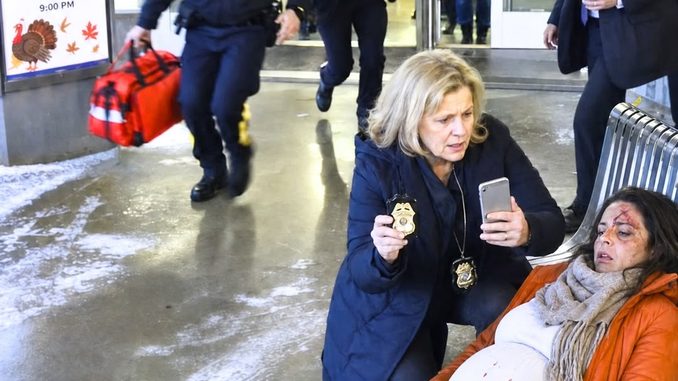
I grabbed my coat and keys before walking to the hall closet, where a small lockbox had remained untouched for years. Inside rested an old federal badge and identification case, reminders of a career I had quietly left behind after my husband died.
Long before I became the soft-spoken widow everyone underestimated, I had spent decades as a federal prosecutor. I had stood across courtrooms from people who believed power placed them beyond accountability, and I had learned that the first hour after a violent crime often determined everything that followed. The first phone call, the first witness, and the first preserved piece of evidence could change an entire case.
At 5:19 that morning, I backed my SUV out of the driveway and headed toward the downtown bus terminal. The streets were nearly empty beneath the freezing rain, and every ordinary house I passed seemed strangely disconnected from the nightmare unfolding ahead.
When I arrived at Bay 6, the terminal was almost deserted. The fluorescent lights buzzed overhead while the automatic doors released brief bursts of warm air that never reached the benches outside. My eyes found Chloe immediately.
She was curled beneath a broken streetlamp without a coat, shivering uncontrollably in the freezing wind. One shoe was missing, blood had dried near her temple, her lip was split, one eye had swollen nearly shut, and her sweater hung torn from one shoulder. She had folded herself around the pain as though trying to disappear.
I dropped to my knees beside her.
“Baby,” I whispered. “Look at me. Stay with me.”
Her unfocused eyes slowly found mine. She reached weakly toward my coat, leaving blood across the sleeve before speaking in little more than a whisper.
“They beat me.”
I leaned closer.
“Who?”
“Marcus… and Sylvia.”
The words landed with terrifying simplicity. I didn’t cry or scream because there would be time for grief later. Right then, I needed answers.
“With what?”
Her lips trembled.
“Golf club.”
I wrapped my scarf gently against the side of her face, but she still flinched as soon as my hand came near her. That tiny reflex hurt more than the blood or the bruises because it told me my daughter had learned to expect pain whenever someone reached toward her.
“Did Marcus bring you here?”
“Yes.”
“Did anyone see him?”
She nodded weakly.
“Maybe cameras… He parked by the east entrance. Sylvia wiped the floor before we left. She said nobody would believe me.”
A violent cough interrupted her, and I saw blood on her lips.
“He has someone else,” she whispered.
“Who?”
“I don’t know her name. Sylvia said I had to leave so his mistress could take my place at the table. She said I embarrassed him.”
The words hit me harder than I expected. While my daughter lay bleeding on a frozen bus terminal bench, they were preparing Thanksgiving dinner so another woman could sit in her chair.
I kept talking to Chloe, trying to keep her conscious, but after squeezing my sleeve one final time, her body suddenly went limp in my arms. Fighting every instinct to fall apart, I pulled out my phone and dialed 911.
“I need Advanced Life Support at the downtown bus terminal, Bay 6,” I said steadily. “Adult female with severe blunt-force injuries, possible internal bleeding, exposure to freezing temperatures, and I need officers immediately. I want to report an attempted murder.”
Part 2: The Evidence They Never Expected
The paramedics arrived within minutes, moving with the speed and precision that comes from seeing the worst days of people’s lives. While they stabilized Chloe and wrapped her in thermal blankets, I answered every question they asked, listing her injuries, the possible weapon, and everything she had managed to tell me before losing consciousness.
As they loaded her into the ambulance, I stayed beside the stretcher, refusing to let go of her hand.
“I’m here,” I whispered. “You’re not alone anymore.”
The ride to the hospital felt endless. I watched every number on the heart monitor because numbers were easier to trust than hope. When we arrived, I immediately informed the intake nurse that Chloe had been assaulted, abandoned in freezing weather, and named two specific attackers before she lost consciousness.
Medical staff moved quickly. Photographs were taken of every visible injury, blood samples were collected, and Chloe was rushed for emergency scans. Before long, a detective arrived to begin taking statements, and I gave him everything I knew in the exact order it had happened.
I described Marcus’s phone call, repeated Chloe’s account word for word, showed him the text messages, and explained that security cameras at the bus terminal had likely captured everything. Years in federal court had taught me that memories fade quickly, but evidence preserved immediately can withstand years of scrutiny.
The detective listened carefully without interrupting.
When I finished, he nodded.
“We’ve already sent officers to secure the surveillance footage.”
“Good,” I replied. “Don’t let anyone overwrite it.”
He assured me they were already working on it before asking one final question.
“Is there anything else we should know?”
I thought about Marcus’s call, Sylvia’s obsession with her expensive rug, and the complete absence of concern either of them had shown for Chloe.
“Yes,” I answered quietly. “They’re hosting Thanksgiving dinner this morning.”
The detective looked surprised.
“After doing this?”
“They’re expecting guests.”
He exchanged a glance with another officer. Neither of them said anything, but I could tell they understood exactly what kind of people we were dealing with.
A short time later, officers at the bus terminal began reviewing the surveillance recordings. The footage showed Marcus’s vehicle pulling up beside Bay 6 before dawn. It captured him opening the passenger door, Chloe struggling to stand, and Sylvia stepping out beside him while my daughter collapsed against the bench.
Neither of them tried to help her.
Instead, they simply watched as she slid onto the freezing concrete before turning back toward the car.
One particular frame caught everyone’s attention.
Sylvia bent over Chloe, but instead of checking whether she was alive, she removed something from my daughter’s hand before calmly walking away.
The detective enlarged the image.
It was Chloe’s wedding ring.
“That wasn’t theft,” he muttered.
“No,” I replied. “It was control.”
Before anyone could continue the discussion, my phone buzzed again.
Marcus.
The detective motioned for me to answer on speaker.
I accepted the call.
“Eleanor,” Marcus said sharply, “where are you?”
I didn’t respond.
“Don’t make a scene,” he continued. “Chloe embarrassed herself last night. She was drunk. She fell. She needs help, but not the kind you’re trying to turn this into.”
The detective silently began taking notes while Marcus continued talking.
“I have important people at my house today,” he said. “If you show up here with some emotional story, I’ll make sure Chloe loses everything. She’s unstable, and I have witnesses.”
From somewhere behind him, Sylvia’s voice drifted into the call.
“Tell that old woman she should be grateful we didn’t call the police on her daughter.”
The detective held up one finger, asking me to keep Marcus talking.
I asked the first question that came to mind.
“What happened to Sylvia’s rug?”
Marcus sighed impatiently, believing I had finally accepted his version of events.
“She bled on it,” he answered.
The room fell completely silent.
Marcus immediately realized what he had admitted.
“After she fell,” he added quickly.
It was too late.
The detective calmly wrote two words across the top of his notebook.
Admission heard.
Within the hour, Chloe’s scans confirmed multiple broken ribs, a concussion, internal injuries, and severe bruising throughout her body. Although she was expected to survive, the doctors explained that abandoning her outside in freezing temperatures had significantly increased the danger.
Meanwhile, officers had gathered enough evidence to seek immediate action. Between Chloe’s statement, the surveillance footage, the photographs of her injuries, Marcus’s recorded phone call, and the medical findings, investigators believed they had more than enough probable cause.
The tactical supervisor reviewed the case file one last time before looking at the detective.
“Are the suspects still at the house?”
“Yes.”
“Any indication they’re destroying evidence?”
“They’re hosting Thanksgiving dinner.”
The supervisor gave a single nod.
“Then let’s go.”
While Marcus carved turkey and entertained his guests, he had no idea that investigators were already on their way. He believed the woman he had abandoned had nobody powerful standing behind her.
He couldn’t have been more wrong.

Part 3: The Door They Never Expected to Open
While Marcus entertained his Thanksgiving guests, officers quietly surrounded the property. According to the reports I later reviewed, the dining room was beautifully arranged with crystal glasses, fine china, fresh flowers, and a perfectly roasted turkey waiting to be served. Seated beside Marcus was a woman none of the relatives recognized, while the chair that had once belonged to Chloe wasn’t empty.
It had been removed entirely.
That detail stayed with me because an empty chair reminds people someone is missing. Removing the chair allows everyone to pretend that person never belonged there in the first place.
The first knock at the front door barely interrupted dinner. Sylvia reportedly rolled her eyes and told another family member to answer it, assuming it was a late guest. Moments later, a second knock came much harder, followed by officers identifying themselves outside the house.
According to witness statements, Marcus stood so quickly that his chair slammed backward into the wall.
“Nobody open that door,” Sylvia shouted.
It didn’t matter.
Within seconds, officers entered the house and secured everyone inside. They gave clear instructions, separated the guests, and immediately began documenting the scene. Marcus demanded to know who had authorized the operation, while Sylvia repeatedly threatened lawsuits, convinced her social status would somehow end the investigation before it began.
Their confidence disappeared as investigators moved through the house.
The expensive Persian rug Sylvia had complained about was photographed before being collected as evidence. Officers documented bloodstains that someone had unsuccessfully tried to clean, located a golf club inside the mudroom, and photographed faint smears that remained along the hallway baseboards. Each new discovery quietly dismantled the story Marcus had been preparing to tell.
Sylvia insisted Chloe had simply become drunk and violent.
“She attacked us,” she claimed. “My son was only defending himself.”
One detective calmly placed a printed surveillance image on the dining table.
The photograph showed Sylvia bending over Chloe at the bus terminal, removing the wedding ring from her unconscious hand before abandoning her on the bench.
For the first time that morning, Sylvia stopped talking.
The officers searched her handbag.
Inside was Chloe’s wedding ring.
Meanwhile, Marcus continued insisting that Chloe had injured herself by falling. He repeated the same explanation several times, never realizing investigators had already preserved the surveillance footage, photographed Chloe’s injuries, recorded his own phone call, and documented his admission that she had bled on the rug before he changed his story.
The evidence didn’t contradict him in one place.
It contradicted him everywhere.
Back at the hospital, I remained beside Chloe while doctors completed additional examinations. They confirmed she had suffered broken ribs, internal injuries, a concussion, severe bruising, and dangerous exposure to freezing temperatures after being abandoned outside. Every report, every photograph, and every medical finding strengthened the case investigators were already building.
Late that afternoon, Chloe finally opened her eyes.
She looked around the hospital room in confusion before finding me beside the bed.
“Mom…”
I squeezed her hand gently.
“I’m here.”
She swallowed painfully before asking the question that broke my heart more than anything else that day.
“Did I ruin Thanksgiving?”
That is what abuse does to someone. Instead of asking why they were hurt, they worry about the inconvenience their suffering caused everyone else.
I brushed a strand of hair away from her face.
“No, sweetheart,” I said softly. “They ruined a crime scene. There’s a difference.”
Tears filled her eyes as years of fear finally gave way to relief. For the first time since her marriage began, she no longer had to defend herself or pretend everything was fine. She cried quietly while I held her hand, grateful that she was alive.
The months that followed weren’t easy. There were surgeries, physical therapy appointments, interviews with investigators, court hearings, protective orders, insurance paperwork, and eventually divorce proceedings. Chloe approached her recovery the same way she had approached every challenge in life, organizing medical records, police reports, and legal documents into carefully labeled folders that covered my kitchen table.
Marcus eventually accepted a plea agreement after prosecutors confronted him with the surveillance footage, medical evidence, witness statements, and recordings of his own admissions. Sylvia’s attempts to blame everyone except herself collapsed once investigators recovered Chloe’s wedding ring from her purse and connected every piece of physical evidence inside the house.
Recovery took much longer than the criminal case.
Some mornings Chloe still struggled to lift her arm without pain. Some nights she woke suddenly because the sound of a car door outside convinced her Marcus had returned. We slowly built new routines together without ever calling them coping mechanisms. Tea before bed, the porch light left on every night, a spare key to my house always in her purse, and a permanent place waiting for her at my table.
The following Thanksgiving, Chloe arrived carrying sweet potatoes just as she had promised years earlier.
She smiled as she set the dish on the counter.
“I made them a little firmer this year,” she teased. “You’d better not complain.”
I laughed for the first time in what felt like forever.
As we sat together around the table, surrounded by the familiar smell of pumpkin pie, coffee, and cinnamon, I realized the holiday no longer reminded me of violence. It reminded me that my daughter had survived.
People sometimes ask whether I regret never telling Marcus that I had once been a federal prosecutor.
I never do.
If he had known who I was, he might have hidden his actions more carefully. Instead, he showed investigators exactly who he was because he believed Chloe had no one capable of standing up for her.
He was wrong.
She had evidence.
She had the truth.
And she had a mother who refused to let anyone erase either one.
Leave a Reply