Part 1: The Birthday Dinner They Chose to Skip
Owen’s tenth birthday began exactly the way a child’s birthday should. I woke before seven, made pancakes, stuck a candle into the tallest stack, and watched my husband Grant perform “Happy Birthday” with so much theatrical confidence and so little musical ability that Owen laughed until he hiccupped.
That evening, we were supposed to celebrate at Bellucci’s, Owen’s favorite Italian restaurant. My parents, Linda and Walter, were coming, along with my younger sister Whitney, her husband Paul, and their two children, and Owen had already planned where everyone would sit.
At 4:30, while I was folding laundry, my phone buzzed with a message from Mom.
“Running behind. Let’s push it to next weekend. Okay? Love you both.”
Dinner was only ninety minutes away. I called her immediately, then Dad and Whitney, but none of them answered.
When I told Owen, disappointment crossed his face before he quickly hid it. He looked down at the soccer cards he had been organizing and gave me the kind of polite little smile no ten-year-old should already know how to use.
“It’s okay. Pizza is fine.”
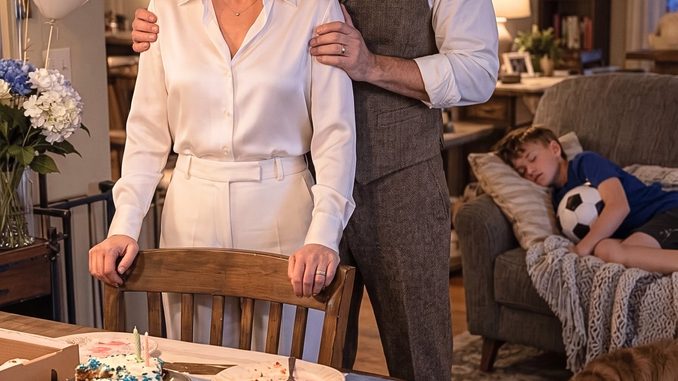
Grant ordered pizza, and the three of us spent the evening watching an animated movie on the couch. Owen eventually fell asleep against my shoulder with his new soccer ball tucked under one arm, and I convinced myself that we had rescued his birthday well enough.
Then, at 9:15, I opened Instagram.
Whitney’s story showed a long table covered with white linen, candles, polished glasses, expensive food, and several painfully familiar faces. My parents were sitting beside Whitney and her family at Harrison & Cole, one of the most expensive steakhouses downtown.
Across the image, Whitney had written:
“FAMILY NIGHT. BEST TABLE IN THE HOUSE.”
There had been no emergency, no delay, and no unexpected complication. They had canceled Owen’s birthday dinner and gone somewhere else together.
I called Mom immediately.
“Yes,” she admitted after an uncomfortable pause. “We were going to tell you.”
When I reminded her that it was Owen’s birthday, she explained that Harrison & Cole was more appropriate for a grown-up evening. I pointed out that Whitney’s children were sitting at the table, including Mason, who was only one year older than Owen.
Finally, Mom stopped trying to disguise the real reason.
“Owen would have been restless. Your father wanted a nice evening. Honestly, he might have embarrassed us.”
Something inside me became completely still.
Suddenly, years of isolated disappointments formed a pattern. My parents had skipped Owen’s school events while finding time for Whitney’s children, arranged holidays around my sister’s schedule, and repeatedly treated my son as the grandchild who could simply understand when everyone else came first.
One incident could be explained.
Ten were a choice.
Mom told me we could celebrate with cake the following weekend, but I no longer wanted another excuse.
“Got it.”
I hung up and opened my laptop.
Two years earlier, Dad’s hours at the manufacturing plant had been dramatically reduced, and my parents had feared losing their home. Grant and I were financially comfortable, so I offered to cover their $2,380 monthly mortgage payment until they recovered.
Every month for twenty-four months, the money had transferred automatically.
More than $57,000.
The next payment was scheduled for Monday.
Grant stood behind me as I stared at the option labeled Cancel recurring transfer.
“What are you thinking?”
“I’m thinking they had four hundred dollars for steak. I’m thinking Mom said my son would embarrass them. And I’m thinking maybe I’ve been solving a problem they don’t actually have anymore.”
Grant rested his hand on my shoulder.
“Then maybe it’s time to let them solve it.”
I clicked Cancel.
That night, I tucked the blanket around my sleeping son and finally understood what I had been teaching him every time I minimized my own hurt to keep my parents comfortable.
For two years, I had protected adults from the consequences of their financial problems.
From that moment forward, protecting Owen from learning that love required accepting disrespect mattered more.
And by the next morning, my parents would discover exactly what that decision cost.
Part 2: The $57,000 Truth
At 7:03 the next morning, my phone rang from an unfamiliar number. A representative from my mother’s bank explained that Mom had listed me as an authorized backup contact for certain account alerts, and the bank had detected that the recurring deposit used for their mortgage payment had been canceled.
“Are you aware the recurring transfer was canceled?”
“Yes.”
“Was that intentional?”
“Yes.”
The representative accepted my answer and said they would continue trying to reach Mom. I hung up without calling my parents because I wasn’t trying to punish them, but I was finished rescuing adults before they even acknowledged they needed help.
At 7:41, Mom called.
“What did you do?”
There was no greeting and no question about Owen. Her immediate concern was the missing $2,380.
“You cannot just cancel money we depend on.”
“Mom, listen to what you just said. You said I can’t cancel my money.”
She immediately reframed the situation as though I were retaliating over one insignificant dinner. But this wasn’t simply about being excluded from an expensive restaurant; it was about canceling Owen’s birthday ninety minutes beforehand, celebrating with everyone else, and then claiming my ten-year-old might have embarrassed them.
“We’re your parents. We need that money.”
“Why?”
That question changed the conversation.
Dad’s hours had been reduced two years earlier, but I had never asked whether his situation had improved. I had simply continued sending the mortgage payment every month because I trusted my parents to tell me when they no longer needed assistance.
“Are Dad’s hours still reduced?”
Mom avoided answering until Dad finally took the phone. His defeated voice told me the truth before he finished explaining it.
“I went back to full hours last April.”
Almost eleven months.
Eleven unnecessary transfers.
More than $26,000 sent after the original reason for helping them had disappeared.
“You never told me.”
“I should have.”
“Why didn’t you?”
Dad hesitated before giving me the answer that transformed my disappointment into something much deeper.
“Your mother thought we should let the money keep coming. She said you were doing well. She said you wouldn’t miss it.”
They had not merely forgotten to update me. Mom had consciously decided that because Grant and I were financially stable, there was no reason to stop accepting money they no longer needed for survival.
Then I discovered where some of that financial freedom had gone.
Dad admitted that while I continued covering their mortgage, they had used their own income to help Whitney with expenses for her children. Whitney apparently didn’t know where that money originated, but the arrangement was painfully simple: I was subsidizing my parents so they could financially support my sister.
“What about Saturday? Did my money pay for dinner?”
“Not directly.”
“What does that mean?”
“It all went into the same household budget.”
I laughed once.
“So yes.”
The birthday dinner suddenly felt different. My parents had excluded my son from an expensive evening partly made easier because I had spent two years removing their largest monthly expense.
Dad apologized and promised to resume paying his own mortgage. When he asked whether they could come over, however, I refused.
“Not today.”
He wanted to apologize to Owen, and I agreed that he could call that evening, but I gave him one condition.
“Tell him the truth. Don’t say everyone was busy. Don’t say plans changed. Tell him you chose another dinner instead of his birthday.”
At seven that night, Dad called Owen and did exactly that. He admitted they had made a selfish choice and that none of it had been Owen’s fault.
Then Owen asked the question Dad clearly hoped he could avoid.
“Did Grandma think I would be annoying?”
After a long silence, Dad finally admitted that Mom had said something unfair about him and that he had failed to stop her.
“That wasn’t very nice,” Owen said.
“No.”
“Okay. Thanks for saying sorry.”
Then, after another pause, Owen asked whether the steak had at least been better than Bellucci’s.
“No,” Dad admitted.
Owen considered that answer seriously.
“Okay. Then you picked wrong anyway.”
Grant covered his mouth to keep from laughing.
But watching my son handle the conversation taught me something far more important than anything contained in those bank statements.
Owen could accept an apology without immediately restoring everything to normal.
At ten years old, he already understood something I had spent thirty-five years learning:
Forgiveness did not require immediate access.
Part 3: The Family Story Began to Crack
An hour after Dad apologized to Owen, Whitney called me. She sounded confused and irritated because Mom had told her that I had canceled their mortgage money simply because the family went to dinner without me.
“That is one version.”
“What other version could there possibly be?”
So I told her everything. I explained Dad’s reduced hours, the $2,380 monthly transfers, the more than $57,000 Grant and I had sent over two years, and the fact that Dad had returned to full-time work eleven months earlier without anyone telling me.
Then I mentioned something Whitney clearly hadn’t expected.
“Dad said some of the money they freed up went toward school expenses for your kids.”
“What school expenses?”
She became completely quiet as I explained that Mom had deliberately encouraged Dad not to tell me his hours had returned because she wanted my payments to continue. Whitney insisted she had believed Dad had received a raise, and I believed her.
But there was still Owen.
“You knew Saturday was his birthday.”
“Yes.”
“Why did you go?”
Whitney explained that Mom had told her Owen preferred to celebrate at Bellucci’s the following weekend and that I was completely fine with rescheduling. That explained why Whitney had attended the steakhouse dinner, but it didn’t explain the Instagram post announcing “FAMILY NIGHT” while my son sat at home eating pizza.
“I’m sorry.”
For once, I didn’t rush to make the apology easier for her. Whitney and I had spent our adult lives occupying different roles in Mom’s world: I was the dependable daughter she could always count on, while Whitney was the daughter she openly celebrated.
“I’m done pretending things don’t hurt just because saying so makes Mom uncomfortable.”
“You’re right about that too.”
Three days later, Whitney asked whether she and her children could visit before Owen’s delayed birthday dinner. I let Owen decide, and he said yes.
She arrived with Mason and Sophie carrying one modest blue package. There were no dramatic balloons or extravagant gifts designed to erase what had happened, and before giving Owen anything, Whitney apologized directly.
“I knew Saturday was your birthday. Grandma told me the dinner had been moved, and I didn’t call you to check. I should have.”
She also admitted that posting the photograph had been thoughtless. Owen accepted the apology before opening her gift, a soccer jersey with his name printed across the back.
His face immediately brightened.
Then he looked suspiciously at Whitney.
“Did Grandma pay for this?”
Whitney froze.
“No. I bought this.”
“With your own money?”
“Yes.”
“Okay. Cool.”
A week after the birthday that never happened, we finally went to Bellucci’s. Owen wore his new jersey, Whitney brought her family, and Dad arrived carrying a gift and looking noticeably older than he had before all of this began.
He hugged Owen, then quietly told me he had paid his own mortgage.
“I moved money out of savings. I canceled a few things too.”
“Dad, you don’t have to report your finances to me.”
“I know. I just wanted you to know I handled it.”
That mattered because he wasn’t asking me to rescue him. He was simply taking responsibility for an obligation that had always belonged to him.
Mom wasn’t there.
I hadn’t invited her, and Owen hadn’t asked me to.
At first, her empty chair felt enormous, but gradually the table filled with normal conversation. Owen and Mason laughed, Dad traded stories with Grant, Whitney and I argued over a childhood memory, and Mr. Bellucci arrived carrying two scoops of vanilla ice cream while pretending the kitchen had made another accounting mistake.
Owen blew out his candle and announced that his wish was for us to celebrate there every year.
Looking around that table, I realized nobody was pretending anymore. The people sitting there had either admitted what they had done wrong or accepted that the truth might be uncomfortable.
I thought that might be where the story ended.
Then, the following Wednesday evening, Mom appeared unexpectedly on my doorstep.
She wasn’t dressed for a performance or carrying another apology gift.
She was holding a large manila envelope.
And inside it were eleven months of numbers she could no longer explain away.

Part 4: The Numbers She Could No Longer Hide
Mom sat at the same kitchen table where I had canceled the recurring mortgage transfer. For nearly a minute, neither of us spoke, and then she pushed the manila envelope toward me.
“What is this?”
“Numbers.”
Inside were bank statements, dates, transfers, and a handwritten summary of nearly a year of spending after Dad had returned to full-time work. There were payments toward Whitney’s children’s school expenses, restaurant bills, weekend trips, a new dining set, and other purchases that had increased almost immediately after Dad’s schedule returned to normal.
At the bottom of the page was one total.
$26,180.
It was almost exactly the amount I had transferred during those eleven months.
“I can’t repay it all at once.”
“I didn’t ask you to.”
“I know.”
Then Mom did something unusual. Instead of explaining why circumstances were complicated or reminding me that family was supposed to help family, she folded her hands and admitted what she had spent days avoiding.
“I was wrong.”
When Dad returned to full-time work, she had initially convinced herself they deserved some financial breathing room. After that, she justified keeping my payments because I had offered the money voluntarily and because Grant and I appeared financially comfortable.
“I kept changing the reason in my head so I wouldn’t have to admit what I was doing.”
“What were you doing?”
She swallowed.
“Taking advantage of you.”
There was nothing left to reinterpret. She had known the original emergency was over and allowed my money to continue arriving because it made her life easier.
Then I asked about Owen.
Mom admitted that what she had done to him was worse. She wanted an elegant dinner at Harrison & Cole and had begun thinking of Whitney’s family as the “easy family” because they enjoyed dressing up and going to the places she preferred.
When I challenged her excuses about Owen being too energetic, she finally stopped defending them.
“It was an excuse.”
“For what?”
“For treating you like the person who would always understand.”
That answer hurt because it explained years of behavior. I was dependable, so I received the disappointment; I recovered quickly, so plans could be changed on me; I rarely complained, so my feelings became the easiest ones to sacrifice.
“So you gave me the disappointment because I could handle it.”
“Yes.”
“And Owen too?”
She looked down.
“I didn’t think about what I was teaching him.”
“I did.”
I told her the mortgage transfers were not restarting. If Dad ever genuinely lost hours again, they could ask for help and we would discuss it openly, but there would never again be a secret financial arrangement with no questions and no end date.
Mom accepted that without arguing.
She had already canceled a planned vacation and returned an expensive piece of furniture. She and Dad also intended to begin putting money into savings for Owen, not because I demanded repayment, but because they wanted their actions to acknowledge that the money they had accepted actually mattered.
“Does that mean we’re fine?”
“No.”
Her expression fell.
“We’re talking. That’s different.”
For once, she didn’t negotiate.
Two weeks later, Mom sent Owen a handwritten letter apologizing directly to him. A month after that, he decided he was ready to have dinner with his grandparents at Bellucci’s, and I deliberately stayed home.
I didn’t supervise the reconciliation or tell anyone what to say. Owen’s relationship with his grandparents belonged to him, and rebuilding it was their responsibility.
Meanwhile, something unexpected began happening inside my own family. Whitney and I started comparing our childhood memories and discovered that we had spent years resenting completely different versions of each other.
She had always believed I was Mom’s favorite because I was responsible and trusted.
I had always believed Whitney was the favorite because Mom celebrated her more openly.
Neither version was entirely true.
Dad changed more quietly. He began speaking for himself instead of allowing Mom to answer every question for him, paid the mortgage without mentioning it again, reduced unnecessary expenses, and helped sell a second car they barely used.
Mom even took a part-time scheduling job at a dental office.
I didn’t congratulate them for paying their own bills.
I simply stopped carrying responsibilities that had never belonged to me.
And once that $2,380 stopped disappearing from our account every month, I began realizing just how much of my own family’s life I had postponed to keep everyone else comfortable.
Part 5: What $57,000 Finally Taught Me
For two years, Grant and I had become accustomed to losing $2,380 from our account every month. Once those transfers stopped, we suddenly had financial room I had almost forgotten existed.
The first month, we changed nothing. The second month, we increased Owen’s college savings, and the third, we paid down Grant’s work truck before creating a small travel fund for experiences we wanted to share as a family.
That summer, we rented a lakeside cabin for five days. Owen learned to kayak, Grant managed to burn pancakes on an outdoor griddle, and one quiet morning I sat on the dock watching mist rise from the water when an uncomfortable realization finally reached me.
I had spent more than $57,000 keeping my parents comfortable, yet I had previously hesitated to spend six hundred dollars taking my husband and son away for a long weekend.
Generosity had never been the real problem.
The hierarchy was.
Somewhere along the way, I had learned that being a good daughter meant making myself useful. I had placed my parents’ comfort above my own household’s freedom because part of me feared that if I stopped providing what everyone needed, I might also stop being loved.
That didn’t happen.
Some relationships became more distant, but others became more honest. Mom gradually learned to catch herself when she started making excuses, Dad became more accountable for his own decisions, and Whitney and I finally began understanding the roles we had both been assigned within the family.
One evening, I told Grant that canceling the transfer had once felt like the cruelest thing I had ever done. Now I understood that continuing to send the money after learning the truth would have been worse because it would have taught everyone that their choices carried no consequences.
“Including Owen,” Grant said.
“Especially Owen.”
By the following March, Owen was turning eleven, and we returned to Bellucci’s. This time, nobody canceled.
My parents came, Whitney brought her family, and the table was wonderfully imperfect. Mason spilled water, Sophie complained about mushrooms, crayons landed on the floor, and Mom laughed when Owen stole a garlic knot from her plate.
Nobody was elegant.
Nobody needed to impress anyone.
When dessert arrived, Mr. Bellucci once again pretended the oversized serving of ice cream was an unfortunate kitchen mistake. We sang while Grant performed terribly, Dad somehow sounded even worse, and Owen blew out eleven candles surrounded by people who had finally learned that showing up mattered more than appearances.
My family had not magically become perfect. One canceled bank transfer could never repair decades of unhealthy patterns, just as apologies could not erase everything that had happened.
What changed was me.
I could say when something hurt without minimizing it to protect someone else. I could accept an apology without pretending the past had disappeared, and when someone became angry because I established a boundary, I could allow them to be angry without immediately trying to fix their discomfort.
I never restarted my parents’ mortgage payments.
If they genuinely need help someday, I will listen, and I may choose to help again. But there will be questions, clear numbers, honest conversations, and an end date because secrecy will never again be disguised as generosity.
Sometimes I still remember Whitney’s Instagram story from Owen’s tenth birthday: the candles, Dad’s expensive steak, Mom laughing, and the words FAMILY NIGHT displayed across a celebration that excluded my son.
At the time, I believed that photograph proved Owen and I were standing outside something important.
Eventually, I understood that we weren’t outside at all.
We were standing at the entrance to an old family pattern, and for the first time, I chose not to walk back into it.
The most important thing I did that year wasn’t paying more than $57,000 toward my parents’ mortgage, and it wasn’t canceling the payments either. It was teaching Owen, and finally teaching myself, that kindness without boundaries eventually stops being kindness and becomes expectation.
Sometimes the healthiest answer is simply no.
No, I will not finance this anymore. No, my child will not be treated as optional, and no, I will not keep everyone else comfortable by sacrificing myself first.
That small word changed our family more profoundly than all the money I had ever given them.
Years of pretending had finally broken.
What replaced them wasn’t perfect.
It was honest.
And for the first time, honest felt far more like family than pretending everything was fine ever had.
Leave a Reply