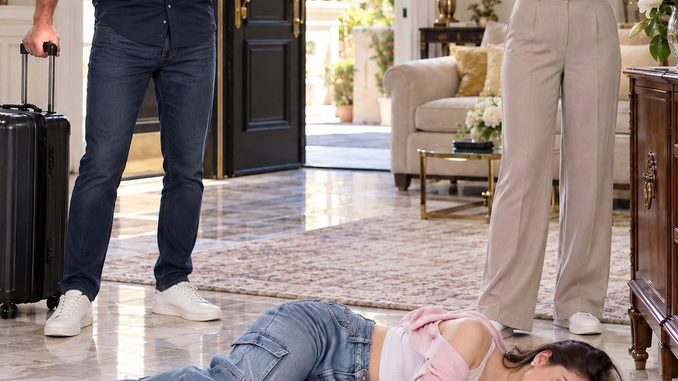
Part 1: I Found My Daughter Unconscious by the Front Door—And My Wife Refused to Call for Help
My wife stood with her arms crossed while our twenty-year-old daughter lay unconscious on the hallway floor. I’d just returned from a two-week business trip when I found Daniela beside the entryway cabinet, her face pale and a small injury near her temple. When I demanded to know why nobody had called an ambulance, Patricia shrugged. “She was breathing. I figured she’d get up eventually.” I didn’t argue. I called 911. But what Daniela whispered to me at the hospital that night made me question everything I believed about my marriage.
My name is Javier Ramirez, and for twenty-two years, I believed my wife and I had built a stable, loving family in Columbus, Ohio. We had one daughter, Daniela, who was attending college and working part-time to cover her personal expenses.
I worked as an industrial maintenance supervisor, a job that frequently required me to travel. The long hours weren’t easy, but I believed I was providing the security my family deserved.
That Friday afternoon, I arrived home earlier than expected.
My suitcase was still in my hand when I noticed Daniela lying near the front door. At first, I thought she’d fallen asleep in an awkward position, but as I approached, I saw that her eyes were closed and she wasn’t responding.
“Daniela? Honey, can you hear me?”
I knelt beside her, speaking her name again while checking whether she was breathing. When she didn’t respond, fear tightened around my chest.
Patricia appeared from the kitchen.
“What’s going on?” I demanded. “What happened to our daughter?”
She looked down at Daniela.
“I don’t know. She probably got dizzy and fell.”
“How long has she been lying here?”
“I wasn’t watching the clock, Javier.”
I stared at her.
“Did you call an ambulance?”
“No. She was breathing, so I assumed she’d wake up.”
For a moment, I couldn’t believe what I was hearing.
Our daughter was lying unconscious on the floor, and my wife was talking about her as though she’d simply fallen asleep on the couch.
I called 911 immediately.
While we waited for the paramedics, I stayed beside Daniela, following the dispatcher’s instructions and trying to remain calm. Patricia remained several feet away, occasionally glancing toward the kitchen.
When the paramedics arrived, one of them asked whether anyone had witnessed the fall.
“My wife was home,” I explained.
Patricia shook her head.
“I was in the kitchen. When I came out, Daniela was already on the floor.”
The paramedic looked at her carefully.
“Did you see her lose consciousness?”
“No.”
“Then how do you know she simply fainted?”
Patricia hesitated.
“I don’t. That’s just what I assumed.”
I accompanied Daniela to the hospital, where doctors examined her and ordered imaging to check for a serious head injury. They diagnosed a concussion and decided to keep her under observation.
Fortunately, the initial tests didn’t reveal a more severe injury.
But nobody could explain how she’d fallen.
During the ambulance ride, I kept replaying Patricia’s answers. She’d suggested that Daniela fainted, then claimed she hadn’t seen anything, and finally admitted she didn’t know how long our daughter had been unconscious.
Something wasn’t right.
That night, I sat beside Daniela’s hospital bed, holding her hand while the monitors beeped softly around us.
Shortly before midnight, her eyes opened.
“Dad?”
I leaned forward immediately.
“I’m here, sweetheart.”
She blinked several times, looking confused.
“You came home?”
“Yes. I’m right here.”
Her eyes filled with tears.
“I’m sorry, Dad.”
I felt my chest tighten.
“What are you apologizing for?”
Daniela glanced toward the hospital room door.
“Mom told me that if I told you what she was doing, you’d hate me.”
I stared at her.
“Daniela, there’s nothing you could tell me that would make me stop loving you.”
She squeezed my hand.
“Mom wanted to sell my car.”
For a moment, I didn’t understand.
“The Honda?”
She nodded.
Two years earlier, I’d helped Daniela purchase a reliable used Honda Civic. She’d contributed money from her part-time job, and we’d registered the vehicle in her name.
It was her car.
“Why would your mother want to sell it?”
“She said we needed the money. She told me you’d already agreed.”
I shook my head.
“I never agreed to sell your car.”
Daniela began crying harder.
“I told her that, but she wouldn’t listen. She kept demanding my keys and asking me to sign papers.”
I moved closer.
“Did you argue about the car today?”
She nodded.
“Mom went through my things and found the documents. When I tried to take them back, she grabbed my arm.”
I felt my stomach turn.
“What happened next?”
Daniela looked down at the blanket.
“She pushed me. I lost my balance and hit my head against the cabinet.”
For several seconds, I couldn’t speak.
My daughter had been injured during an argument with her mother, and Patricia had left her lying on the floor without calling for help.
“Did your mother see you fall?” I asked quietly.
Daniela nodded.
“She came over and took my car keys out of my jacket pocket.”
I stared at her.
“She took your keys while you were hurt?”
“Yes.”
Daniela swallowed.
“She told me, ‘Maybe now you’ll learn that things happen my way in this house. And don’t you dare tell your father.’”
I felt a cold anger rising inside me, but I forced myself to remain calm. Daniela needed reassurance, not another frightening confrontation.
“You did the right thing telling me,” I said. “I’m going to make sure you’re safe.”
She held my hand more tightly.
“Dad, there’s something else.”
I waited.
“Mom’s been trying to sell the car for weeks. She took pictures of my driver’s license and asked me to sign documents I didn’t understand.”
“Did you sign anything?”
“No. I refused.”
Then Daniela told me something that made the situation even more disturbing.
“She said she had to finish everything before you came home. And yesterday, I heard her talking to Uncle Oscar about some papers with my signature on them.”
I looked toward the dark hospital window, trying to understand what my wife and her brother could possibly have been planning.
I knew one thing.
Whatever Patricia had been doing, it involved more than a disagreement over a car.
And the next morning, I intended to find out exactly what she’d been hiding while I was away.
Part 2: My Wife Tried to Sell Our Daughter’s Car—Then I Found a Signature Daniela Never Wrote
The morning after my daughter told me her mother had pushed her, I drove home from the hospital with one question running through my mind. Why had Patricia become so desperate to sell a car that legally belonged to our twenty-year-old daughter?
Daniela was still under observation for a concussion, and the doctors had advised her to rest. Before leaving, I promised I would return that afternoon and asked her to tell the medical staff if she remembered anything else about the incident.
When I entered the kitchen, Patricia was eating breakfast.
“How’s Daniela?” she asked, barely looking up.
“She has a concussion. The doctors are monitoring her.”
Patricia set down her coffee.
“Well, at least it wasn’t anything serious.”
I stared at her, struggling to understand how she could speak so casually about our daughter being hospitalized.
“Why were you trying to sell Daniela’s car?”
Her hand froze beside the cup.
“Is that what she told you?”
“Yes.”
Patricia shook her head.
“That girl exaggerates everything. I’ve been trying to teach her some financial responsibility.”
“The Honda is registered in her name, Patricia. You can’t sell it without her permission.”
She pushed back her chair.
“We’re her parents! You’re the one who helped pay for it!”
“And Daniela contributed her own savings. The car belongs to her.”
Patricia crossed her arms.
“You have no idea what I’ve been dealing with while you’ve been traveling.”
“Then explain it to me.”
She looked away.
I took a breath before asking the question that mattered most.
“Did you push our daughter?”
“No.”
“Daniela told me you grabbed her arm and pushed her into the entryway cabinet.”
Patricia’s expression changed.
“I barely touched her. She pulled away and lost her balance.”
A moment earlier, she’d denied touching Daniela at all.
Now she was admitting there had been physical contact.
“Why didn’t you call an ambulance?”
“I told you. I thought she’d be fine.”
I looked at the woman I’d been married to for twenty-two years and realized I no longer knew which parts of her story to believe.
“Where are Daniela’s car keys and ownership documents?”
“I don’t know.”
“Patricia.”
“What?”
“I need you to tell me where they are.”
She stood abruptly.
“I’m not going to be interrogated in my own kitchen.”
She walked upstairs, leaving her unfinished breakfast on the table.
I went into the small home office where we kept our insurance records, tax documents, and vehicle paperwork. I wasn’t looking for an argument; I wanted to understand whether anyone had already attempted to transfer Daniela’s property.
Inside a drawer we used for household bills, I found a manila folder I didn’t recognize.
The first page was an offer from a used-car dealership.
It listed Daniela’s Honda Civic, its vehicle identification number, and a proposed purchase price of approximately $8,500.
The next page was a photocopy of Daniela’s driver’s license.
Beneath it was a vehicle-sale authorization bearing a signature that was supposed to be hers.
I studied the handwriting.
Daniela had signed enough birthday cards and school forms over the years for me to recognize the way she wrote her name. The signature on the authorization looked wrong, particularly the final letters.
I took photographs of the documents without altering them.
Then I noticed an appointment confirmation.
Patricia had scheduled a meeting with a vehicle-title service for Monday morning, just two days away.
She was planning to complete the transaction while Daniela was still recovering.
I called the business listed on the paperwork and explained that the vehicle’s registered owner was hospitalized and had not authorized its sale.
The employee wouldn’t disclose private account information over the phone, but she explained that ownership and authorization would have to be verified before any transfer could proceed.
I asked how Daniela could report a disputed authorization and was told to have her contact the business directly when she was able.
After hanging up, I examined the folder again.
A separate document identified a witness to the proposed authorization.
Oscar Ramirez.
Patricia’s younger brother.
Oscar owned a small auto repair shop outside Columbus. I’d known him for more than twenty years and had helped him occasionally when business was slow.
I couldn’t understand why he’d become involved in selling his niece’s car.
I called him.
He answered on the fourth ring.
“Javier! You’re back already?”
“Yes. I need to ask you something.”
“Sure.”
“Why is your name on paperwork authorizing the sale of Daniela’s Honda?”
There was a pause.
“Patricia said you were handling that.”
“No. She told Daniela I’d approved the sale, but I never did.”
Oscar cleared his throat.
“I think you should talk to your wife.”
“I already have. Now I’m asking you.”
He didn’t answer.
I looked down at the document.
“Did you witness Daniela signing this authorization?”
Another silence.
Finally, Oscar said, “I didn’t think it would become such a big problem.”
My stomach tightened.
“What exactly did you witness, Oscar?”
“I have to go, Javier. We’ll talk later.”
He ended the call.
I sat at the desk for several minutes, staring at the folder. Two people I had trusted for decades appeared to be involved in an attempt to sell my daughter’s property without her consent.
But I still didn’t know why they needed the money so urgently.
I opened our joint bank account and reviewed the recent transactions. Among the ordinary grocery bills and utility payments was an unfamiliar charge for $275 to an automotive documentation service.
The date matched the paperwork I’d found.
I saved a copy of the statement and returned the documents to their folder.
Then I remembered something.
Six months earlier, after several packages disappeared from our front porch, we’d installed a security camera near the entryway. Its field of view included part of the hallway and the cabinet where I’d found Daniela.
I hadn’t thought about it during the emergency.
I opened the camera application and searched for Friday afternoon.
At 3:42 p.m., Daniela appeared on the screen carrying her college backpack.
Patricia stepped into the hallway and blocked her path.
The two argued. Daniela reached for a folder in her mother’s hands, but Patricia grabbed her arm and pulled it away.
Then my wife pushed her with both hands.
Daniela stumbled backward and struck the side of the cabinet before falling to the floor.
I stopped the recording, my hands trembling.
After a moment, I forced myself to continue.
Patricia approached our daughter, knelt beside her, and searched the pocket of her jacket.
She removed the car keys.
Then, instead of calling for medical assistance, she took out her phone.
The camera’s microphone captured her voice clearly enough for me to recognize the name she spoke.
“Oscar, I’ve got the keys. But she still won’t sign anything.”
I stared at the screen.
Daniela remained motionless on the floor while Patricia continued talking.
And when I heard what my wife said next, I understood that she’d known our daughter needed help—and had chosen to discuss the car instead.
Part 3: My Wife Left Our Daughter Unconscious—And the Security Camera Revealed Why
I watched the security footage three times before I could bring myself to believe what it showed. My wife had pushed our twenty-year-old daughter into a hallway cabinet, watched her fall, and then called her brother about selling Daniela’s car instead of getting medical help.
The camera’s microphone had captured enough of the conversation to make my hands tremble.
“Oscar, I’ve got the keys,” Patricia said. “But she still won’t sign. We need to figure something out before Javier gets home.”
Our daughter lay motionless less than six feet away.
I leaned closer to the computer screen as Patricia continued speaking.
“No, I don’t think she’s seriously hurt. She fell during an argument. I’ll deal with that later. Just find out whether we can move the appointment forward.”
I stopped the recording.
For twenty-two years, I’d trusted Patricia with our family. Whenever my job required me to travel, I assumed Daniela was safe at home with her mother, even when the two of them occasionally disagreed.
Now I was looking at proof that my trust had been dangerously misplaced.
I restarted the video and watched the remaining footage.
Patricia walked into the kitchen while Daniela remained on the floor. A few minutes later, she returned to the hallway, glanced at our daughter, and disappeared again without offering assistance.
Daniela moved one hand and appeared to attempt to sit up, but she couldn’t manage it.
Nearly twenty minutes passed before I appeared on the recording, carrying my suitcase through the front door.
I remembered that moment perfectly.
I’d been excited to surprise my family by returning early from my business trip. Instead, I’d found my daughter unconscious and my wife behaving as though nothing urgent had happened.
I saved the original recording and made a separate backup, careful not to edit the footage.
Then I heard the front door open.
Patricia had returned from the grocery store.
She walked into the office carrying a shopping bag.
“Javier, are you still angry with me? We need to discuss this like adults.”
I turned the computer toward her.
“Sit down.”
She frowned.
“Why?”
“Because there’s something you need to see.”
I played the recording.
At first, Patricia looked irritated. Then the footage showed her pushing Daniela, and the color drained from her face.
When her own voice came through the speakers, speaking to Oscar while our daughter lay on the floor, she covered her mouth.
Neither of us spoke until the video ended.
“Why didn’t you call an ambulance?” I asked.
Patricia began crying.
“I didn’t mean for her to get hurt.”
“That wasn’t my question.”
“She lost her balance. I never thought she’d hit her head.”
“You saw her lying there. You knew she wasn’t getting up.”
Patricia wiped her face.
“I panicked.”
I looked at the frozen image on the screen.
“You were calm enough to call Oscar about selling her car. You weren’t too frightened to make a phone call. You simply chose the wrong person to call.”
She lowered her eyes.
I placed the manila folder on the desk.
“I also found the sale authorization, the copy of Daniela’s identification, and the appointment with the title service. Tell me why you were trying to sell her car without her permission.”
Patricia stared at the papers.
Then she whispered, “Because I needed the money.”
I waited.
For several minutes, she struggled to explain. Finally, she admitted that her brother’s auto repair shop had been in financial trouble for nearly a year.
Oscar had fallen behind on payments to suppliers and was struggling with a business loan. Patricia had secretly borrowed $18,000 to help him keep the shop operating.
“He promised he’d pay me back,” she said. “He told me business would improve.”
But the shop lost two important customers, and Oscar stopped making payments.
Patricia had begun using her savings to cover the monthly installments. When that wasn’t enough, she’d taken money from our joint account and obtained another loan.
By the time she finished explaining, the combined debt had grown to more than $26,000.
I stared at her.
“You borrowed all that money without telling me?”
“I thought I could fix everything before you found out.”
“And when you couldn’t, you decided to sell Daniela’s car?”
Patricia nodded.
“The dealership offered about $8,500. It would’ve given me enough to catch up on some payments.”
“That car belongs to our daughter.”
“We’re supposed to help family, Javier!”
I felt something inside me harden.
“Helping family doesn’t mean taking property from someone who never agreed to give it.”
Patricia insisted that Daniela was too young to understand the financial pressure she was under. She said she’d intended to replace the car once Oscar’s business recovered.
But none of those promises changed what she’d done.
“Did you copy Daniela’s signature?” I asked.
Patricia looked down.
“Yes.”
“And Oscar knew?”
“He agreed to help with the paperwork.”
I remembered the evasive telephone conversation I’d had with my brother-in-law earlier that morning.
Two adults had decided that their financial problems justified using my daughter’s identity and selling her property without her consent.
Then Patricia began pleading with me.
“Javier, we’ve been married twenty-two years. Please don’t destroy everything over one terrible mistake.”
I looked toward the hallway.
“Our daughter could have suffered a much more serious injury. You left her there while you tried to arrange a car sale.”
Patricia sobbed.
“I was afraid of losing everything.”
“And because you were afraid, you forgot the one person you were supposed to protect.”
I left the office before my anger overwhelmed me.
Outside, I called Oscar.
He answered after several attempts.
“Javier, I was going to call you.”
“Did you know Patricia was trying to sell Daniela’s car without her permission?”
He hesitated.
“Patricia told me you agreed to it.”
“Then why did you sign paperwork claiming Daniela had authorized the sale?”
There was a long silence.
“I didn’t think it would go this far,” he finally admitted.
I closed my eyes.
“Daniela is in the hospital with a concussion. Your sister pushed her during an argument about the car.”
Oscar sounded startled.
“Patricia said Daniela had fallen.”
“Did she tell you that before or after she called you to say she’d taken the keys?”
He didn’t answer.
I ended the call and contacted the dealership to report that the registered owner had not authorized any sale. I also preserved the questionable documents and arranged to discuss the matter with an attorney.
But the most difficult conversation was still ahead of me.
That afternoon, I returned to the hospital.
Daniela was sitting upright in bed, drinking water when I entered. She looked relieved to see me, although the small bandage near her temple reminded me of how close I’d come to losing her.
“Dad, did you talk to Mom?”
“Yes.”
“Did she believe me?”
The question stopped me.
I sat beside her and took her hand.
“Daniela, your mother isn’t the person who needed to believe you. I am. And I do.”
Her eyes filled with tears.
Then she told me something I hadn’t expected.
“Dad, I’ve been trying to tell you things were getting worse for months. But every time I called, you said you were busy and that Mom and I needed to work things out ourselves.”
I remembered those conversations.
I’d believed I was encouraging my daughter to become independent. Instead, I’d left her feeling that she had nowhere to turn when her mother began threatening her.
“I’m sorry,” I whispered.
Daniela squeezed my hand.
“I didn’t need you to solve every problem, Dad. I just needed to know you’d listen.”
I held her hand for a long time, realizing that protecting my daughter would require more than confronting Patricia.
It would require changing the way I’d been a father.
Then Daniela looked toward the hospital room door and asked a question I wasn’t prepared to answer.
“Dad, when they let me go home, will Mom still be there?”
I looked into her frightened eyes.
And I knew that whatever happened to my marriage, I could not ask my daughter to return to a home where she no longer felt safe.
Part 4: My Wife Begged Me to Save Our Marriage—But My Daughter Was Afraid to Come Home
My twenty-year-old daughter looked at me from her hospital bed and asked a question no father should ever have to hear.
“Dad, when they discharge me, will Mom still be at home?”
Daniela’s voice was barely above a whisper. She was recovering from a concussion after her mother pushed her into a hallway cabinet, and I had just discovered security footage proving that Patricia had left her without medical help while arranging to sell her car.
I pulled my chair closer.
“You won’t have to be alone with your mother, sweetheart. I’ll make sure you’re safe.”
Daniela studied my face as though she needed to know whether I truly meant it.
“Even if Mom gets angry?”
“Even then.”
She began crying, and I held her hand until she felt calm enough to rest.
That afternoon, I spoke with the hospital staff about Daniela’s recovery and the circumstances of her injury. With her agreement, I also asked about documenting what she’d told me and obtaining appropriate support.
I didn’t want her to feel pressured into making decisions while she was still recovering. But I wanted her to understand that what happened wasn’t something she had to hide to protect our family.
Before leaving, I promised to return the following morning.
When I arrived home, Patricia was waiting in the living room.
She stood as soon as I entered.
“How’s Daniela?”
“She’s improving. The doctors will decide when she’s ready to leave.”
Patricia clasped her hands together.
“I want to see her.”
“Daniela isn’t ready for that.”
Her expression changed.
“I’m her mother, Javier.”
“I know. That’s why what happened is so difficult to understand.”
Patricia began crying.
“I’ve apologized. What else do you want me to do?”
I set my keys on the table.
“I want you to take responsibility without expecting Daniela to comfort you.”
She looked wounded.
“Are you seriously going to turn our daughter against me?”
“Daniela saw what happened. She doesn’t need me to tell her how she feels.”
For a moment, Patricia stared at me in silence.
Then she said, “We can’t throw away twenty-two years of marriage because of one argument.”
I thought about the recording.
I remembered seeing Daniela collapse, then watching Patricia search her jacket for the car keys instead of calling for help.
“This isn’t about one argument,” I replied. “You tried to sell our daughter’s property using a signature she didn’t provide. You pushed her, left her injured, and lied to me about what happened.”
Patricia lowered her eyes.
“I was desperate.”
“Being desperate doesn’t give you the right to hurt someone.”
She sat down heavily.
“What happens now?”
I took a breath.
“For now, we need to live separately. Daniela needs somewhere she can recover without being frightened.”
Patricia wiped her face.
“Are you asking me to leave?”
“I’m asking us to arrange a temporary separation while we obtain legal advice and decide what happens next.”
She stared toward the hallway.
For several minutes, neither of us spoke.
Finally, Patricia agreed to stay with her brother Oscar while we worked out the immediate arrangements. We discussed collecting her personal belongings and keeping communication focused on necessary matters.
Before leaving, she stopped beside the front door.
“Do you still love me?”
The question hurt more than I’d expected.
“I don’t know how to separate the woman I loved from the person I saw on that recording.”
She began crying again.
I didn’t follow her outside.
The next morning, I returned to the hospital and told Daniela that her mother would be staying elsewhere for the time being.
She looked relieved, then immediately seemed ashamed of that relief.
“Dad, I don’t want you to be lonely because of me.”
I shook my head.
“This isn’t your responsibility. Your mother and I have to deal with the consequences of our own decisions.”
Daniela stared at the blanket.
“Mom keeps texting me.”
“Do you want to read the messages?”
“Not right now.”
“Then you don’t have to.”
She looked up at me.
“Really?”
“Really.”
For years, I’d told Daniela to work things out with her mother whenever they disagreed. Now I understood that encouraging reconciliation without listening to her concerns had made her feel responsible for keeping peace at any cost.
I wasn’t going to repeat that mistake.
When Daniela was discharged, the doctor explained the symptoms we needed to monitor and the precautions she should follow during her recovery. I arranged time away from work so I could stay home with her.
As we approached the house, she became quiet.
I noticed her staring at the front door.
“Would you rather stay somewhere else for a while?” I asked.
She shook her head.
“No. I want to be home. I just don’t want another argument.”
“There won’t be one today.”
Inside, the hallway had been cleaned, but the cabinet where she’d struck her head remained in its usual place.
Daniela stopped beside it.
I waited without rushing her.
After a moment, she walked past it and headed upstairs.
That evening, I prepared dinner and brought her a plate. She ate slowly, and we talked about ordinary things—her college classes, a friend who had sent flowers, and a professor who’d offered flexibility while she recovered.
It was the longest uninterrupted conversation we’d had in months.
The following day, I met with an attorney.
I brought copies of the questionable vehicle documents, the transaction records, and the original security footage. I explained what Daniela had told me and asked how we could protect her property and address the incident appropriately.
The attorney advised us about reporting the suspected forgery and assault, preserving evidence, and obtaining guidance regarding our family’s finances.
She also explained that Daniela was an adult and would need to make certain decisions about her own legal rights.
I understood.
I wanted to support my daughter, not replace one controlling parent with another.
When I returned home, Daniela was sitting at the kitchen table with her laptop.
“Dad, did you talk to someone about the paperwork?”
“Yes. And I’d like you to meet the attorney when you feel ready.”
Daniela nodded.
“I want to report what happened.”
I sat across from her.
“Are you sure?”
“Yes. Mom and Uncle Oscar tried to sell my car without asking me. I don’t want them doing something like that again.”
I reached across the table and squeezed her hand.
“Then I’ll help you through the process.”
Over the next several days, we gathered the records and made a formal report through the appropriate authorities. We provided the medical documentation, the disputed authorization, and the security footage.
There was no immediate arrest or dramatic courtroom confrontation.
The matter would require investigation, and the outcome wasn’t something either of us could predict.
But for Daniela, taking that step mattered.
She was finally being heard.
Meanwhile, Patricia continued sending messages asking to speak with her. Some contained apologies; others insisted that the situation had been exaggerated.
Daniela chose not to respond.
I respected her decision.
One evening, while we were washing dishes together, she asked whether I planned to divorce her mother.
I dried my hands before answering.
“I’m considering it. But I want to make that decision carefully.”
Daniela nodded.
“I don’t want you to stay married because you think it’s what I need.”
I looked at her.
“What do you need?”
She thought for a moment.
“I need to know that when I tell you something is wrong, you’ll listen.”
I felt tears gathering in my eyes.
“You have my word.”
She hugged me carefully, and for the first time since I found her on the hallway floor, I felt that we were beginning to rebuild something important.
But the following morning, I received a message from Patricia.
Oscar says the attorney contacted him. Javier, please don’t let Daniela ruin her uncle’s business over this. We can settle everything privately.
I read it twice.
Even now, Patricia seemed more concerned about her brother’s financial problems than the harm done to our daughter.
I set the phone down and looked toward the stairs, where Daniela was getting ready for breakfast.
For twenty-two years, I’d believed protecting my family meant keeping everyone together.
Now I understood that sometimes protecting the people you love means refusing to pretend everything is fine.
And the next time Patricia asked me to choose between preserving our marriage and respecting our daughter’s safety, I already knew what my answer would be.
Part 5: My Wife Asked Me to Save Our Marriage—But My Daughter Had Already Made Her Decision
Three months after I found my daughter unconscious on our hallway floor, my wife asked us to meet her at a coffee shop. Patricia said she wanted to apologize properly, but I knew an apology couldn’t erase what she’d done. What surprised me was that Daniela agreed to see her.
“Are you sure you’re ready?” I asked.
My daughter was sitting at the kitchen table, reviewing an assignment for her college psychology class. The headaches from her concussion had gradually improved, although she was still attending follow-up appointments and working through the anxiety that followed her injury.
“I don’t know if I’m ready,” she admitted. “But there’s something I need Mom to understand.”
I nodded.
“Then I’ll go with you.”
Daniela looked relieved.
“Thanks, Dad.”
During the previous three months, our lives had changed in ways I never expected. Patricia was staying with her brother Oscar, and I had begun consulting an attorney about separating our finances and ending our marriage.
The investigation into the disputed vehicle authorization and Daniela’s injury was still ongoing. We’d provided the original security footage, medical records, and documents connected to the attempted sale, but our attorney had reminded us that the authorities would determine what could be established.
I wasn’t interested in inventing a punishment for Patricia or Oscar. I wanted the truth documented, our daughter’s property protected, and everyone involved held responsible through the appropriate process.
We had also reviewed our joint financial accounts and taken steps to prevent further unauthorized transactions. Patricia’s debts were more complicated than I’d realized, and the attorney was helping me understand which obligations might affect us legally.
Meanwhile, Oscar had begun selling some equipment from his struggling repair shop to repay part of what Patricia had lent him.
None of those developments changed what happened to Daniela.
That was something my wife still seemed to struggle to understand.
When we arrived at the coffee shop, Patricia was already sitting at a table near the window. She looked exhausted, with dark circles beneath her eyes and a nervous expression I barely recognized.
She stood when she saw us.
“Daniela.”
My daughter stopped a few feet away.
“Hi, Mom.”
Patricia moved as though she wanted to hug her, but Daniela stepped back slightly.
Her mother noticed and returned to her chair.
We sat down.
For several moments, nobody spoke.
Finally, Patricia reached into her purse and removed a folded letter.
“I wrote this because I didn’t think I’d be able to say everything without crying.”
She placed it on the table.
Daniela looked at the envelope but didn’t pick it up.
Patricia took a shaky breath.
“I know I hurt you. I know I lied about what happened, and I know I had no right to take your keys or try to sell your car.”
My daughter remained silent.
“I was terrified about the money. Your uncle’s business was failing, and I kept making worse decisions because I didn’t want your father to find out.”
Patricia wiped her eyes.
“But none of that excuses what I did.”
I watched Daniela carefully.
For months, she’d been carrying the memory of lying helpless on the floor while her mother talked about selling her car. No explanation about debts could make that experience disappear.
“Mom,” Daniela said quietly, “do you know what hurt me the most?”
Patricia shook her head.
“It wasn’t even the car.”
My wife looked confused.
“Then what was it?”
Daniela’s eyes filled with tears.
“When I fell, I remember looking at you. I couldn’t get up, and I was scared. But I thought you’d help me because you’re my mom.”
Patricia covered her mouth.
“I know, sweetheart.”
“No, I don’t think you do.”
Daniela’s voice trembled, but she continued.
“I was waiting for you to hold my hand or call someone. Instead, you took my keys.”
Tears rolled down Patricia’s cheeks.
“I’m so sorry.”
Daniela looked down at the table.
“I still love you, Mom. But I’m afraid of trusting you.”
Patricia reached toward her.
My daughter gently pulled her hand away.
“Please don’t ask me to forgive you today.”
Patricia stopped.
“I won’t.”
“I need time. And I need to know that you won’t blame me for what happens with the investigation or your marriage.”
My wife glanced at me.
For a moment, I worried she’d start arguing again.
Instead, she lowered her head.
“You’re right. Those are consequences of my decisions, not yours.”
Daniela finally picked up the letter.
“I’ll read this when I’m ready.”
We left without an embrace or a promise that everything would return to normal.
And that was all right.
On the drive home, Daniela stared out the window for several minutes before speaking.
“Dad, was I too harsh?”
I shook my head.
“You told her how you felt. You didn’t insult her or threaten her. You set a boundary.”
She nodded slowly.
“I used to think that if someone apologized, I had to forgive them immediately.”
“You don’t.”
She turned toward me.
“Even if they’re family?”
“Especially when you need time to feel safe again.”
That evening, I sat alone in the living room and thought about my marriage.
Patricia and I had shared twenty-two years together. We’d celebrated birthdays, paid mortgages, raised our daughter, and built a life that once seemed permanent.
I couldn’t pretend those memories meant nothing.
But I also couldn’t pretend they justified what I’d seen on the security recording.
The next week, I told Patricia I intended to proceed with the divorce.
She cried when I said it.
“Is there really nothing I can do to change your mind?”
“I hope you continue getting help and taking responsibility,” I replied. “But I can’t rebuild our marriage on promises I no longer trust.”
It was one of the hardest conversations of my life.
Still, when I ended the call, I felt certain I’d made the decision I could live with.
Over the following months, Daniela gradually returned to her routine. She resumed her full college schedule, spent more time with friends, and continued receiving support as she recovered from the emotional impact of what happened.
I changed my work arrangements, reducing overnight travel whenever possible. I couldn’t undo all the evenings I’d been absent, but I could become more attentive to the life my daughter was living now.
We started having dinner together regularly.
Sometimes we discussed serious things. Other evenings, we laughed about a terrible movie or argued playfully over whose turn it was to wash the dishes.
Those ordinary moments became precious to me.
One Saturday morning, Daniela asked whether I’d ride with her while she drove to campus.
Her Honda Civic had remained registered in her name, and we’d confirmed that no sale or title transfer had been completed.
She hadn’t driven much since the incident.
“Of course,” I said.
We climbed into the car, and she adjusted her seat and mirrors. For a moment, her hands remained still on the steering wheel.
“You okay?” I asked.
She nodded.
“Just nervous.”
“Take your time.”
She started the engine and pulled slowly away from the curb.
The drive was uneventful, but I could see her confidence returning with every familiar intersection.
When we reached the university, she parked near the main entrance and turned off the engine.
“Dad, can I tell you something?”
“Anything.”
She looked down at her hands.
“For a while, I thought families were supposed to stay together no matter what happened.”
I waited.
“But now I think being a family means you should feel safe telling the truth. Even when the truth is uncomfortable.”
I felt my throat tighten.
“I think you’re right.”
She smiled faintly.
“Thank you for believing me.”
I reached over and squeezed her shoulder.
“Thank you for trusting me enough to tell me.”
Daniela got out of the car and walked toward the campus buildings. I watched until she disappeared among the other students, carrying her backpack and moving with the quiet confidence I remembered from before everything happened.
I knew our family would never look exactly as it once had.
I didn’t know whether Daniela would eventually rebuild a relationship with Patricia. That choice belonged to her, and I intended to respect it.
The legal and financial matters would also take time to resolve.
But something important had already changed.
My daughter no longer had to wonder whether I’d listen when she said something was wrong.
And I no longer confused keeping a marriage intact with keeping my family safe.
For years, I’d measured my success as a father by the bills I paid, the home I maintained, and the opportunities I provided. I still believed those things mattered, but I finally understood they weren’t enough.
A child can have a comfortable house and still feel alone inside it.
Daniela hadn’t needed a more expensive car or a larger home.
She’d needed a father who would listen.
The day I returned from my business trip, I thought the worst thing I’d discover was that my daughter had been injured. What I hadn’t expected was to learn how long she’d been afraid to ask me for help.
I couldn’t change the twenty minutes Patricia left her on the floor.
But I could make sure Daniela never again had to face something frightening while wondering whether her own father would believe her.
And that promise mattered more to me than preserving the appearance of a perfect family.
Leave a Reply