Part 1: The Little Boy Standing Beside Her Coffin
“Stay away from my mother! You have absolutely no right to be here!”
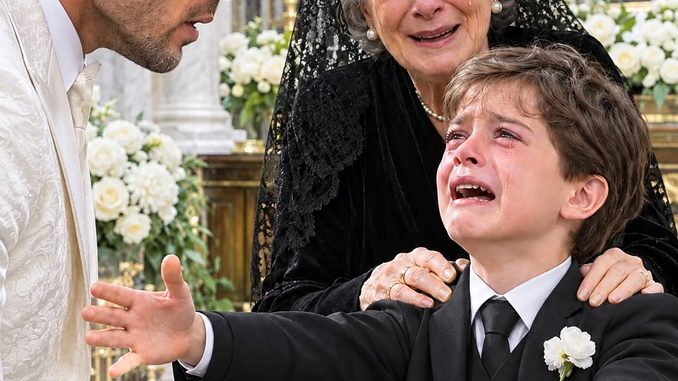
A little boy stood protectively in front of my ex-wife’s coffin, stretching his small arms outward to prevent me from approaching. His oversized black funeral suit and tear-swollen eyes suggested he couldn’t have been older than seven.
What truly unsettled me, however, was his extraordinary resemblance to me. From his thick eyebrows and straight nose to the tiny mole beneath his left eye, he looked almost exactly as I had at his age.
My name is Adrián Serrano, a thirty-eight-year-old businessman who owns a successful real estate company in Madrid. Earlier that morning, an old friend had informed me that my ex-wife, Valentina, had passed away following a serious illness.
Despite having spent seven years apart, I drove to Valencia carrying a wreath of white flowers, intending to quietly pay my final respects. I never imagined that attending her funeral would force me to question everything I believed about our divorce.
“What’s your name, little one?”
“You don’t deserve to know!”
“Where is your father?”
“Mom told me my father died a long time ago.”
His answer immediately brought back painful memories of my marriage. Seven years earlier, after three years together, I had divorced Valentina because I believed she had been unfaithful.
Someone had shown me a photograph of her leaving a hotel with another man, and my mother, Rosa, insisted it was undeniable evidence of betrayal. Trusting her judgment completely, I confronted Valentina without allowing her to properly explain the circumstances.
“You betrayed me. Sign the divorce papers, take whatever money you want, and disappear from my life.”
“Adrián, do you genuinely believe I would betray you?”
“You no longer deserve my trust.”
Valentina eventually signed the documents, refused my financial assistance, and walked away. Throughout the following seven years, I never made a single attempt to contact her.
As I stood before her coffin, an elderly woman approached and immediately pulled the boy closer. I recognized her as Doña Carmen, Valentina’s mother, whose expression hardened the moment she saw me.
“How dare you show your face here after everything my daughter suffered?”
“Carmen, please tell me. Is this child my son? Why didn’t Valentina ever contact me?”
“You think she never tried? Perhaps you should ask your own mother.”
At that exact moment, Rosa called my phone. When I explained where I was and asked whether Valentina had been pregnant during our divorce, her voice became unusually defensive.
“Absolutely not! Leave immediately, Adrián. Don’t believe anything those people tell you!”
Carmen took the phone from my hand and confronted Rosa directly.
“After seven years, are you still going to deny what you did?”
My mother immediately disconnected the call. Carmen then retrieved an old envelope bearing my name in Valentina’s familiar handwriting, explaining that her daughter had instructed her to deliver it only after her death.
Before I could open it, a black vehicle stopped outside, and Rosa hurried into the funeral home. Her face turned pale when she noticed the envelope.
“Adrián, don’t open that! Carmen, name your price. I’ll give you money or property, anything you want. Just destroy that letter!”
“Not everything in this world can be purchased, Rosa.”
Ignoring my mother’s desperate objections, I opened the envelope and discovered a handwritten letter, an old hospital record, and the photograph that had destroyed my marriage. When I turned the photograph over, I found a name Valentina had written on the back.
It belonged to Marco Delgado, my closest friend, business partner, and the man who had stood beside me at my wedding. Suddenly, the betrayal I had believed in for seven years began to take on an entirely different meaning.
Part 2: The Letter That Revealed Seven Years of Deception
I stared at Marco Delgado’s name, struggling to understand how my closest friend had become involved in the misunderstanding that destroyed my marriage. My mother stepped toward me, desperately attempting to convince me that Valentina’s family was manipulating the situation.
“Adrián, please don’t believe them. They’re trying to turn you against me!”
“If that’s true, Rosa, why are you so terrified of him reading that letter?” Carmen demanded.
My mother remained silent as I examined the photograph more carefully. For the first time in seven years, I noticed that Valentina was leaning heavily against Marco, her face visibly pale and one hand resting against her stomach.
She didn’t resemble someone leaving a romantic encounter. Instead, she appeared to be experiencing considerable physical discomfort, while Marco seemed to be supporting her.
I unfolded the hospital record, which was dated the same evening the photograph had been taken. According to the document, Valentina had received emergency medical attention for complications associated with an early pregnancy, and Marco had accompanied her to the hospital.
“Did you know about this, Mom?”
Rosa lowered her eyes, giving me the answer she refused to express aloud. Carmen immediately instructed her to leave, and my mother quietly collected her handbag before walking out of the funeral home.
With trembling hands, I unfolded Valentina’s final letter. She explained that shortly after our divorce, she had discovered she was expecting my child and immediately attempted to contact me.
However, when she arrived at my house, Rosa refused to let her inside. My mother threatened that if I learned about the pregnancy, our family’s attorneys would secure custody of the baby and leave Valentina with nothing.
Frightened by our family’s wealth and influence, Valentina left Valencia and began rebuilding her life. She continued working throughout her pregnancy and after our son was born, giving him her surname because she wanted him to grow up without fearing that someone might take him away.
When he became old enough to ask about his father, she told him that I was gone. She admitted that she hadn’t known how to explain such a painful situation to a young child.
Her final request was not for money, revenge, or an apology. She simply wanted me to respect our son’s feelings if I ever discovered his existence.
“Please don’t force yourself into his life, Adrián. If you want to know him, earn his trust. Don’t use your money, gifts, or lawyers to demand his affection. Let him decide when he’s ready.”
She reminded me that our child owed neither of us anything. As his parents, we were responsible for providing him with a childhood filled with security and love.
I read the letter three times before realizing that nearly everyone had departed. Carmen remained beside the sleeping boy, watching me quietly.
“His name is Mateo,” she finally explained. “Mateo Ríos.”
Learning my son’s name on the day of his mother’s funeral was almost unbearable. When I asked whether I could speak to him, Carmen gently refused.
“Today belongs to his mother. If you respect Valentina’s wishes, there will be other opportunities.”
I accepted her decision and approached the coffin one final time. Looking at Valentina’s photograph, I whispered the apology I should have offered seven years earlier, knowing that no amount of regret could bring her back.
Part 3: The Woman Who Destroyed My Marriage
The following morning, I summoned Marco to my office without explaining why. He entered with his usual friendly smile, but his expression immediately changed when he noticed the photograph lying on my desk.
“I’ve been afraid of having this conversation for seven years, Adrián.”
“Then stop hiding the truth. Tell me exactly what happened that night.”
Marco explained that Valentina had received a message apparently sent from my phone, asking her to meet me at a hotel to discuss an urgent family matter. He had received a similar message directing him to the same location.
When Marco arrived, he found Valentina in the lobby, frightened, pale, and experiencing severe discomfort. He immediately helped her into his car and drove her to the nearest hospital, where she received medical treatment.
Afterward, Valentina insisted on returning to the hotel to retrieve her belongings. Someone photographed them as they left the building, creating the misleading image that eventually ended our marriage.
“Why didn’t you explain any of this to me?”
“Your mother threatened me. She said that if I interfered, she would make Valentina’s life unbearable. I thought remaining silent would protect her.”
Marco opened his briefcase and retrieved an old mobile phone containing the original messages. Although he had remained silent for years, he had never been able to bring himself to delete the evidence.
With assistance from Valentina’s former attorney, Isabel Ferrer, we began investigating the circumstances surrounding the photograph. Hotel records confirmed that neither Valentina nor Marco had reserved a room, while the preserved messages established that both had been deliberately summoned there.
Eventually, we uncovered the photographer’s original receipt, bearing Rosa Serrano’s unmistakable signature. My mother had orchestrated the entire situation because she disapproved of my marriage.
Marco signed a formal statement documenting everything, including the threats he had received. I thanked him for helping Valentina obtain medical treatment but made it clear that his silence had allowed a devastating deception to continue.
Nevertheless, I recognized that I carried considerable responsibility myself. Nobody had forced me to dismiss my wife’s explanation or abandon her without investigating the truth.
One week after the funeral, Isabel showed me the documents Valentina had prepared concerning Mateo’s future. Carmen was designated as his guardian, and any relationship between Mateo and me was to develop gradually, with initial visits taking place at her home.
“The child sets the pace. Nobody else.”
I signed a written commitment respecting Valentina’s wishes while Isabel handled the necessary legal procedures. That evening, I invited my mother to my house and placed the hospital record, preserved messages, Marco’s statement, and photographer’s receipt before her.
“I only wanted what was best for you,” Rosa insisted.
“You destroyed my marriage because you thought Valentina wasn’t good enough for our family.”
“She wasn’t suitable for you!”
“She was my wife, Mom, and she was carrying my child.”
After years of deception, Rosa finally admitted that she had deliberately concealed the truth. I informed her that she would no longer hold a position on my company’s board and would have no involvement with Mateo without his guardian’s approval and the appropriate legal authorization.
“Adrián, I’m your mother!”
“And Mateo is my son. Valentina spent years protecting her child, while you spent those same years controlling yours.”
Rosa left without answering. For the first time in my life, I understood that loving my family didn’t require unquestioning obedience to someone whose decisions had caused so much suffering.
Part 4: Learning How to Become His Father
My first scheduled visit with Mateo took place at eleven on a Saturday morning. I arrived at Carmen’s apartment in Valencia without expensive presents or anything that might make him feel obligated to welcome me.
“You have one hour,” Carmen explained. “He’s in the living room.”
Mateo was sitting on the floor surrounded by colored pencils, barely acknowledging my presence when I greeted him. After receiving permission to sit nearby, I settled onto the sofa, leaving enough space for him to feel comfortable.
For several minutes, neither of us spoke. Eventually, I noticed that he was drawing a small house with a garden and a woman standing in the doorway.
“That’s Mom,” he explained quietly.
“She was beautiful.”
Mateo nodded before returning his attention to the picture. When my hour ended, I thanked Carmen and departed without requesting additional time, attempting to embrace him, or expecting him to call me his father.
I returned the following Saturday and continued visiting every week. Some afternoons passed almost entirely in silence, while others involved drawing pictures, playing games, or listening to Mateo enthusiastically describe his favorite trading cards.
One afternoon, he challenged me to a football match in a nearby park, assigning me the position of goalkeeper. When I deliberately exaggerated a fall while attempting to block one of his shots, he burst into laughter.
It was the first time I had heard my son laugh. That simple moment brought me greater happiness than any professional accomplishment I could remember.
Gradually, Carmen became more comfortable with my presence. She initially offered me water during my visits, eventually began preparing coffee, and finally invited me to remain for lunch.
“Don’t misunderstand, Adrián. This doesn’t mean everything has been forgiven. It’s just lunch.”
“I understand, Carmen. And I’m grateful.”
Over the following months, I discovered that Mateo loved football, enjoyed drawing houses, disliked carrots, and was always interested in hearing stories about his mother. Whenever he asked about Valentina, I described her kindness, determination, and remarkable ability to make people laugh during difficult times.
I never criticized her or attempted to present myself as the innocent victim of our failed marriage. I wanted Mateo to remember his mother with affection rather than become burdened by conflicts that belonged to the adults around him.
One Saturday, while we were constructing a tower from wooden blocks, Mateo suddenly asked the question I had been anticipating for months.
“Why didn’t you come when Mom was still alive?”
I stopped arranging the blocks, knowing that offering excuses would only repeat the mistakes I had made seven years earlier.
“Because I made a terrible mistake. I believed something about your mother that wasn’t true, and I refused to listen when she tried to explain.”
Mateo remained quiet as I continued.
“None of that was your fault, Mateo. And it wasn’t your mother’s fault either.”
He examined the unfinished tower thoughtfully before responding.
“Grandma says big mistakes take a long time to fix.”
“She’s absolutely right.”
“Are you fixing yours?”
“I’m trying, Mateo. Every single day.”
He considered my answer for several moments before selecting another wooden block and placing it in my hand.
“Help me finish the tower.”
I struggled to hold back my tears as I accepted the block. Mateo hadn’t forgiven me or started calling me Dad, but he had offered something equally meaningful at that stage of our relationship.
For the first time, my son had deliberately invited me to remain beside him rather than simply tolerating my presence.
Part 5: The Empty Chair Beside My Son
As the months passed, I began accepting practical responsibility for Mateo’s future. Through the appropriate legal procedures, I established my paternity and arranged financial provisions for his education and long-term welfare.
Working with Isabel, I also addressed the outstanding medical expenses associated with Valentina’s illness. Carmen had never requested financial assistance, but I wanted to fulfill my responsibilities without making either of them feel indebted to me.
Mateo would receive the support he deserved regardless of whether he eventually developed affection for me. I also respected the surname Valentina had chosen for him, knowing that Mateo Ríos was an important part of his identity.
That summer, Carmen invited me to accompany them to the cemetery on Valentina’s birthday. Mateo carried a bouquet of flowers while I followed several steps behind, allowing him to approach his mother’s grave privately.
After carefully arranging the flowers beside her photograph, he spoke softly.
“Mom, the Saturday man came too.”
I remained motionless, deeply affected by the unexpected description. Although Mateo wasn’t ready to call me his father, he no longer considered me an unwelcome stranger.
I had become someone who consistently appeared every Saturday. That modest distinction meant more to me than the wealth, influence, and professional recognition I had accumulated throughout my career.
Later, Carmen revealed that Valentina had never spoken negatively about me to Mateo. Despite everything she had endured, she wanted our son to form his own opinions when he was old enough to understand the circumstances.
“She deserved much better than what I gave her,” I admitted.
“Yes, she did. And Mateo deserves honesty.”
As our visits gradually became longer, I stopped measuring our relationship by what Mateo called me. Instead, I paid attention to whether he appeared comfortable around me, laughed during our games, or trusted me enough to share memories of his mother.
One year after Valentina’s funeral, Mateo celebrated his eighth birthday. Carmen organized a modest gathering in her garden, complete with homemade cake, lemonade, paper decorations, and several of his classmates.
I arrived at the agreed time and waited for Carmen to invite me inside. While Mateo played with his friends, I stood near the garden fence, uncertain where I should sit and determined not to intrude upon his celebration.
Then Mateo approached the table, picked up an empty wooden chair, and dragged it across the patio. He positioned it directly beside his own before looking toward me.
“Sit here, Adrián.”
For several seconds, I couldn’t respond. After months of being known simply as the Saturday man, my son had finally addressed me by my name and voluntarily made room for me beside him.
“Thank you, Mateo.”
“It’s my birthday. You can sit here.”
Carmen watched from the kitchen doorway, offering a faint smile before returning inside. Mateo and I enjoyed cake and lemonade together, then played another football match that ended with my predictable defeat.
Watching him laugh, I thought about Valentina’s final letter and the seven years I had wasted believing a lie. I would never be able to receive her forgiveness or recover the precious childhood moments I had missed.
However, I could still honor her final request by treating our son with patience, compassion, and respect. I could continue earning his trust without demanding that he accept me before he was ready.
The first time Mateo saw me, he stood in front of his mother’s coffin and ordered me to leave. One year later, he placed a chair beside his own and invited me to stay.
That simple wooden chair became the most meaningful gift I had ever received. I finally understood that fatherhood wasn’t about claiming a title or exercising authority, but about consistently showing up until a child could trust that you would never voluntarily disappear from his life again.
Leave a Reply