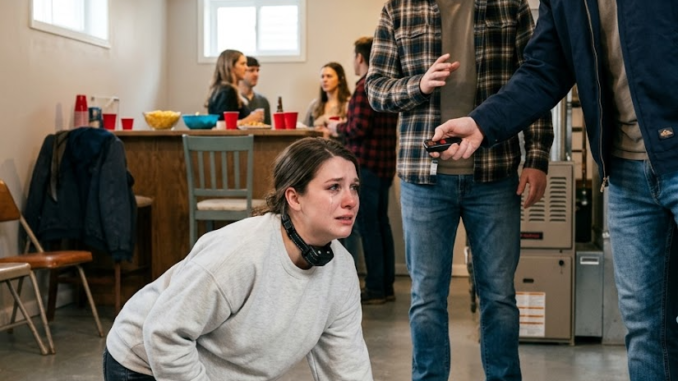
The basement smelled like wet concrete, stale beer, and the hot metallic dust that rose whenever the furnace kicked on.
The music upstairs was loud enough to rattle the cheap paneling, but the sound I remember most was the plastic click of the remote in Michael’s hand.
I was twenty-seven weeks pregnant, on my hands and knees, with an electrified collar locked around my neck.
My maternity jeans were already torn at one knee from the concrete, and every instinct in my body told me to curl around my stomach.
Michael would not allow it.
“Hands down,” he said whenever I reached toward the baby.
He stood behind the basement bar with a paper cup of bourbon, relaxed enough to look bored, while two of his friends watched from the wall and Chris stood near the water heater.
I had known Michael for almost three years.
At first, he was the man who brought coffee to my early shifts, remembered which prenatal crackers settled my stomach, and talked about painting the spare room before the baby arrived.
Control did not enter our relationship wearing a warning label.
It came as concern about where I was going, irritation about who kept calling, and little jokes about how emotional pregnancy had made me.
By the time he started checking my phone, he had already trained me to apologize for making him suspicious.
By the time he locked the basement door, I had already spent months explaining his behavior to myself.
That night ended the explanations.
The collar was not a prank-store toy.
It had a thick black strap, a receiver box at the side, and a small red light that blinked whenever Michael raised the remote.
He had tested it earlier against a metal chair leg, grinning when the chair jumped against the floor.
Then he fastened it around my neck and told his friends I needed to learn respect.
One of the men laughed too quickly.
The other looked toward the basement stairs, but Michael noticed and pushed the remote into his hand.
“Go ahead,” Michael said. “She knows the rules.”
The man pressed the button.
My muscles tightened so sharply that my palm slid on the concrete.
There was no blood, no dramatic movie scream, just a burst of pain and the humiliating knowledge that the room had watched it happen.
Michael laughed.
“Again.”
The second man pressed it.
I remember the furnace humming, ice knocking inside a cup, and my own breath coming too fast.
I also remember Chris not laughing.
He had been Michael’s closest friend since long before I met either of them.
Michael trusted him with the garage code, the spare key, and every ugly confession he made after midnight.
He trusted Chris because Chris had spent years playing the quiet one, the man who listened more than he spoke.
That trust was the reason Chris was in the basement.
It was also the reason Michael never noticed the wire beneath his shirt.
At 9:18 p.m., the recorder hidden on Chris began transmitting to the federal team outside.
The second recorder was already inside me.
I had swallowed the capsule-sized device before Michael brought me downstairs, a reckless act I would never tell another person to copy, because I believed it was the only place he would not search.
It had no flashing light and no visible switch.
Its only purpose was to preserve sound.
The remote clicks.
The names.
The laughter.
Michael’s voice.
When Michael held the remote toward Chris, the whole room seemed to contract around that one object.
“Your turn,” Michael said.
Chris kept his hands at his sides.
“Enough.”
Michael smiled without warmth.
“Don’t get soft now.”
Chris looked at me, then at the collar, then back at Michael.
“I said enough.”
For a moment, nobody understood that the balance had changed.
The man nearest the stairs stared at his phone.
The other shifted his weight and tried to laugh, but the sound died halfway out.
Michael stepped around the bar.
“You think you’re better than me?”
Chris did not answer.
Michael shoved the remote against Chris’s chest.
“Press it.”
Chris took the remote at last, turned it over, and read the serial number printed on the back.
He said every digit clearly.
Michael’s expression tightened.
“You planning to marry it?”
“Just confirming the device,” Chris said.
“Confirming it for who?”
The party upstairs kept moving.
A chair scraped across the kitchen floor.
Someone shouted at the music to turn it up.
Then a door opened, and measured footsteps crossed the room above us.
Michael heard them.
His eyes shifted toward the ceiling.
Chris touched the seam of his shirt, and the black wire showed for less than a second.
That was enough.
Michael moved fast.
He reached for the remote, and Chris let him take it because the agents were already on the stairs.
Michael’s thumb hovered over the button.
The basement door opened.
The lead agent entered with Michael’s full name already in her mouth.
A second agent followed, then a local detective carrying a clear evidence bag and a folded probable-cause affidavit.
Michael looked from the agents to Chris.
“You wired me?”
Chris’s jaw tightened.
“You wired yourself every time you opened your mouth.”
Michael turned toward me.
His thumb began to move.
Chris knocked his wrist sideways.
The remote struck the concrete, bounced beneath a barstool, and stopped beside my left hand.
The second agent reached the collar receiver and shut it down.
I covered my stomach for the first time in what felt like hours.
Michael started talking before anyone asked him a question.
He called it a joke.
He called it consensual.
He said pregnancy had made me unstable and that the collar was not powerful enough to hurt anyone.
The lead agent listened without interrupting.
Then she placed the probable-cause affidavit flat on the basement bar.
The document stated the allegation in one blunt clause: Michael had tortured his pregnant girlfriend with a remote-controlled shock collar while directing witnesses to participate.
The possible sentence was measured in years, not apologies.
Michael stopped talking.
One of his friends whispered, “I only pressed it once.”
The detective turned toward him.
The man’s face crumpled.
“I didn’t know this was real,” he said.
I looked at the collar still locked around my neck.
“It was real to me.”
That was the first full sentence I spoke in the basement.
Nobody answered.
The detective sealed the remote in the evidence bag.
Another officer photographed the collar receiver, the concrete floor, and the serial label Chris had read aloud.
The receiver’s internal memory contained a timestamped activation log.
Each press appeared as a separate entry.
The times matched the audible clicks captured by Chris’s wire and the recorder I had swallowed.
At 9:18 p.m., the first activation registered.
At 9:26 p.m., Michael leaned near my face and said, “Beg like the bitch you are.”
At 9:27 p.m., another activation followed.
The evidence did not depend on anyone suddenly becoming brave.
It existed in sound, timestamps, hardware memory, photographs, and a sworn affidavit.
That mattered because fear makes witnesses unreliable in the eyes of people who have never been afraid.
Objects do not feel shame.
Logs do not worry about being called dramatic.
Recordings do not soften a cruel sentence to keep peace in the family.
Michael was handcuffed beside the basement bar.
He twisted toward Chris and promised to ruin him.
Chris did not respond.
The two friends were separated and questioned.
The one who had whispered about pressing the remote began crying before he reached the stairs.
The other kept insisting he had only watched, as if watching had been a neutral act.
I was taken upstairs wrapped in a blanket.
The party had frozen around the kitchen island.
Paper cups sat where people had abandoned them.
A bowl of chips had spilled across the floor.
Several guests stared at the officers, then at me, then away.
Nobody asked what had happened.
They could see enough.
At the hospital, the collar was removed and packaged as evidence.
The nurses checked the baby first.
That was the only thing I wanted.
When the monitor produced a steady rhythm, I cried so hard that one nurse had to hold the cup of water because my hands would not stop shaking.
Chris waited outside the room.
He did not ask to be thanked.
When I finally agreed to see him, he stood near the door and looked older than he had that morning.
“I should have stopped it sooner,” he said.
“Yes,” I answered.
He lowered his head.
That answer hurt him, but it was true.
Being wired did not erase the minutes he had stood in the room.
Helping the agents did not make every choice clean.
He had protected the investigation, but for several terrible moments, I had not known whether he was protecting me.
“I’m sorry,” he said.
I believed he meant it.
Belief was not forgiveness, and forgiveness was not owed.
The federal team copied the audio into an evidence file before the capsule recorder was recovered.
The first transcript ran thirty-seven pages.
Michael’s defense attorney tried to argue that the recording lacked context.
The prosecutor responded by playing the sequence in order.
The room heard Michael instruct me to crawl.
It heard him order my hand away from my stomach.
It heard the remote click.
It heard the men react.
It heard the sentence he had delivered like a punch line.
“Beg like the bitch you are.”
The words sounded smaller in court than they had in the basement.
That surprised me.
Cruel men depend on rooms built around their power.
Take away the bar, the friends, the music, and the frightened woman on the floor, and sometimes all that remains is a weak voice saying something ugly into a microphone.
The probable-cause affidavit became a criminal complaint.
The criminal complaint became an indictment.
The activation log was admitted with the device serial number, the evidence photographs, and the audio timestamps.
Chris testified about the wire.
The two friends testified about the remote.
One claimed Michael had pressured him.
The other admitted he had pressed the button because everyone else was laughing and he did not want to look afraid.
Neither explanation impressed the jury.
When I testified, Michael watched me with the same hard eyes he had used in the basement.
He wanted the old version of me to return.
The woman who explained him.
The woman who apologized.
The woman who mistook endurance for loyalty.
She did not.
I described the concrete under my palms.
I described the collar against my throat.
I described the moment the baby moved and I decided that silence could be evidence if the recorder was listening.
Michael’s attorney asked why I had not simply left earlier.
The courtroom went still.
I looked at the attorney, then at the jury.
“Because leaving a controlling man is not one decision,” I said. “It is a hundred small exits, and he was guarding every door.”
The prosecutor did not ask another question.
The verdict came after less than a day of deliberation.
Guilty.
Michael showed no reaction until the clerk repeated the finding on the most serious count.
Then his shoulders dropped.
Not much.
Just enough for me to see that he finally understood the future no longer belonged to him.
At sentencing, the judge referred to the collar as an instrument of domination, not a joke.
The judge also spoke about the pregnancy, the forced posture, the witnesses, and Michael’s attempt to press the remote after agents entered.
The sentence sent him to prison for years.
I expected relief to feel clean.
It did not.
Relief arrived mixed with nausea, grief, anger, and the strange emptiness of no longer having to prepare for the next threat.
I moved into a small apartment with a secondhand couch and a front window that faced a parking lot.
It was not beautiful, but the door locked from the inside, and nobody else had the code.
The baby was born healthy.
I will not turn that fact into a miracle designed to make the rest easier to accept.
Health did not erase the basement.
It gave me a future that Michael had tried to reduce to one night.
Months later, Chris sent a letter through my attorney.
He wrote that he had left Michael’s circle, completed his cooperation, and started counseling.
He did not ask me to answer.
I kept the letter in the same folder as the hospital discharge papers, the court notice, and the final evidence inventory.
Not because I treasured it.
Because I had learned the value of records.
The last item on the inventory was listed in plain black type: REMOTE-CONTROLLED COLLAR, ONE UNIT, DISABLED.
I read that line more than once.
Disabled.
The word felt better than destroyed.
Destroyed things can be remembered as powerful.
Disabled things are simply unable to do what they were built to do.
A year after sentencing, my attorney called with the final strange detail.
Because of Michael’s behavior during transport and repeated threats inside the facility, the prison had assigned him a permanent electronic shock-control device for movement outside his cell.
It was not the same collar.
It was an institutional restraint controlled by officers, and it remained part of his security classification.
When I heard, I did not laugh.
I did not celebrate the idea of pain becoming punishment.
Abuse does not turn into justice merely because the target changes.
Justice was the recording.
Justice was the affidavit.
Justice was the jury hearing his own voice.
Justice was my child sleeping safely in the next room while Michael no longer possessed a key, a code, or a remote that controlled my body.
Still, the symmetry was impossible to ignore.
The man who had made a game out of a button now lived under a device he could not remove.
Cruelty becomes a game the moment a room agrees to call the victim the entertainment.
The basement had agreed.
The courtroom did not.
Neither did I.
For a long time, I thought survival meant enduring whatever happened next.
Now I understand it differently.
Survival was the moment I stopped explaining him.
It was the black wire beneath Chris’s collar.
It was the serial number read aloud.
It was the remote hitting concrete.
It was my hand finally covering my stomach.
And it was the sound of Michael’s grin disappearing before the music stopped.
Leave a Reply