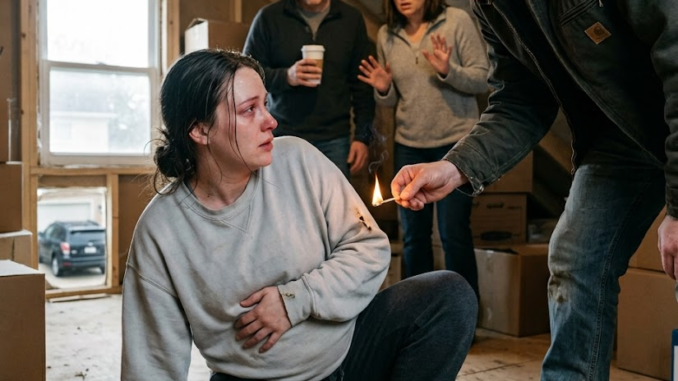
After cutting out my tongue, my husband kept me pregnant and mute in the attic, burning me for entertainment.
I wrote evidence with my toes.
The attic smelled of old wood, hot insulation, and the bitter trace of smoke that clung to the rafters long after he left.
In the summer, the heat sat over me like another locked door.
In the winter, cold moved through the floorboards and into my knees until I could no longer tell where the wood ended and my body began.
Below me, the house kept pretending to be normal.
The refrigerator hummed.
The garage door groaned open at the end of the day.
A family SUV rolled into the driveway.
The mailbox filled with envelopes.
Sometimes I heard grocery bags being set on the kitchen counter.
Sometimes I heard laughter.
That was the worst sound because it meant the world had not stopped.
My world had narrowed to the slant of the roof, the locked attic hatch, a small window, and the child moving inside me.
His world kept going.
He called the attic “the room.”
He said it casually, as though it were a guest room that needed paint or a storage space no one used.
“Stay in the room.”
“I left water in the room.”
“Don’t make noise in the room.”
The words made captivity sound like housekeeping.
He had taken my voice first.
After that, he behaved as if he had taken ownership of every fact that came out of the house.
If I could not speak, then he could explain me.
If I could not argue, then he could decide what I believed.
If I could not call for help, then he could tell himself there was no emergency.
He was wrong about one thing.
Silence is not the same as emptiness.
At first, I survived hour by hour.
I watched the light move across the floor and used it to guess the time.
I counted the sounds from downstairs.
The garage door meant evening.
The shower pipes meant he was getting ready for work.
The refrigerator cycling late at night meant the house was quiet enough for me to shift without being heard.
My pregnancy gave time another rhythm.
Some days the baby moved so sharply that I pressed both hands against my stomach and waited for the motion to settle.
Other days there was only a slow rolling pressure under my ribs.
I learned to breathe through fear without making sound.
I learned how to lower myself to the floor without letting the old boards complain.
I learned which corner stayed dry when rain tapped the roof.
I learned how small a person can make herself and still remain alive.
He brought people upstairs.
Not every day.
Only when he wanted an audience.
They were people who knew him well enough to follow him into a locked attic and not ask the question that mattered.
Why is she here?
Some looked at me and then quickly looked away.
Some laughed because he laughed.
Some seemed uncomfortable, but discomfort is a weak thing when it never becomes action.
Once, a person stood near the hatch holding a paper coffee cup.
Their fingers tightened around it while my husband moved toward me with a flame.
I saw the lid flex.
I saw their mouth open.
For one second, I thought they might say something.
Then my husband smiled.
They smiled too.
That was how it worked.
He made cruelty feel like a private joke, and everyone who wanted to remain welcome in his world agreed to laugh.
The first time he held a flame near my skin, I reacted exactly as he hoped.
I pulled away too quickly.
My shoulder struck the wall.
He laughed at the fear on my face.
After that, he repeated the act, changing the distance, the angle, the words.
The point was not only pain.
The point was control.
He wanted proof that he could still make my body answer even after my mouth no longer could.
Sometimes he pointed to my stomach and asked questions.
“Do you think I’m a good husband?”
“Do you understand why this is necessary?”
“Are you going to behave?”
Then he turned to whoever had followed him upstairs.
“See?” he would say. “She agrees with me.”
The line became part of the performance.
So did the laughter.
My anger came fast in the beginning.
It rose so violently that I could feel it in my teeth.
I imagined lunging at him.
I imagined knocking the flame from his hand.
I imagined using the weight of my body to drive him backward toward the attic stairs.
For one ugly heartbeat, the picture felt almost possible.
Then the baby moved.
That small motion brought the room back into focus.
The stairs were steep.
The hatch opened outward.
He was stronger.
One reckless second could cost more than my life.
I did not forgive him.
I chose timing over rage.
That choice looked like weakness from the outside.
It was not.
One afternoon, after he left, I noticed an old cardboard storage bin had shifted away from the wall.
Behind it was dust, a broken picture frame, and a pencil worn down almost to nothing.
The pencil was too short to hold comfortably.
It was perfect.
I waited until the house went quiet.
Then I placed the pencil on the floor, curled my toes around it, and tried to make a mark on the back of a torn piece of cardboard.
The pencil slipped.
I tried again.
It rolled under my heel.
I tried a third time.
The first mark was only a gray scar across the paper.
It did not look like writing.
It looked like damage.
I kept going.
By morning, I had made one crooked line and half a letter.
The next night, I finished the letter.
Two nights later, I wrote a number.
The first complete thing I wrote was not my name.
It was a time.
2:14 a.m.
That was when the attic hatch had opened.
I added another time beneath it.
2:19 a.m.
That was when he had told me no one would believe me.
Then 2:26 a.m.
That was when the people behind him laughed.
The letters leaned into one another.
Some were too faint.
Some tore through the paper because my toes pressed too hard.
But they were mine.
The next scrap held a date.
The one after that held a quote.
Then a clothing detail.
Dark jacket.
Work boots.
White coffee cup.
Blue shirt at the hatch.
I began numbering the scraps.
One.
Two.
Three.
I pressed them flat beneath my heel and hid them under a loose floorboard near the wall.
Each time I added a page, I repeated the same process.
Date.
Time.
Who came upstairs.
What he said.
What they saw.
What they did.
What they refused to do.
I did not know whether any court, officer, doctor, or neighbor would ever see those pages.
I did not know whether my handwriting would be understood.
I only knew that memory could be attacked.
Paper could wait.
That became my work.
The attic was no longer only a place where things happened to me.
It became a record room.
A pencil stub became a tool.
A floorboard became a file.
My toes became witnesses.
Some nights cramps twisted through my legs before I finished a line.
Some nights the child inside me pressed so hard against one side that I had to stop and breathe.
The pencil left a groove between my toes.
The skin split once from the pressure.
I wrapped the foot in a strip torn from the hem of my sweatshirt, waited until the cut closed, and started again.
I wrote because each page made his version of the world smaller.
He said I agreed.
The pages said I could not answer.
He said no one had been upstairs.
The pages listed what they wore.
He said nothing had happened.
The timestamps showed repetition.
He said I was confused.
The order of the pages proved I was not.
Pattern is what cruelty fears most.
A single moment can be denied.
A pattern begins to speak for itself.
His confidence grew while the stack grew.
That was the strange balance of those weeks.
The more careless he became, the more precise I became.
He stopped looking behind the storage bins.
He left the hatch open while he talked.
He repeated himself.
He assumed I could not use what I heard.
He forgot that a person does not need a voice to remember a sentence.
Once, he stood beneath the bare bulb and told one of his visitors that I had become “easier.”
I wrote the word later.
Easier.
I underlined it twice.
Another time, he said I had “finally learned.”
I wrote that too.
Finally learned.
I left space beneath the phrase and added my own sentence.
He thinks stillness means surrender.
The letters took nearly twenty minutes.
They were the clearest words I had written.
Before all of this, there had been a time when I trusted the ordinary details of our life.
He had warmed the car on a cold morning before an appointment.
He had handed me a paper cup of coffee and reminded me to hold it with both hands because the lid was loose.
He had carried grocery bags from the SUV while I searched for the house keys.
Those memories became harder to hold because they belonged to a version of him that no longer seemed real.
Trust often disappears backward.
You do not only lose faith in the future.
You begin questioning every kindness that came before.
Had he been patient, or had he been studying me?
Had he been protective, or had he been practicing control?
Had the house ever been a home, or had it only been a place with doors he expected to lock one day?
I could not answer those questions.
So I returned to the facts I could prove.
2:14 a.m.
Dark jacket.
Two witnesses.
Flame near left sleeve.
Exact words: “See? She agrees with me.”
Fact by fact, the stack grew thick enough to wrap in cloth.
I divided it into two groups.
The first held obvious pages.
The second held the most detailed record.
I placed the obvious pages under the loose floorboard.
I slid the second group deeper into a narrow space beside the beam.
It was not a perfect plan.
It was only the best plan the attic allowed.
Then came the afternoon when everything changed.
The sun was bright enough to push through the small window and cast a hard rectangle across the floor.
Dust moved inside the light.
The house below was quiet except for voices near the stairs.
My husband opened the hatch.
Two people followed him.
One carried a white paper coffee cup.
The other wore a pale shirt and kept one hand on the ladder as if they already wanted to leave.
My husband looked relaxed.
That frightened me more than anger.
Anger makes mistakes.
Confidence takes its time.
He walked toward me, speaking to them as though I were not a person in the room.
He told them I had become calmer.
He said pregnancy made women “emotional.”
He said I sometimes imagined things.
Then he took out the flame.
The person with the coffee cup shifted.
The lid clicked under their fingers.
My husband lowered the flame toward the sleeve of my sweatshirt.
I twisted away.
A thread caught.
A small orange edge appeared and vanished when I slapped the fabric against the floor.
Thin smoke lifted between us.
They laughed.
The sound rose into the rafters and stayed there.
For a second, the whole room froze.
The coffee cup trembled.
The other visitor stared at a knot in the floorboard.
My husband watched my face, waiting for panic.
I felt panic.
I did not give it to him.
Instead, I looked past his shoulder.
My eyes settled on the loose floorboard.
It was a mistake.
His smile changed.
Not much.
Only enough.
His gaze dropped to my foot.
The pencil was still between my toes.
Then he saw the paper.
A thin corner had pushed out from beneath the board.
The room became quiet.
He moved toward it slowly.
I covered the gap with my heel.
He noticed that too.
“What is that?” he asked.
I kept my face empty.
He crouched.
The match burned lower between his fingers.
He reached around my foot and pulled the first page free.
The writing was crooked because I had made it crooked on purpose.
One false date.
Three broken lines.
A sentence that made me appear confused.
He read it once.
Then again.
His shoulders loosened.
He turned toward the people behind him and laughed.
“I told you,” he said. “She doesn’t even know what day it is.”
The person in the pale shirt gave him the laugh he wanted.
The person with the coffee cup did not.
Their eyes stayed on my foot.
My husband waved the decoy page in front of me.
He wanted the room restored to its old shape.
Him standing.
Me crouched.
The witnesses agreeing.
The story belonging to him.
Then paper shifted beneath the floor.
A dry whisper against wood.
His head snapped down.
My toes had pressed too hard against the second edge.
He shoved the loose board aside.
Beneath it was the cloth-wrapped stack.
Numbered scraps.
Dates.
Times.
Descriptions.
Repeated phrases.
The names I knew.
The details I did not.
The person with the coffee cup leaned forward before they could stop themselves.
The top page described the day they had first come upstairs.
White coffee cup.
Dark pants.
Silver watch.
Stood near hatch.
Looked away when flame appeared.
Their own body became evidence before they said a word.
The cup fell.
Coffee struck the floor and ran between the boards.
They folded back against the wall, one hand over their mouth.
“I didn’t know you were writing it down,” they whispered.
The sentence was not an apology.
It was fear.
My husband did not move.
His eyes passed over the stack.
Then the witness.
Then me.
He was calculating how much existed, who had seen it, and whether control could still be repaired.
“What else did you write?” he asked.
I could not answer.
He grabbed the cloth bundle and flipped through the pages too quickly.
One slipped free.
Then another.
The attic floor filled with his own words.
No one will believe you.
She agrees with me.
She imagined it.
She finally learned.
His voice had been turned into graphite.
The visitor in the pale shirt backed toward the hatch.
My husband looked up sharply.
“Stay where you are.”
They stopped.
That was the moment the room changed.
Not because anyone had rescued me.
No one had.
Not because the evidence had reached safety.
It had not.
The hatch was still open behind him, and he still stood between me and the stairs.
But his audience had stopped laughing.
The person with the coffee cup was crying without making a sound.
The other visitor stared at the scattered pages as if each one had become a door they should have opened sooner.
My husband looked at them and saw witnesses for the first time.
Then he looked at me and saw an author.
“Who else has seen this?” he asked.
I shifted the pencil between my toes.
His eyes followed the movement.
I lowered the graphite point to the bare wood.
The first line came slowly.
Not a name.
Not an accusation.
A message.
I wrote one letter.
Then another.
He leaned closer.
The witness by the wall stopped breathing.
I finished the word.
MORE.
My husband’s face changed.
He did not know whether it meant more pages, more copies, more witnesses, or more plans.
I let him wonder.
For the first time since he locked the attic hatch, uncertainty belonged to him.
I had not been saved.
I had not escaped.
The house below still looked normal from the street.
The mailbox still stood at the end of the driveway.
The SUV still waited outside.
The world had not suddenly become fair.
But the lie that no one could ever know had cracked open on the attic floor.
My evidence existed.
His witnesses had seen it.
And he no longer knew how far my silence had traveled.
That was my chance.
Not rescue.
Not yet.
A chance.
Sometimes survival begins before the door opens.
Sometimes it begins the moment the person holding the key realizes the prisoner has been keeping records.
Leave a Reply