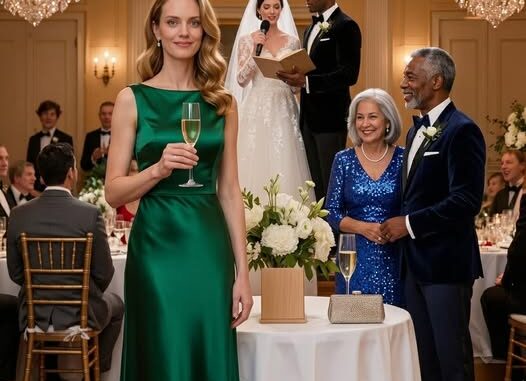
Fifteen Years After My Father Kicked Me Out
“If it wasn’t for pity, no one would have invited you,” my father said, glass of Bordeaux in hand, with two hundred and fifty guests close enough to hear.
At my own sister’s wedding, I had not spoken to my family in fifteen years.
The ballroom at Greenfield Country Club glittered around him as if the room itself had chosen his side. Crystal chandeliers poured warm light over white roses, champagne towers, polished silver, and tables filled with people who had known my last name longer than they had ever known me. Men in custom suits sat beside women in silk dresses and diamond earrings, all of them careful, composed, and suddenly very interested in what the forgotten daughter would do next.
I sat at table 22.
It was the last table in the room, tucked near the kitchen doors, close enough that every time a waiter passed through, a gust of warm air and the smell of plated salmon brushed against my shoulder. My centerpiece was made of silk flowers. My place card did not say Evelyn Ulette.
It said guest of the bride.
My father, Gerald Ulette, stood beside me like a man delivering a verdict.
His wife, Margaret, stood just behind him in a red dress and pearls, one hand resting on his arm in that polished way she had, as if she were calming him while quietly making sure everyone kept watching. Richard Hail, my father’s business partner and Margaret’s older brother, held a scotch glass near his chest. He had spent dinner making small jokes about my career, my watch, my life, and now he looked almost disappointed that I was not giving him a better show.
I lifted my wine glass.
My hand was steady.
Fifteen years earlier, it would not have been. Fifteen years earlier, I would have cried before dessert, grabbed my coat, and driven home through tears, telling myself the whole way that his words did not matter.
But I was not twenty-two anymore.
I looked at my father, took one quiet sip, and smiled.
“Funny thing about pity,” I said softly. “The people who give it usually need it most.”
The silence around our table tightened.
Gerald’s mouth opened, then closed. He had expected tears. He had expected me to defend myself too loudly, to embarrass myself, to hand him proof that he had been right about me all along.
Instead, I gave him calm.
Calm unsettled him more than anger ever could.
Across the ballroom, at the head table, my sister Clare was watching me with her hand locked around her husband’s. She looked like a bride from a magazine: off-the-shoulder white gown, cathedral train, hair pinned in soft waves, tiny diamonds catching light at her ears. But her jaw was set, and her green eyes were bright with something that was not bridal joy.
It was fury.
She had asked me to come.
The invitation had arrived two weeks earlier in a plain envelope with no return address. Clare’s handwriting was still small and careful, slanting left the way it had when we were girls passing notes under bedroom doors.
Please come. I need you there.
That was all it said.
I had held the card for a long time in my apartment near Patrick Space Force Base, tracing the letters with one finger while the Florida rain tapped against the window. I had not seen Clare in person since she was fifteen and crying from the second-floor window while my suitcase sat on our father’s porch.
I was thirty-seven now.
I was a major general in the United States Air Force.
But that invitation made me feel twenty-two again.
The morning of the wedding, I drove three hours through Connecticut with the windows cracked. October smelled like wood smoke, wet leaves, and old endings. The invitation sat on the passenger seat beside a gas station coffee, and every few miles I told myself I could still turn around.
Near Fairfield, I pulled onto the shoulder and looked at myself in the rearview mirror.
“You have landed helicopters in storms,” I said out loud. “You can walk into a wedding.”
The GPS said seven minutes to Greenfield Country Club.
The building appeared behind stone pillars and manicured hedges, all ivy, marble, and old money trying very hard not to look new. A valet in a black vest waved me toward the front circle, but I shook my head and parked in the overflow lot between a caterer’s van and a gardener’s truck.
I did not come to prove anything.
I came because my sister asked.
Inside the lobby, a welcome board stood on a gilded easel. The Ulette family, established 1988.
Every member of my family was on it. My father. Margaret. Clare. Cousins. People I barely recognized.
Everyone except me.
The year they had chosen, 1988, was the year I was born.
Somehow, I had still been edited out.
That was the Ulette family talent. They did not just reject you. They revised the room until it looked like you had never belonged there in the first place.
My father had started that revision fifteen years earlier.
I was twenty-two then, fresh out of college, sitting at the breakfast bar in our Westport house with an acceptance letter from Air Force officer training school in my hand. Gerald Ulette had built Ulette Insurance Group from a one-desk office in Bridgeport into a respected regional company. He believed that made his dreams automatically mine.
“I built this company so my daughters would never struggle,” he said. “And you want to fly helicopters?”
“I want to save people,” I told him.
He took it personally. Gerald took everything personally.
My mother had died when I was sixteen, after three years of treatments, hospital rooms, and quiet afternoons where she tried to make leaving feel less terrifying. On one of her last clear days, she held my hand and said, “Promise me you won’t live small, Evelyn.”
I promised.
Three weeks later, she was gone.
Two years after that, my father married Margaret.
Margaret never shouted. She did not need to. She was skilled in softer things: small suggestions, rewritten stories, smiles that arrived a second too late. That morning, while I sat with the acceptance letter in my hand, she stood in the living room and said loudly enough for me to hear, “Let her go. She’ll come crawling back.”
I did not crawl back.
By sunset, my suitcase was on the porch.
My father did not throw it. He placed it there carefully, like punctuation.
“You made your choice,” he said.
Three words.
Fifteen years later, they still sounded louder in my memory than anything I had ever heard through a headset.
He changed the locks that afternoon. By the end of the week, I was off the family health insurance. Within a month, every photograph of me in that house had disappeared. I know because Clare told me years later in whispering phone calls Margaret did not know about.
I left with one suitcase, $1,100 in savings, and the clothes on my back.
From my old bedroom window, Clare watched me go. She had braces then. Her face was wet with tears. She was still a child, and there was nothing either of us could do.
So when she ran to me at the wedding reception fifteen years later, I almost did not recognize the sound of my own name in her voice.
“Evelyn.”
She moved too fast for a bride, her train gathered in one hand, her heels clicking sharply against the marble. Then she was in my arms, jasmine perfume and hairspray and the same little sister who used to climb into my bed during thunderstorms.
“You came,” she whispered. “Oh God, you came.”
I held her carefully, afraid of crushing lace and beadwork and the strange fragile bridge between us.
“Of course I came.”
She pulled back and looked over her shoulder. “Dad doesn’t know I sent the invitation.”
“Clare.”
“Listen to me.” She gripped both my hands. “I have something planned tonight. No matter what Dad says, please stay.”
“What are you talking about?”
Her eyes filled, but her voice stayed firm. “You’re the reason I’m standing here today. And tonight, everyone will know.”
Before I could ask what she meant, her maid of honor called her for photos. Clare squeezed my hand once more and turned away. As she did, I saw the inside of her wedding band.
One word was engraved there.
Phoenix.
It meant nothing to me then.
By midnight, it would mean everything.
Gerald found me seventeen minutes into cocktail hour. I had been counting.
He crossed the room with the stride of a man who believed ownership was mostly posture. He wore a custom brown suit, his silver hair swept back, his watch flashing under the chandeliers. He did not say hello. He did not say it had been a long time.
“I didn’t realize Clare’s guest list included charity cases.”
I set my wine glass down on the nearest high-top table.
“Hello, Dad. You look well.”
“You have some nerve showing up here.”
His voice was low, but his eyes scanned the room to make sure we had an audience.
“I’m here for Clare,” I said. “Not for you.”
His jaw tightened. He had always hated being dismissed.
Then Margaret appeared, as if summoned by the scent of control slipping.
“Oh, Evelyn,” she said, hand pressed lightly to her chest. “How unexpected. I told Gerald someone from the charity list must have gotten mixed up with the invitations.”
I let the insult land without flinching.
Years of training teach you that when turbulence hits, you do not jerk the controls. You hold steady and ride through.
Gerald leaned closer.
“Clare has a trust fund, an apartment, her car, half this wedding. All of it runs through me. You want to test how far that goes?”
There it was.
Money as leash. Love as currency. Control disguised as generosity.
“Fifteen years,” he said, straightening his cuff. “And you still can’t read a room. Some people simply don’t belong.”
He walked away.
Margaret followed him, her heels clicking like punctuation.
She was not finished.
Twenty minutes later, she steered me toward a cluster of guests near the terrace doors and introduced me like an unfortunate family rumor.
“Everyone, this is Gerald’s older daughter. She left the family years ago to… what is it you do again, dear? Something with planes?”
“I’m in the Air Force.”
“Right.” Margaret tilted her head. “She always had trouble settling down. Some people need structure.”
The group smiled politely and looked anywhere but at me.
Then Richard Hail joined in.
He was the kind of man who measured importance by the size of his boat and the cost of his watch. He looked at the Marathon watch on my wrist, olive drab, built for rescue operations, worth less than the dinner wine.
“Military, huh?” he said. “Good for you. Someone has to do it. I just prefer people who build something instead of following orders.”
Margaret laughed.
The other guests pretended not to hear.
I smiled and said nothing.
Not every battle is worth fighting.
Not yet.
Later, in the hallway between the cocktail lounge and the ballroom, Gerald caught my arm. Not hard. Just firm enough to remind me he still thought he could decide when I stopped walking.
“Let me be clear,” he said. “When this reception ends, you disappear again.”
“Clare is thirty. She makes her own decisions.”
“Clare’s decisions are funded by my money.”
The hallway was quiet, with oil paintings on the walls and brass sconces throwing soft light onto carpet thick enough to swallow footsteps. It was the kind of place designed to make ugly conversations look civilized.
Then he crossed a line.
“Your mother,” he said, “your real mother, would be ashamed of what you’ve become.”
Everything inside me went still.
My mother had spent her last coherent afternoon telling me not to live small. My father had just tried to turn her memory into a weapon.
For one second, the training dropped away, and I was not a general, not a pilot, not a rescue officer.
I was a daughter who missed her mother.
I breathed in for four seconds. Held for four. Breathed out for four.
Combat breathing works in cockpits.
It works in hallways too.
“You don’t get to use Mom’s name to hurt me,” I said. “Not anymore.”
I turned and walked away.
Behind me, his voice followed like a stone thrown at my back.
“You were always the weak one, Evelyn. That’s why you ran.”
Dinner was called at seven.
The ballroom filled with two hundred and fifty guests moving between round tables and white linens, crystal glasses and candlelight, soft music and practiced laughter. I found table 22 with the kitchen door at my back.
My father stood at the head table and tapped his glass with a fork.
The room fell silent.
“Clare has always been my pride,” he began.
His voice carried warmth so practiced it almost sounded real.
“She understood that family means loyalty. She understood that when you are given everything, you do not throw it away chasing some fantasy.”
Several guests glanced toward me.
I raised my glass and kept my face still.
“I raised my daughters to know their worth,” he continued. “And Clare always knew hers.”
Two hundred and fifty people.
My father had just told every one of them that I was the daughter who did not make it.
At the head table, Clare’s hand tightened around David’s. She caught my eyes across the room and gave the smallest nod.
Wait, it said.
I know what he just did.
And it is almost time.
I did not understand, but I stayed.
Dinner was halfway finished when Margaret brought Richard to my table again. Together with Gerald, they formed a neat little tribunal around my chair.
Richard swirled his drink. “What do they pay you anyway? Eighty, ninety a year? I spend that on my boat.”
“The work is rewarding,” I said.
“Rewarding,” Margaret repeated, smiling. “How sweet.”
Gerald pulled a chair beside me and sat close enough that his cologne crowded the air.
“You see all these people?” he said. “Every one of them knows you abandoned your family. Showing up tonight doesn’t change that. It just proves you’re still looking for something you’ll never get.”
I looked at him. “And what’s that?”
“My approval.”
The table went silent.
He was not entirely wrong.
Somewhere inside me, there was still a twenty-two-year-old girl who wanted her father to put a hand on her shoulder and say, I’m proud of you.
But she had waited fifteen years.
She could keep waiting.
I set my glass down and said nothing.
That silence bothered him most of all.
So he stood, pushed back his chair, and let his voice rise.
“If it wasn’t for pity, no one would have invited you.”
Silverware stopped.
A waiter froze three steps from the kitchen door.
A woman at the next table lifted a hand to her mouth.
I lifted my wine glass, took a sip, and smiled.
Then I saw Clare rise.
She leaned toward David, and he nodded. She smoothed her dress, squared her shoulders, and began walking toward the stage.
My father had delivered his closing argument.
He did not know the defense had not started.
Before Clare reached the microphone, I stepped away to the ladies’ room.
The room was nicer than most apartments I had lived in during my twenties. Marble vanity. Brass fixtures. Hand towels folded into fans. A basket of expensive lotion arranged like a still life.
I locked the door and looked at myself in the mirror.
My eyes were red, but dry.
I looked down at my hands. One knuckle still carried a pale scar from a rescue years before, when torn metal had cut through my glove while I pulled a crewman from a damaged aircraft. Those hands had saved strangers. Tonight, they were shaking.
I thought about leaving.
My keys were in my clutch. Thirty steps to the parking lot. Three hours back to Florida in the morning. I could be on I-95 before anyone noticed table 22 was empty.
Then my phone buzzed.
A text from Colonel Diane Webb, my mentor.
Heard you’re at that wedding. Remember who you are, General. We’re proud of you.
I read it twice.
Diane had written the recommendation letters that moved me from cockpit to command. She had called me after hard missions and told me to sleep, because carrying the weight did not mean refusing rest.
She did not know my father.
She knew what mattered.
I looked back at the mirror.
Same eyes. Same scar. Same woman.
“I am not the girl he kicked out,” I whispered. “I am Major General Evelyn Ulette, and I do not leave missions unfinished.”
I washed my face with cold water, straightened my hair, and returned to the ballroom.
Gerald saw me come back. A small satisfied twitch moved at the corner of his mouth. He thought I had gone to cry.
Let him think that.
I sat at table 22, placed my napkin across my lap, and picked up my fork. My posture changed before I realized it. Spine straight. Shoulders level. Chin still.
Not defiant.
Commanding.
At a nearby table, an older man watched me. White hair. Trimmed mustache. Upright posture that did not belong to ordinary guests. Later, I would learn his name was Thomas Brennan, retired colonel, Air Mobility Command.
He leaned toward his wife and murmured, “Watch her, Dorothy. That’s officer bearing.”
When Gerald’s group drifted away, Thomas approached.
“Thomas Brennan,” he said, extending a hand. “Retired colonel. Twenty-eight years.”
“Evelyn Ulette.”
His eyes went to my watch.
“Rescue wing?” he asked.
“You know your watches, Colonel.”
“I know my people.”
We spoke for four minutes. He never asked my rank. That would have been too direct. But halfway through, something in his tone shifted. He stopped calling me Miss Ulette.
He called me ma’am.
A retired colonel does not do that by accident.
When he stood to leave, he shook my hand firmly.
“I don’t know your rank, and you don’t have to tell me,” he said quietly. “But I know enough to say this table does not suit you, ma’am.”
Then the maid of honor speech began.
Rebecca Caldwell, Clare’s college roommate, stood at the small stage with a champagne flute trembling in her hand. She told the usual stories first: burned pancakes, a stray cat, late-night drives, soup after heartbreak.
Then her voice changed.
“Seven years ago, I almost lost Clare.”
The room stilled.
“She drove off Millstone Bridge during a rainstorm. Her car went over the guardrail and into the river. She was trapped underwater. A military rescue helicopter was dispatched. The pilot did not wait for the dive team. She entered the water herself and pulled Clare out.”
My chest tightened.
The room blurred slightly.
Millstone Bridge.
Rain. Black water. Diesel taste. A submerged car. A seat belt jammed. A face in the floodlight.
Clare.
I had not known it was her until I dragged her to the riverbank and saw her in the helicopter light. I had pressed my hands to her chest and counted compressions in the rain while every part of me wanted to break apart.
She coughed after two minutes and fourteen seconds.
The most beautiful sound I had ever heard.
I filed the report and flew the next morning.
That was the job.
You do not use rescues as leverage. You do not trade saved lives for family reconciliation.
You just fly.
Clare was rescue number 112.
The only one I cried for.
David found me during the dessert shuffle.
He slid into the chair beside me and kept his voice low.
“I only have a minute. Clare has been planning this for six months.”
“Planning what?”
He pulled out his phone and opened a document. I recognized the letterhead before I read the words.
Department of the Air Force.
“Two years ago,” David said, “Clare filed a Freedom of Information Act request for the Millstone Bridge rescue report. Most of it was redacted, but the pilot’s name cleared review.”
He turned the screen toward me.
Captain Evelyn Ulette.
My name.
My rank at the time.
Verified.
“When she read it,” David said, “she collapsed. She had spent five years not knowing who pulled her out of that river. It was her own sister.”
I could not speak.
“She tracked everything after that,” he continued. “Every article. Every promotion. She knows your current rank. She knows about the Distinguished Flying Cross. She delayed the wedding six months to match your leave schedule.”
“Why didn’t she call me?”
His expression hardened.
“She tried. Margaret blocked every number she used. Changed the house phone. Intercepted a letter.”
Fifteen years of silence.
And half of it had been manufactured.
“When Clare takes the mic tonight,” David said, standing, “just be ready.”
He squeezed my shoulder once and returned to the head table.
At 9:15, the band stopped playing.
Clare stood on the stage with the microphone in her hand.
“Before we cut the cake,” she said, “I need to do something I should have done years ago.”
Gerald leaned back with the satisfied posture of a man expecting tribute.
Margaret beamed.
Their daughter thanking them in front of two hundred and fifty people. The natural order of things.
“Most brides thank their parents for raising them,” Clare said. “I will thank my father tonight, but not for the reasons he expects.”
Gerald’s smile held, but something near his eyes shifted.
Clare searched the room until she found me at table 22.
“I want to honor someone who made this day possible,” she said. “Someone most of you do not know. Someone my family tried to erase.”
A murmur moved through the ballroom.
Gerald’s jaw tightened.
Margaret’s hand tightened on his arm.
“Daddy, you taught me loyalty,” Clare said. “But you taught my sister something more important. You taught her that some people are worth saving, even when they do not save you back.”
Her voice broke on the last word.
Then she reached behind the podium and lifted a craft paper envelope.
“I need to tell you about the night I almost died.”
The ballroom became so quiet I could hear the kitchen staff stop moving behind me.
“Seven years ago, my car went into the Connecticut River during a storm. I was trapped underwater. I stopped breathing. A military rescue pilot arrived. She entered the water in the dark, pulled me out, and performed CPR on the riverbank until I came back.”
She opened the envelope and pulled out the document.
“I did not know her name for five years.”
She held the paper up so the official seal was visible from the back tables.
“Two years ago, I filed a request and received this report. The pilot’s name was Captain Evelyn Ulette.”
She looked at me.
“My sister.”
The gasp moved through the room like a wave.
Table by table.
Breath by breath.
Gerald stood perfectly still, his mouth open but no sound coming out.
“My father kicked out the woman who saved my life,” Clare said. “And for fifteen years, she never said a word about it.”
She was not finished.
“After that rescue, Evelyn kept serving. She kept flying. She kept saving people.”
She picked up another printed page.
“Major General Evelyn Ulette. Commander, 920th Rescue Wing. Recipient of the Distinguished Flying Cross, the Air Medal, and the Humanitarian Service Medal.”
Her voice grew stronger with each line.
“Two hundred and thirty-seven confirmed rescues.”
The number landed hard.
I heard someone whisper, “Two hundred and thirty-seven?”
Clare turned toward me and lifted her right hand to her forehead.
“To Major General Evelyn Ulette,” she said, “the bravest person I know and the best sister I could ever have.”
Her salute was imperfect.
Her fingers were slightly spread. Her angle was too steep.
It did not matter.
It was the most precise gesture I had ever seen.
I stood slowly.
My chair scraped against the floor, and two hundred and fifty heads turned toward table 22.
Then Thomas Brennan rose.
His salute was crisp, exact, thirty years of muscle memory in one motion.
His wife stood beside him.
Another veteran stood.
Then another.
The applause began as a few hands and spread like a lit fuse until the entire ballroom was on its feet.
I had received medals from generals. I had been saluted by colonels. Nothing had ever meant more than my little sister in her wedding dress saluting me from a stage.
Gerald stood inside the ovation like a man caught in water too deep to stand in.
His face had gone the color of old chalk.
Margaret tried to recover first.
“Gerald always supported Evelyn in his own way,” she said to the nearest guest.
Nobody looked at her.
Nobody cared.
Gerald cleared his throat.
“This is hardly the place,” he said.
The applause drowned him out.
He was not accustomed to being drowned out.
Thomas Brennan walked to my table and took my hand in both of his.
“It’s an honor, General.”
Then he turned to my father.
“Sir, I served twenty-eight years in the United States Air Force. I have met five major generals in my career. Your daughter is the youngest woman I have ever known to hold that kind of command in rescue operations. And you put her at table 22.”
Gerald’s survival instinct kicked in.
When the ground shifts, men like my father deny the earthquake.
“Major General?” he said with a thin laugh. “Please. She was always good at exaggerating.”
David had been waiting for that.
He opened a laptop near the stage and connected it to the projector. The screen behind the cake table filled with light.
An official biography appeared.
My face.
My uniform.
Two stars.
A helicopter behind me.
David read calmly.
“Major General Evelyn R. Ulette, commander, 920th Rescue Wing, Patrick Space Force Base, Florida.”
He scrolled.
“Distinguished Flying Cross citation for extraordinary achievement during a rescue operation. Captain Ulette personally entered a submerged vehicle to extract a civilian survivor under extreme conditions, performing lifesaving resuscitation on scene.”
My father stared at the screen.
His own daughter’s face, twenty feet tall.
The evidence was public record.
The story he had built for fifteen years had just met a document.
Fiction does not survive contact with proof.
Then something happened nobody had planned.
Richard Hail stood near table one, gripping his scotch glass with both hands. His face had flushed during the ovation, then drained of color. Sweat shone along his hairline. He tugged at his collar.
The glass slipped from his hand.
It shattered across the marble.
Richard clutched his chest and went down hard, pulling the tablecloth with him. White roses, plates, and silverware crashed to the floor.
Patricia screamed.
Margaret screamed.
The room erupted.
I was already moving.
Twenty feet vanished beneath me before my conscious mind finished naming what my training had already identified.
Male, sixties. Sudden collapse. No response. Possible cardiac emergency.
I dropped to my knees beside him, tilted his head back, checked his airway, then his pulse.
Nothing.
“Call 911,” I said.
My voice came out in command register.
Not Gerald’s forgotten daughter.
Not the woman at table 22.
A rescue officer.
“Now.”
I positioned my hands at the center of Richard’s chest, locked my elbows, and started compressions.
One. Two. Three. Four.
I counted out loud because counting keeps panic out of the room.
“Is there an AED in this building?”
A staff member sprinted toward the lobby.
Thirty compressions. Two breaths.
Thirty compressions. Two breaths.
The man who had mocked the military less than an hour earlier had no pulse. The only thing between him and not making it through the night was a pair of military-trained hands.
The AED arrived.
I tore open the pads, placed them, and told everyone to clear.
Shock.
Richard’s body jerked.
Still nothing.
I started again.
Thirty compressions.
Two breaths.
The crowd formed a wide circle. The panic drained into helpless silence as people realized they were not watching a scene anymore. They were watching a life hang in the balance.
The monitor showed a shockable rhythm.
“Clear.”
I pressed the button.
A beep returned.
Then another.
Richard coughed, wet and ragged, and his eyelids fluttered.
I rolled him onto his side and kept one hand on his shoulder.
“Stay still, Richard. You’re okay. Help is coming.”
The room was absolutely silent.
Two hundred and fifty people.
No sound except the AED monitor and Richard’s labored breathing.
Paramedics arrived six minutes later. They assessed him quickly and loaded him onto the stretcher. The lead medic looked at me, kneeling on the marble in a cocktail dress, my hands still warm from compressions.
“Whoever started CPR saved this man’s life,” he said. “Textbook response.”
Then he asked, “Are you a medical professional?”
“Advanced cardiac life support certified,” I said. “Air Force rescue training.”
He nodded the way professionals nod at other professionals.
As they lifted Richard, he turned his head. His eyes found mine.
The man who had mocked the uniform was looking at the woman whose training had restarted his heart.
His face crumpled.
“I’m sorry,” he whispered. “For what I said. I’m so sorry.”
“Don’t apologize,” I said. “Just breathe.”
Margaret stood near the stretcher with mascara streaked down her face. She looked at me, and for the first time all evening, the contempt was gone. In its place was something she probably could not name.
Gerald stood five feet away with his arms at his sides.
Fifteen years of narrative gone in six minutes of CPR.
After the paramedics wheeled Richard out, Clare appeared beside me and held out the microphone.
I shook my head.
She pressed it into my hand anyway.
“Please,” she whispered.
I looked at the microphone.
I was not a speaker. I was a pilot. I gave orders over radios and in briefing rooms, not ballrooms.
But Clare’s face told me this was not about speeches.
So I took it.
“I did not come here tonight for recognition,” I said.
My voice was steadier than I expected.
“I came because my sister invited me.”
The room listened.
“I have spent fifteen years serving people I have never met, pulling them from water, from fire, from wreckage. I would have served my family too, if they had let me.”
I found my father in the crowd.
“Dad, I forgive you. Not because you have asked, but because I need to. Carrying resentment does not suit me.”
He blinked.
Said nothing.
“But I want you to understand something. I did not fail. I chose differently. And that choice has saved two hundred and thirty-seven lives, including your daughter’s.”
I set the microphone down.
Then, without it, I said the part meant only for him.
“I do not need your approval to know my worth. But I hope, for Clare’s sake, that one day you learn to measure people by what they give, not what they owe you.”
The applause came again.
Louder this time.
Longer.
Gerald stood in the center of it and did not clap.
What happens when two hundred and fifty people recalibrate at the same time is not always dramatic. Sometimes it is quiet. It is the direction people drift when they decide who they want to stand near.
They drifted toward table 22.
A woman from the country club crowd pressed my hand and said she had no idea. A couple from Gerald’s church told me their son had served in the Marines. A teenager with braces asked if I had really flown through storms, and for the first time that night, I laughed.
Thomas Brennan introduced me to Hamilton Reed, chairman of a veterans charitable foundation in Hartford.
“General,” he said, “we have been looking for an honorary chair for our annual gala. Someone with operational experience and the kind of integrity this room just witnessed. Would you consider it?”
“I would be honored.”
Across the room, Gerald stood in the corner that had once been his stage.
His business associates kept a careful distance.
One man pulled him aside. I could not hear the words, but I saw Gerald’s face. Whatever was said, it was not congratulations.
Margaret sat alone at the head table, staring down at the tablecloth. The story she had helped build—Evelyn the failure, Evelyn the runaway, Evelyn who played at service—had dissolved in half an hour.
Patricia Hail found me near the bar.
Her eyes were red.
“Thank you for saving my husband,” she said, gripping my hand with both of hers. “And I’m sorry. For all of it.”
For the first time all evening, Gerald Ulette was seated at the metaphorical table 22.
Nobody was coming to keep him company.
The reception wound down slowly, then all at once. Guests moved toward the valet stand. The band played one last slow song. Caterers began clearing plates. I stepped onto the terrace, and the October air hit my face like cold water.
Clean. Sharp. Full of fallen leaves and the last trace of cigar smoke.
Connecticut in autumn always feels like an ending and a beginning at the same time.
I heard the terrace door open behind me.
Gerald stepped outside alone.
No Margaret on his arm. No Richard beside him. No audience.
Just a sixty-four-year-old man in a suit that suddenly seemed too large for him.
He stood beside me at the stone railing and looked out over the dark lawn.
Neither of us spoke for a long time.
The fountain gurgled below.
A car door slammed somewhere near the valet stand.
“I was wrong,” he said.
Three words.
It took him twenty seconds of silence to reach them.
He said them the way men like my father say things they have never said before. Quietly. Stiffly. As if each syllable cost him something he had been hoarding for years.
“I know,” I said.
His hands tightened on the railing.
“Your mother,” he said. “Your real mother. She would have been proud.”
His voice broke on proud.
Not theatrically. Just a hairline fracture in the register, the sound of a foundation shifting after too many years of pressure.
“She would have been proud of both of us,” I said, “if we had given her the chance.”
He was quiet again.
“Can we start over?”
I looked at him then.
Really looked.
The silver hair. The lines around his mouth. The expensive watch that suddenly looked like just a watch.
“I’m not sure we can start over,” I said. “But we can start from here, with honesty.”
He nodded.
He did not reach for me.
I did not reach for him.
We were not there yet.
Maybe we never would be.
“I’ll call you,” he said. “If you’ll answer.”
“I’ll answer.”
I paused.
“I do not need you to be the father you were not. I need you to become the father Clare can still have. Maybe someday, the father I can still know.”
He stayed on the terrace.
I walked inside.
The distance between us was smaller than it had been that morning.
Not by much.
But enough.
Clare caught me in the lobby near the coat check. Her cathedral train was bunched over one arm. Her mascara was ruined. Her veil was gone, probably lost somewhere between the toast and the paramedics.
She was grinning like she had won something bigger than a wedding.
“Ev, wait.”
She pulled a canvas tote bag from behind the counter.
“I need to show you something.”
Inside was a scrapbook.
Handmade. Thick paper. Glue-stick edges. Slightly crooked layouts made by someone who loved the work more than the result.
I opened it.
The first page held a local newspaper clipping from seven years earlier.
Unnamed Air Force pilot saves drowning victim at Millstone Bridge.
The pilot’s name had been redacted. Clare had circled the headline in red marker.
I turned the pages.
Printouts from Air Force websites. Screenshots of promotion announcements. A photo from a medal ceremony. A regional news feature about a flood rescue in North Carolina where I had commanded the response team.
Seven years of collecting.
Seven years of watching from a distance.
Seven years of assembling the life I had lived without her.
The last page was my official portrait.
Two stars.
Dress uniform.
A helicopter behind me.
Under it, in Clare’s small left-slanting handwriting, she had written:
My sister. My hero. My Phoenix.
I cried then.
For the first time in the story.
For the first time in front of another person in longer than I could remember.
Not weak tears.
The tears of a woman finally being seen.
Clare held me the way I used to hold her during thunderstorms.
“You saved two hundred and thirty-seven people, E,” she whispered. “But tonight, let someone save you for once.”
I pulled back and looked at her wedding band.
Phoenix.
My call sign.
The name the Air Force had given me because I kept going into places other people were leaving and came back carrying someone.
Clare had engraved it on her ring because without that night at Millstone Bridge, there would be no Clare, no David, no wedding, no this.
“I’ve been watching you,” she said. “Every mission. Every promotion. I was there, even when you didn’t know.”
I drove home with the windows down.
Route 15 was almost empty at midnight, just headlights, guardrails, and reflective signs flashing past like signal flares. The scrapbook sat on the passenger seat beside Clare’s handwritten invitation.
Two pieces of paper.
Two different stories about the same family.
Near Fairfield, I passed the exit for Westport.
The house was only a short distance off the ramp. Five bedrooms. White fence. Flagstone path. The porch where my suitcase had sat fifteen years earlier.
I slowed down.
I could see the roofline through the trees. The porch light was on.
I did not stop.
I used to think home was a place. A house with your name on the mailbox and your photographs on the wall.
It is not.
Home is where they see you.
Really see you.
For the first time in fifteen years, somebody had.
My phone buzzed in the cup holder.
A text from Colonel Webb.
How’d it go?
I typed back with one hand at a red light.
Mission accomplished. All personnel accounted for.
Then I smiled.
A real one.
Not the polite one I had worn during cocktail hour. Not the defiant one I aimed at Gerald over my wine glass. A small private smile nobody needed to see.
My father spent fifteen years telling people I was a failure.
That night, two hundred and fifty people watched me save a man’s life on a dance floor.
The truth does not need a microphone.
It just needs time.
Some people measure success in watches, suits, bank accounts, and rooms that go quiet when they speak.
I measure mine in heartbeats.
Two hundred and thirty-eight now.
That was my number.
And I did not look back
Leave a Reply