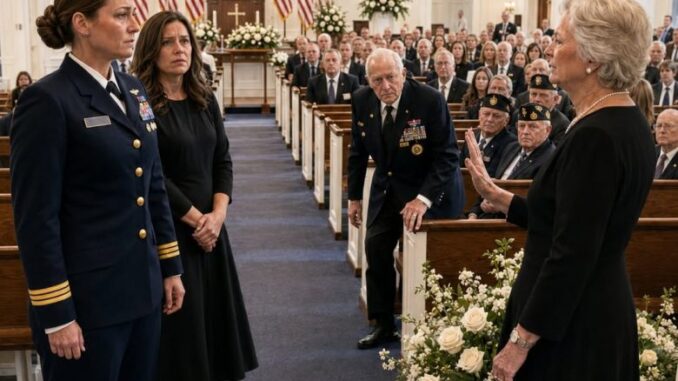
My mother told me I was not allowed to wear my military uniform to my father’s memorial service.
The entire church watched as she tried to stop me at the door.
But seconds later, a decorated veteran sitting in the front row stood, looked directly at her, and revealed the truth my father had prepared for the day I finally came home.
My name is Sarah Mitchell, and for twelve years, my hometown believed I had abandoned my family.
For twelve years, my mother made certain they believed it.
The morning of my father’s memorial, I sat alone in a hotel room outside Cedar Creek, Tennessee, staring at my reflection.
My Navy dress uniform lay carefully across the bed, every crease sharp and every ribbon aligned.
I already knew what would happen if I wore it.
My mother would hate it.
But I knew something else too.
My father had asked me to wear it.
Not in person.
In a letter.
One of the last he ever sent.
Sarah,
When they honor me, wear what you earned. Do not wear it for them. Wear it for me.
I read those words one final time before buttoning my jacket.
Then I drove to the church.
The First Baptist Church of Cedar Creek sat on a familiar hill, its white steeple cutting into the gray November sky.
American flags lined the entrance, snapping in the cold wind.
The parking lot was full.
Veterans.
Church members.
Neighbors.
Friends.
People had traveled from surrounding counties to honor Colonel James Mitchell, retired Army officer, respected community leader, and my father.
To them, he was a hero.
To me, he was simply Dad.
The man who taught me to change a tire before I was old enough to drive alone.
The man who secretly added cinnamon to pancake batter.
The man who mailed handwritten letters even when military rules prevented him from knowing exactly where I was stationed.
And now he was gone.
Worse, I had missed his funeral.
Not because I chose to.
Six weeks earlier, I had been unconscious in a military hospital in Germany after an attack left shrapnel embedded in my side and damaged two ribs.
My hometown did not know that.
My mother never told them.
Instead, she told everyone I had stayed away.
That I had forgotten my family.
That the military had changed me.
As I stepped from my rental car, conversations faded around me.
People noticed the uniform immediately.
A woman near the entrance covered her mouth.
Two older men stopped speaking.
A teenager stared openly at my ribbons until his grandmother touched his shoulder.
I felt every pair of eyes following me.
Still, I kept walking.
Each step felt heavier than the last.
The medal above my left pocket caught the weak morning light.
I had not worn it for attention.
I wore it because my father asked me to.
Inside the church lobby, I saw my younger sister, Emily.
For a moment, neither of us spoke.
“Sarah?” she whispered.
I smiled faintly.
“Hi, Em.”
Her eyes filled.
“You came.”
“I promised I would.”
She glanced at my uniform.
Something moved across her face—pride, confusion, and perhaps shame.
Before she could speak, a familiar voice cut through the lobby.
“No.”
The word echoed like a gunshot.
I turned.
My mother stood near the sanctuary doors.
Elaine Mitchell looked exactly as I remembered her—silver hair styled perfectly, black dress pressed without a wrinkle, pearl earrings, and eyes burning with anger.
The crowd instinctively moved aside.
She walked toward me.
“You are not wearing that in here,” she said.
The lobby became silent.
Dozens of people watched.
I swallowed.
“Mom—”
“No,” she interrupted. “Your father’s memorial is not about you.”
The words struck harder than I expected.
Years of distance.
Years of misunderstandings.
Years of silence.
All of it collapsing into one sentence.
Around us, people exchanged uncomfortable glances.
Many believed her version of my absence.
Many thought I had abandoned my father during his illness.
My hands tightened at my sides.
For a moment, I considered leaving.
It would have been easier.
I could return to the hotel, remove the uniform, and let Cedar Creek preserve the story it preferred.
Then I remembered Dad’s letter.
I lifted my chin.
“I’m here because Dad wanted me here.”
My mother’s expression hardened.
“Then you will attend dressed appropriately.”
“This is appropriate.”
“Not after what you did.”
“What did I do?”
“You disappeared.”
“I was deployed.”
“You always had an excuse.”
“I was injured when he died.”
She looked toward the people surrounding us.
Her voice softened into the sorrowful tone she used whenever she wanted witnesses to see her as the wounded party.
“Your father waited for you, Sarah. He kept believing you would come home. Even at the end.”
My chest tightened.
That was not what Dad’s letters had said.
He knew I had requested leave.
He knew it had been denied twice.
He knew I was trying.
But my mother spoke with such certainty that the people nearby lowered their eyes as if witnessing a private shame.
Emily moved closer.
“Mom, maybe we should go inside.”
Elaine ignored her.
“You do not get to arrive in uniform now and pretend you were the devoted daughter.”
“I am not pretending anything.”
“You want everyone to admire you.”
“I want to honor Dad.”
“Then remove the uniform.”
The sanctuary doors remained open behind her.
Rows of mourners filled the pews.
Veterans sat near the front.
Community leaders stood along the walls.
The tension became unbearable.
Then something unexpected happened.
A man seated in the first row slowly rose.
Every head turned.
The elderly veteran moved into the aisle with the careful pace of a man whose body had aged but whose authority had not.
He adjusted his jacket, revealing rows of military ribbons across his chest.
His gaze settled on my mother.
Then on me.
The room became quiet enough for me to hear my heartbeat.
“My name is Major Robert Hayes,” he said, his voice rough but steady. “Before another word is spoken against that woman, this church deserves the truth.”
My mother’s face tightened.
“Robert, this is not the time.”
He looked at her with something colder than anger.
“No, Elaine. This is exactly the time.”
A murmur moved through the sanctuary.
I stood frozen near the doors, feeling every stare shift from my uniform to my mother and back again.
Major Hayes turned toward the congregation.
“Colonel Mitchell asked me to speak today if Sarah came home wearing that uniform. He knew there was a chance someone would try to shame her for it.”
My throat closed.
My mother whispered, “Stop.”
He did not.
“Sarah Mitchell did not abandon her father. She was deployed. Twice, she tried to return when James became ill. Twice, her leave was denied because her unit was supporting active operations. Six weeks before his funeral, she was seriously injured overseas.”
Gasps moved through the pews.
Emily covered her mouth.
My knees weakened, but I remained standing.
Major Hayes reached inside his jacket and removed a letter sealed in a clear protective sleeve.
“James knew the rumors. He knew people were being told his daughter did not care. He wrote this before he died and gave it to me.”
My mother stared at the letter as though it were a weapon.
Major Hayes unfolded it.
“If my daughter walks into that church in uniform, let her stand proud. She has carried wounds many of you cannot see. She has served with honor. If anyone tells her she is unwelcome, then that person is dishonoring me.”
The silence afterward was absolute.
Emily stepped away from our mother and came to my side.
One by one, veterans in the front rows stood.
An older woman near the center rose next.
Then a former teacher.
Then others.
They did not applaud.
The moment was too solemn for that.
They simply stood.
My mother looked around, suddenly surrounded by the truth she had buried.
But Major Hayes was not finished.
He lowered the letter and looked directly at me.
“Sarah, your father left you something else. Something Elaine begged me never to reveal.”
From his jacket, he removed a small brass key.
My mother’s face went white.
Behind the altar stood a memorial display containing Dad’s dress uniform, medals, folded flag, photographs, and the polished wooden case that had held his ceremonial sword.
A soft electronic beep sounded from the base of the display.
Major Hayes had pressed the brass key against a hidden sensor.
A narrow panel beneath the display released.
The entire congregation watched as he opened it.
Inside was a cedar campaign box.
I recognized it immediately.
Dad carried that box through three assignments when Emily and I were children. It held maps, letters, photographs, and the small personal items he refused to place in checked luggage.
I had not seen it in years.
Major Hayes carried the box to the lectern.
My mother moved toward him.
“You have no right.”
He turned.
“James gave me the right in writing.”
“Those were private family matters.”
“You made them public every time you told someone Sarah had abandoned him.”
My mother looked toward Pastor Collins.
“Are you going to allow this?”
The pastor appeared shaken.
“Elaine, Colonel Mitchell personally instructed us to include the display.”
“He did not instruct you to open that box.”
“No,” Major Hayes said. “He instructed me.”
He inserted the key into the old brass lock.
The lid opened.
Inside lay several bundles of letters tied with faded green ribbon.
A small digital recorder.
A sealed envelope bearing my name.
Another marked Emily.
A thick folder labeled MITCHELL SERVICE FOUNDATION.
And beneath them, dozens of unopened envelopes.
All addressed to my father.
All in my handwriting.
My breath stopped.
I knew those envelopes.
I had sent them over the years.
Letters from training.
Letters from ships.
Letters written after midnight in windowless rooms where I could not discuss locations or assignments.
Some had been returned to me.
Many had simply disappeared.
I assumed Dad received them and could not answer.
Now they lay unopened inside his campaign box.
Major Hayes lifted the first bundle.
“James found these hidden in a locked cabinet six months before he died.”
Every face turned toward my mother.
She shook her head.
“No.”
Major Hayes continued.
“They were letters from Sarah. Some were written more than ten years ago. Elaine had intercepted them before James could read them.”
“That is a lie.”
“Your handwriting appears on the notes attached to several envelopes.”
He held up a small yellow slip.
The congregation could not read it, but I could see the dark ink.
Do not give this to James. It upsets him.
Another note read:
Return to sender if possible.
My mother’s face changed.
For the first time, the certainty disappeared.
Emily looked at her.
“You hid Sarah’s letters?”
“I protected your father.”
“From what?”
“Disappointment.”
My voice came out quietly.
“You told him I stopped writing.”
She looked toward me.
“You did stop.”
“No. You stopped delivering them.”
“You chose the Navy.”
“I chose to serve.”
“You chose it over us.”
“I was nineteen.”
“And your father encouraged you.”
The bitterness in her voice revealed something I had never fully understood.
My mother had not only resented my absence.
She had resented Dad for being proud of it.
He had helped me complete my application to the Naval Academy.
When I doubted myself, he told me fear did not mean stop.
My mother saw every step I took away from Cedar Creek as a rejection of her.
Major Hayes removed a second bundle.
“These are copies of emails and leave requests James obtained through Sarah’s casualty liaison after she was injured. They show she requested emergency leave when his illness worsened.”
He opened one page.
“Denied due to operational requirements.”
Another.
“Deferred due to mission status.”
A third.
“Travel medically prohibited following injury.”
He looked toward the congregation.
“Sarah did not choose to miss her father’s funeral. She was unconscious for part of the week and under surgical care afterward.”
My sister made a broken sound beside me.
“Mom told me Sarah declined the military transport,” she whispered.
I turned toward her.
“What?”
Emily’s face crumpled.
“She said they offered to bring you home and you said your work mattered more.”
“That never happened.”
“I know that now.”
My mother stepped backward.
People who had greeted her with sympathy minutes earlier were no longer looking at me with judgment.
They were looking at her with questions.
A woman near the aisle spoke.
“Elaine, you told the prayer group Sarah had not called in nearly a year.”
“She had not.”
“I called every Sunday I was permitted,” I said.
Emily looked at me.
“We never received those calls.”
My mother’s jaw tightened.
“Our family could not live around military schedules.”
“No,” I said. “You refused to.”
Pastor Collins moved toward the lectern.
“Major, perhaps the rest should be handled privately.”
My mother looked relieved.
Then Major Hayes removed the digital recorder.
“James anticipated that.”
He pressed a button.
Static filled the church speakers.
Then my father’s voice entered the room.
Older.
Weaker.
But unmistakable.
“If Robert is playing this, then Sarah came home.”
My knees nearly gave way.
Emily gripped my arm.
Dad continued.
“Sarah, I am sorry I did not understand sooner what was happening. For years, I believed distance was simply the cost of your service. I knew you loved us. I never doubted that completely, even when others asked me to.”
A pause followed.
I could hear his breathing.
“Six months ago, I found your letters in a cabinet Elaine kept locked. I read every one. Some were ten years old. You wrote about training, loneliness, fear, and the people you could not save. You wrote that you missed my pancakes. You asked whether the maple tree survived the storm.”
A faint laugh entered his voice.
“It did.”
Tears blurred the altar.
“I confronted your mother. She said she was protecting me from being disappointed. The truth is that she was punishing both of us because you chose a life she could not control.”
My mother shook her head repeatedly.
“No. James never said that.”
His recorded voice continued.
“Elaine, if you are hearing this, do not call my words confusion. Robert recorded this with my physician and attorney present. I knew exactly what I was saying.”
A murmur moved through the room.
Major Hayes placed a hand on the cedar box.
Dad spoke again.
“I did not tell Sarah what I discovered because she was deployed, and I did not want anger to interfere with her safety. That may have been another mistake. I thought I had more time.”
His voice weakened.
“I wrote to her through Robert. We exchanged six letters before my final hospitalization.”
Major Hayes lifted the green-ribbon bundle.
Those were the letters I had received.
Dad had written that he understood.
That he was proud.
That my mother’s anger was not mine to carry.
He never mentioned the hidden letters.
He wanted our final words to contain love rather than accusation.
“Sarah,” his recording continued, “you did not abandon me. You became exactly the person I hoped you would become. Your mother may never forgive you for leaving Cedar Creek. That does not mean you did something wrong.”
I covered my mouth.
The church disappeared around me.
For one moment, I was back at sixteen, standing beside Dad’s truck while he taught me how to change a tire.
Then at nineteen, holding an appointment letter while Mom cried in the kitchen.
Then at twenty-seven, reading one of his notes beneath the red light in a ship’s compartment.
Then in the hospital, waking to the news that he had died three days earlier.
His voice returned me to the sanctuary.
“I have established the Colonel James Mitchell Service Foundation using the proceeds from the land my brother and I inherited. It will support young people from rural Tennessee entering military service, nursing, emergency response, and public service.”
Major Hayes lifted the thick folder.
“I have appointed Sarah chair of the foundation.”
My mother stepped forward.
“No.”
Dad’s recording continued as though answering her.
“Elaine believed the foundation should be managed through the church committee. I disagreed. Sarah understands service without applause. She understands what duty costs. Emily will serve as a trustee if she chooses. Robert Hayes and Pastor Collins will complete the initial board.”
Pastor Collins lowered his eyes.
My mother stared at him.
“You knew?”
“I knew Colonel Mitchell created the foundation,” he said. “I did not know every reason.”
“You let me plan this memorial while hiding that from me?”
“He instructed us to announce it today.”
Dad’s voice entered the room one final time.
“My daughters, do not let my death become another weapon between you. Tell the truth. Protect each other when you can. Walk away when you must.”
A long pause followed.
“Sarah, wear the uniform.”
Then the recording ended.
No one moved.
The small red light on the recorder went dark.
I stood near the church doors in the uniform my mother had ordered me to remove.
My father’s voice still seemed to remain in the rafters.
Major Hayes closed the cedar box.
Then he turned toward me and saluted.
The veterans in the front rows followed.
One by one, hands rose.
Army.
Navy.
Air Force.
Marine Corps.
Men and women from different generations.
I returned the salute.
My vision blurred so badly that I could barely see them.
When the veterans lowered their hands, Emily stepped in front of me and wrapped both arms around my body.
I flinched when she touched my healing side.
She pulled back immediately.
“You’re hurt.”
“I’m recovering.”
“Why didn’t you tell me?”
“I tried to call.”
Her eyes moved toward our mother.
Understanding spread across her face.
“She changed her number last year,” Emily whispered. “She said you already had it.”
“I didn’t.”
Our mother looked suddenly smaller.
Not remorseful.
Cornered.
“Emily, I was trying to hold this family together.”
“You separated us.”
“No. Sarah left.”
“I served,” I said.
“You left me.”
The words came from a place older than the church, the uniform, or Dad’s illness.
They came from the kitchen the day I received my academy appointment.
Mom had held the letter with both hands and asked why I wanted to escape her.
I told her it was not about escape.
She never believed me.
“You were my mother,” I said. “I was not supposed to remain small so you would feel safe.”
Her face tightened.
“I sacrificed everything for this family.”
“And Dad sacrificed too.”
“He understood duty.”
“So do I.”
“You think wearing medals makes you like him?”
“No.”
I looked toward the campaign box.
“Loving him made me like him.”
For the first time, she had no answer.
Pastor Collins asked everyone to take their seats.
My mother stood near the sanctuary doors, uncertain where to go.
Her reserved seat remained in the first row beside Emily’s.
Emily looked at it.
Then she took my hand.
“You sit with me.”
Mom stared at her.
“Emily.”
“I need space.”
“You are choosing her?”
“No,” Emily replied. “I am choosing the truth.”
A low murmur moved through the church.
Mom turned toward the exit.
For half a second, I thought she might leave.
Then she straightened her shoulders and sat alone in the third row.
The memorial service began twenty minutes late.
I sat beside Emily in the first row.
Major Hayes sat on my other side.
Dad’s dress uniform stood behind the altar.
The folded flag rested beneath his photograph.
Pastor Collins spoke about Dad’s military service, his years mentoring young veterans, and his habit of fixing neighbors’ lawn mowers without accepting payment.
A former sergeant told a story about Dad carrying an injured soldier through floodwater during a training accident.
The congregation laughed when Emily described his cinnamon pancakes.
Then Major Hayes invited me to speak.
I had not prepared anything.
My mother’s confrontation had stripped away every sentence I might have planned.
I walked to the lectern.
Six hundred eyes followed me.
My side ached beneath the uniform.
I placed both hands on the wood.
“For twelve years,” I began, “many people in Cedar Creek believed I had forgotten where I came from.”
No one moved.
“I allowed that belief to remain because explaining military service is difficult when much of it cannot be discussed. I also believed private family pain should remain private.”
I looked toward the cedar box.
“My father understood silence. He lived much of his life within it. But today he reminded us that silence can protect dignity, and it can also protect a lie.”
My mother stared ahead.
“I did not come to defend every decision I made. I missed birthdays. I missed holidays. I failed to return calls quickly enough. Service demanded time I can never return to the people I love.”
I took a breath.
“But I did not abandon my father.”
The words settled through the church.
“I wrote. I called. I requested leave. I tried to come home.”
Emily began crying again.
“I also know my mother was afraid. She believed every mile between us proved she was losing me. Fear explains what she did. It does not excuse it.”
I did not look at her when I said it.
I looked at the people who had repeated her story without ever asking me.
“Many of you heard that I chose not to attend Dad’s funeral. Very few asked whether that was true.”
Several faces lowered.
“I am not asking anyone to choose sides. I am asking you to be more careful with stories that make one person a villain because the explanation is convenient.”
I touched the edge of the lectern.
“My father asked me to wear this uniform. I understand now that he was not asking me to display my rank or ribbons.”
I looked at his photograph.
“He was asking me not to arrive ashamed.”
My voice broke.
“I am not ashamed, Dad.”
The congregation rose.
The applause began quietly.
Then it grew.
I did not feel victorious.
I felt exposed, exhausted, and deeply loved by a man who had prepared to defend me after death because he had not been certain he would be able to do it in life.
After the service, people approached cautiously.
My former English teacher apologized for believing I had refused to come home.
A neighbor admitted she repeated the story at church.
Two veterans asked about my recovery without requesting details.
The teenage boy who had stared at my medals asked whether he could shake my hand.
I let him.
Clara Wilson, whose husband served with Dad decades earlier, held my hand between both of hers.
“Your father never stopped speaking proudly of you.”
“Did he know what people were saying?”
“He did near the end.”
“Why didn’t he correct them publicly?”
She looked toward Major Hayes.
“Perhaps he thought he could repair it privately.”
That was Dad.
He believed most problems could be handled through letters, patient conversations, and time.
My mother believed control could preserve a family.
My father believed gentleness could.
Both discovered too late that some truths require witnesses.
Emily and I remained in the church after most guests departed.
Major Hayes handed me the cedar box.
“It belongs to you.”
I touched the worn lid.
“How long did you have it?”
“Four months.”
“Mom knew?”
“She knew James gave me something. She did not know exactly what remained inside until she saw the box today.”
“She begged you not to reveal it?”
“She came to my home after his funeral.”
He looked toward the empty pews.
“She said exposing the letters would destroy the family.”
“What did you say?”
“That the family was already living inside the damage.”
Emily sat beside us.
“Why didn’t you tell me?”
Major Hayes looked at her gently.
“Your father hoped your mother would tell you herself.”
“She didn’t.”
“No.”
I opened the envelope bearing my name.
Inside was a shorter letter.
Sarah,
By the time you read this, I will have failed to tell you several things while I still had the strength.
First, I knew you loved me.
Second, I should have defended you sooner.
Third, your mother loves you, but she has often confused love with possession. Do not let her fear become your prison.
The foundation is not an inheritance meant to reward you. It is work. Accept it only if the work has meaning for you.
The cabin by Millstone Lake is yours. Your mother has the house for the remainder of her life, but the cabin was always where you and I told the truth.
There is one last box beneath the floorboard near my desk.
Take Robert.
Love,
Dad
I read the letter twice.
The cabin.
Dad and I had spent weekends there when I was in high school. It had one bedroom, no reliable internet, and a porch overlooking dark water.
Mom hated it.
She called it primitive.
Dad called it quiet.
He had left it to me.
Not as a fortune.
As a place where the truth had always been safe.
Emily opened her envelope.
Dad had written that he was proud of her work as a school counselor. He apologized for allowing her to become the messenger between Mom and me. He left her his books, his truck, and a place on the foundation board.
She cried harder than I did.
“I thought he was disappointed in me too,” she said.
“Why?”
“Because I didn’t make Mom tell the truth.”
“You didn’t know all of it.”
“I knew she blocked your calls sometimes.”
I looked at her.
“What?”
Emily wiped her face.
“Not when Dad was dying. Before that. She would see your number and silence the phone. She said he became upset after speaking with you.”
“Why didn’t you tell me?”
“I believed her.”
The honesty hurt.
Emily continued.
“I was twenty-two. I still lived at home. Every time I questioned her, she said I was helping you abandon us.”
I sat beside my sister in the front pew where our father’s memorial had become a public reckoning.
“I’m angry,” I said.
“I know.”
“I don’t know how long it will take.”
“I know.”
“But I don’t want to lose you too.”
Emily leaned against my shoulder carefully.
“You won’t.”
Our mother waited in the parking lot.
She stood beside her car with her black coat pulled tightly around her.
When Emily and I approached carrying the campaign box, she looked at it with resentment.
“So you have everything now.”
“No,” I said. “I have letters.”
“You have his foundation.”
“I have responsibility for it.”
“You have the cabin.”
My eyes narrowed.
“You knew?”
“I knew he changed the deed.”
“Why didn’t you tell me?”
“Would it have brought you home?”
“Nothing would have brought me home while I was unconscious.”
Her face tightened.
“I did not know how badly you were injured.”
“You were notified.”
“A military officer called.”
“And?”
“I thought it was another excuse.”
Emily stared at her.
“Another excuse?”
Mom lifted her chin.
“Sarah always had reasons.”
“Those reasons were orders, Mom.”
“She could have left the Navy.”
I finally understood that no evidence would satisfy her.
No leave request.
No hospital record.
No medal.
No letter from Dad.
The only proof of love she accepted was surrender.
“You wanted me to choose you over my life,” I said.
“I wanted a daughter.”
“You had one.”
“You were never here.”
“I was here until every conversation became a test.”
She looked toward my uniform.
“You enjoy making me look cruel.”
“I tried to leave quietly before Major Hayes stood.”
“You should have.”
Emily stepped between us.
“No. She should not have.”
Mom looked at her.
“You have changed too.”
“I heard Dad’s voice.”
“Your father was ill.”
“His doctor and attorney witnessed the recording.”
“He was angry.”
“He was truthful.”
Mom opened her car door.
“If you walk away with that box, do not expect me to welcome you into my home.”
The house where we grew up had belonged jointly to both parents. Dad’s estate documents gave Mom the right to remain there for life.
She still considered it her final source of power.
I held the campaign box against my chest.
“I’m not asking to enter.”
She waited, perhaps expecting me to soften the answer.
I did not.
She drove away.
The next morning, Major Hayes and I went to the cabin.
He drove because my physician had not yet cleared me for long distances behind the wheel.
The road climbed through bare November trees.
When we arrived, fallen leaves covered the porch.
Dad’s old truck tracks had disappeared beneath mud and pine needles.
Inside, dust lay across the table.
A coffee mug remained beside the sink.
His reading glasses rested on the desk.
For several minutes, I could not move.
Major Hayes waited near the door.
“The floorboard is beneath the chair,” he said.
We lifted the board.
A metal box rested below.
Inside were copies of every letter Dad sent me through Major Hayes.
His medical records.
The foundation charter.
Photographs from my childhood.
And a notebook.
Dad had documented the final year of his life.
Not every day.
Only the days that mattered.
March 4: Elaine said Sarah did not call. Phone log shows blocked number at 1900. Asked her why. She said accidental.
April 12: Found Sarah’s Academy graduation photograph removed from study. Returned it.
May 9: Robert delivered letter from Sarah. First direct contact in months. She believes we have received previous mail.
June 20: Confronted Elaine about cabinet. She said letters were upsetting. Told her this must stop.
July 3: Spoke to attorney about foundation and cabin.
August 14: Sarah requested leave. Denied. Told her not to risk career by fighting orders.
September 2: Her unit liaison reported injury. Elaine refused to discuss it.
September 5: Recorded statement with Dr. Wilson and attorney.
The final entry was written in an unsteady hand.
Sarah will think she failed me.
She did not.
I closed the notebook.
For twelve years, my mother had controlled the story because Dad and I both believed love should remain private.
She spoke publicly.
We wrote quietly.
In Cedar Creek, the louder version became truth.
The memorial changed that.
Not instantly.
Some people continued defending her.
They said grief caused her behavior.
They said military families were complicated.
They said airing private matters inside a church was inappropriate.
Perhaps it was.
But they had not objected when the private lie was told publicly for years.
The foundation began operating the following spring.
Emily accepted a place on the board.
Major Hayes served as vice chair.
Pastor Collins helped create scholarship partnerships with local schools.
I participated remotely while completing rehabilitation and returning to limited duty.
Our first awards went to four students.
One planned to become an emergency-room nurse.
One had enlisted in the Air Force.
One wanted to study wildfire management.
The fourth was a quiet girl from Cedar Creek whose father had died when she was eleven.
At the award ceremony, she wore a dress that was slightly too large and shoes that pinched her feet.
She reminded me of myself before the Navy.
Afterward, she asked why the foundation selected her.
“Because you earned the opportunity,” I said.
“People keep saying I’m brave.”
“Are you?”
She thought about it.
“I’m scared.”
“Those things can exist together.”
My father taught me that.
I passed it forward.
Mom did not attend.
She sent a letter through Pastor Collins accusing the foundation of using Dad’s name to shame her.
I did not answer.
Emily continued seeing her occasionally.
Their relationship became strained but did not end.
I never demanded that my sister choose between us.
Our mother had already done enough choosing for everyone.
Six months after the memorial, Mom called me.
It was the first direct contact since the parking lot.
“Are you still in Tennessee?” she asked.
“I’m at the cabin.”
Silence.
“You changed the locks.”
“Yes.”
“That cabin was part of my marriage.”
“It was left to me.”
“I should be allowed to visit.”
“You once said you hated it.”
“That is not the point.”
I looked through the window at Millstone Lake.
“What do you want, Mom?”
“I want my family back.”
The sentence could have opened a door.
Then she added, “You need to correct what Robert said about me.”
“What part?”
“That I intercepted the letters.”
“You did.”
“I was protecting your father.”
“From knowing his daughter loved him?”
“From waiting for someone who never came.”
“I tried.”
“You always say that.”
I closed my eyes.
Nothing had changed.
“I won’t retract the truth.”
“Then you have chosen the town’s admiration over your mother.”
“No. I chose not to lie.”
She hung up.
For a long time, I sat on the porch.
The old version of me would have called back.
I would have explained until my voice failed.
I would have offered some smaller falsehood to preserve peace.
I did not.
Dad’s warning remained in my mind.
Do not let her fear become your prison.
A year passed before Mom apologized.
The first letter blamed illness.
The second blamed Major Hayes.
The third said I should understand what it was like to lose a husband.
I answered none of them.
Then, eighteen months after the memorial, a fourth letter arrived.
Sarah,
I hid your letters.
I silenced calls.
I told people you chose not to come home.
I did those things because every time your father spoke proudly of you, I heard proof that he had helped you leave me.
I wanted him to need me more than he missed you.
I wanted Emily to remain close, so I made your independence sound like betrayal.
When you were injured, I believed telling people would make them forgive you before I was ready to.
None of that was your fault.
I do not know how to repair what I did.
I am sorry.
There was no request at the end.
No demand that I call.
No accusation disguised as grief.
I read it several times.
Then I placed it beside Dad’s notebook.
I did not forgive her immediately.
But for the first time, I believed she had described the truth rather than defended herself from it.
We began with letters.
That felt appropriate.
I wrote that I was alive, recovering, and not prepared to return to the family home.
She answered without demanding a visit.
Months later, we spoke by phone.
Our conversations lasted ten minutes.
Then twenty.
We avoided subjects she could not discuss honestly.
When she slipped into blame, I ended the call.
Gradually, she learned that access depended on respect.
Two years after the memorial, she visited the cabin.
She asked first.
Major Hayes was present.
So was Emily.
Mom stood on the porch looking older than I remembered.
“I have not been here since James died,” she said.
“I know.”
She looked toward the lake.
“He always came here when we fought.”
“He came here to think.”
“I called it avoidance.”
“Sometimes it was.”
She almost smiled.
Then her eyes moved toward my uniform photograph on the wall.
Dad had framed it years earlier.
“I removed one like that from his study,” she said.
“I read the notebook.”
Her face tightened.
“I was not kind.”
“No.”
“I cannot change twelve years.”
“No.”
She looked at me.
“Do you believe I loved you?”
The question was harder than I expected.
“Yes.”
Relief entered her face.
Then I continued.
“But love did not make what you did safe.”
She nodded slowly.
“I understand.”
Perhaps she did.
Perhaps she only understood enough to remain on the porch without insisting on more.
We drank coffee at Dad’s table.
No dramatic reconciliation occurred.
Trust did not return because one apology arrived.
But for the first time in years, we sat in the same room without anyone rewriting the past.
My military career continued for several more years.
The injuries changed my path.
I moved from operational assignments into training and strategic planning.
At first, I considered that a failure.
Major Hayes reminded me that service did not end when a person stopped standing closest to danger.
I eventually retired from active duty and accepted a civilian position supporting military families during casualty and deployment crises.
I knew what silence could do.
I knew what incomplete information could become inside frightened families.
I helped parents understand why a son could not call.
I helped spouses navigate emergency leave requests.
I told service members to preserve letters.
To name trusted contacts.
To make expectations clear before crisis arrived.
Some lessons are expensive enough that you feel obligated to share them.
Five years after the memorial, Major Robert Hayes died peacefully at home.
At his service, I wore my Navy uniform one final time.
His daughter asked me to speak.
I told the congregation that Major Hayes had carried my father’s truth when Dad could no longer carry it himself.
I told them courage was not always charging forward.
Sometimes courage was standing in a church and telling an old friend that her grief did not entitle her to destroy her daughter.
Mom attended.
She sat beside Emily.
When I approached the lectern, she stood with the veterans.
Not because the past had disappeared.
Because she finally understood what the uniform meant.
After the service, she touched my sleeve.
“Your father would be proud.”
“He was.”
She lowered her eyes.
“Yes.”
That single word contained years.
The First Baptist Church of Cedar Creek still stands on the hill.
The flags still line the entrance on military holidays.
Dad’s memorial display remains behind glass, though the cedar campaign box now belongs at the cabin.
The lower compartment contains information about the foundation.
Every year, new names are added to the scholarship plaque.
People sometimes tell the story of the day Major Hayes stood and defended Colonel Mitchell’s daughter.
They describe the silence.
The letter.
The recording.
The brass key.
Some versions make it sound like an entire church turned against my mother in one dramatic instant.
That is not exactly what happened.
Truth rarely transforms people that neatly.
Some felt betrayed by her.
Some pitied her.
Some apologized to me.
Some avoided the subject.
What changed instantly was not the town’s loyalty.
It was my willingness to carry their judgment.
For twelve years, I believed I needed everyone to understand why I had been gone.
I believed I needed my mother to admit I had not abandoned her.
I believed I needed the town to recognize that service had cost me something too.
Then Dad’s voice filled the church.
Sarah will think she failed me.
She did not.
Those words released me from a trial I had been attending in my own mind for years.
My mother told me I could not enter the church in uniform.
She believed the uniform represented the life that had taken me away.
My father understood something she could not.
It represented the life I had chosen with courage, sacrifice, and love.
I wore it for him.
I stayed when leaving would have been easier.
I listened while his final truth entered the room.
And when Major Hayes handed me the brass key, I did not merely receive a box of letters.
I received my name back.
Not the name my mother had used in prayer groups and family conversations.
Not the daughter who abandoned everyone.
Not the selfish officer who stayed away from her father’s funeral.
Sarah Mitchell.
Daughter.
Sister.
Officer.
Wounded veteran.
A woman who had loved her father across every mile placed between them.
The uniform did not make that true.
The truth had always been there.
The uniform simply made me stand tall enough to stop apologizing for it.
THE END.
Leave a Reply