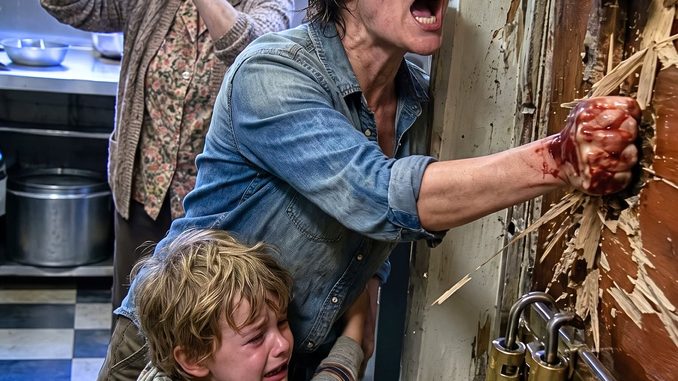
Part 1: The House That Became a Cage
The last thing Michael said before leaving for what he called a business trip sounded almost playful. I was standing in the hallway holding our three-year-old son, Leo, while Michael adjusted the cuffs of the navy suit I had ironed earlier that morning.
“You and Leo won’t starve for three days. Be good while I’m gone, and I’ll bring back a surprise.”
Leo immediately asked whether his father would bring him a dinosaur, and Michael promised he would if he behaved. Something about his smile felt wrong, but I ignored the feeling because ignoring uncomfortable instincts had become part of my marriage.
Michael picked up his overnight bag and walked outside without kissing me goodbye. A few seconds after the front door closed, I heard the deadbolt slide into place from the other side, followed by another heavy metallic lock.
At first, I told myself it must have been an accident. Then I tried the handle and realized I couldn’t open the door.
“Door stuck?” Leo asked.
“I think Daddy locked it by accident.”
I carried him into the living room before checking the other exits. The back door had been secured from outside with a padlock, the laundry-room door was blocked, and the iron security bars covering the windows prevented them from opening more than a few inches.
Only then did I understand what Michael had done. Our home had become a prison.
I grabbed my phone and called him, but the call wouldn’t connect. When I opened WhatsApp, a message beneath his profile confirmed that he had already blocked me.
My mother’s number didn’t work either because my cellular service had been disconnected. The landline was dead, leaving me with no working phone inside the house.
Then Leo asked for cereal.
I opened the refrigerator and found almost nothing inside: half a carton of milk, two bottles of water, butter, and mustard. The freezer held only ice, while the pantry had been deliberately emptied of rice, pasta, crackers, canned goods, cereal, and even flour.
That was when Michael’s goodbye stopped sounding like a joke.
“You and Leo won’t starve for three days.”
He had meant every word.
I searched every cabinet and eventually found half a sleeve of stale crackers, a bruised apple, a crushed granola bar, and three peppermint candies. I gave Leo thin pieces of apple, some crackers, and a little milk while pretending I wasn’t hungry.
“Mommy not eat?”
“I’m okay, baby.”
Leo pushed half of his cracker toward me.
“Share.”
I had to turn away so he wouldn’t see me cry. My three-year-old understood generosity better than the man who had deliberately trapped us inside our own home.
By then, I knew Michael’s actions were not impulsive. He had removed the food, disconnected communications, secured every exit, and arranged everything carefully before walking away.
Our marriage had been deteriorating for months. Michael had grown colder after reconnecting with Valerie Harlow, an old university acquaintance whose name eventually appeared in hotel receipts, private calls, and whispered words he thought I couldn’t hear.
I had questioned him before, but every conversation ended the same way. According to Michael, I was paranoid, emotional, and constantly imagining problems that didn’t exist.
That afternoon, I stopped caring whether he thought I was dramatic.
I dragged a chair beneath one of the barred windows and found an old golf club behind the television. One corner of the frame had already been weakened by cracked plaster, so I wedged the club between the metal and the wall and pushed until my hands hurt.
After repeated attempts, one section finally shifted slightly. It wasn’t enough for me to escape. Then the kitchen faucet stopped running.
I checked the bathroom, shower, and laundry sink, but there was no water anywhere in the house. By late afternoon, Leo’s forehead felt hot, and without medicine, communication, or enough drinking water, my fear turned into something much more urgent.
Michael had not simply locked us inside. He had calculated how long we could survive there.
Part 2: The Woman Who Knew
Near midnight, I smashed the living room window with the golf club because I needed sound to escape even if I couldn’t. The glass shattered across the floor, but the iron bars remained in place, so I screamed through the opening until my throat burned.
“Help! Please! My son is sick!”
For a while, nobody answered. Then I heard sirens in the distance and a car screech to a stop outside, and when I looked through the broken window, I saw my mother-in-law Carol running across the lawn in pajama pants and house slippers while carrying a sledgehammer.
She didn’t waste time asking questions. She examined the bars, raised the hammer, and struck the lower bolts with enough force to crack one of the anchors loose.
“How long?”
“Since this morning.”
Something passed across her face when I answered, and it wasn’t surprise. It looked more like confirmation.
“He locked us in.”
“I know.”
Those two words hit harder than anything else that night.
Carol kept swinging while explaining that she had called Michael twenty-seven times. When he blocked her too, she checked his company schedule and learned there had never been a conference.
“My son is with Valerie Harlow.”
Hearing her say Valerie’s name out loud ended whatever denial I still carried. I had suspected the affair for months, but suspicion and confirmation are very different things.
The final bolt broke just as police arrived. Officers helped pull me and Leo through the damaged window, and the moment my feet touched the wet grass outside, my legs gave out beneath me.
Paramedics checked Leo immediately. He was dehydrated, feverish, and exhausted, but thankfully they believed we had gotten out before his condition became critical.
That detail terrified me more than anything. Michael had apparently calculated the situation carefully enough to frighten us without immediately creating a medical emergency.
Officer Daniels asked me to explain what had happened, but I couldn’t find the words. Carol answered before I could.
“My son intentionally imprisoned his wife and child.”
The officer looked at her carefully.
“You believe this was deliberate?”
“He removed food, disabled communication, shut off the water, and blocked every exit. What part sounds accidental?”
That was when the police began treating the house as evidence instead of simply a domestic dispute. While officers searched inside, I started remembering things I had spent years minimizing: Michael gripping my wrist during arguments, taking my car keys after fights, monitoring money, checking messages, and making me apologize whenever I reacted to his behavior.
He had never left obvious bruises before. That had made it easier for me to tell myself nothing serious was happening.
Thirty minutes later, an officer returned carrying a folder from inside the house. It contained divorce papers, custody documents, property transfer forms, and financial records that appeared to have been prepared before Michael left.
Then Officer Daniels found a handwritten note.
“Three days alone should help Emily understand cooperation.”
My stomach turned as Carol read it. She closed her eyes for a moment before sitting beside me on the ambulance step.
“He did this to me too.”
“What?”
“Not exactly this. The control. The punishments. The isolation.”
For the first time, Carol told me about Michael’s father, Richard. He had raised Michael in a home where fear was treated as discipline, privacy had to be earned, and obedience was presented as proof of love.
When Michael was eleven, Richard removed his bedroom door for two months because he forgot to lock the garage. Carol had spent years believing she could shield her son from that kind of control, but now she understood that he had absorbed more of it than she realized.
“I thought I stopped it from reaching this point.”
Her voice broke slightly.
“I was wrong.”
That night, the police placed Leo and me in a small hotel under emergency protection. At 3:47 a.m., my phone rang from an unknown number.
Michael’s voice sounded completely calm.
“Well. I guess my mother found you.”
“You locked us inside.”
“For three days. You act like I buried you alive.”
“Why?”
There was a short pause before he answered.
“Because I needed leverage.”
In that moment, I finally understood the worst part.
He had not lost control. He had planned everything.
Part 3: The Man Everyone Thought Was Charming
By the following afternoon, Michael’s name had begun appearing across local news sites and neighborhood groups. The story spread quickly because people were fascinated by the idea that a respected executive could deliberately trap his wife and child inside their own home while disappearing with another woman.
The comments were divided, and some were crueler than I expected. People wondered whether there was more to the story, while others questioned why I had stayed with Michael if things had really been so bad.
Officer Daniels told me not to read any of it, but I did anyway. What strangers failed to understand was that abuse had not arrived in my marriage as one obvious act; it had grown through smaller forms of control that I had gradually learned to normalize.
Within forty-eight hours, the court approved a temporary protective order. Police also found records showing that Michael had scheduled the water shutoff during the exact period he planned to be away, which made it harder for anyone to claim that what happened had been accidental.
The prosecutor described the situation plainly.
“He intentionally created conditions that made you and your child dependent on him.”
Leo slowly recovered from dehydration and fever, but he remained unusually quiet. Loud noises startled him, and every knock at the hotel door made him ask whether his father had come back.
“Daddy here?”
Carol visited almost every day and brought groceries, medicine, clothing, and anything else we needed. One evening, she arrived carrying a large storage container filled with documents she had collected over almost twenty years.
“You kept all of this?”
“I kept evidence.”
Inside were medical records, school reports, photographs, handwritten notes, and old newspaper clippings connected to Michael and his father, Richard. That night, Carol finally told me how deeply control had shaped Michael’s childhood.
Richard had been charming and respected in public, but privately he controlled money, isolated Carol from friends, criticized what she wore, and punished emotional reactions while presenting himself as the reasonable one. Carol explained that he rarely did anything obvious enough for outsiders to recognize what was happening.
“He never hit me hard enough to leave marks anyone could photograph. That was intentional.”
Then she showed me an old newspaper article reporting Richard’s death after a fraud investigation destroyed much of his company. Michael had been nineteen when he found his father’s body.
The story did not excuse what Michael had done, but it helped me understand the pattern. He had grown up watching a man who equated control with strength and then watched that same man collapse when he lost it.
Three weeks later, Michael and I faced each other at the custody hearing. He arrived in a tailored gray suit looking calm and polished, while Valerie sat several rows behind him as though none of what happened had anything to do with her.
Judge Eleanor Ruiz reviewed photographs of the exterior padlocks, barred windows, and utility records. Then the prosecutor played audio from Michael’s late-night call.
“Three days alone should help Emily understand cooperation.”
Michael tried to describe what happened as temporary boundaries during a difficult separation. The judge rejected that explanation immediately.
“You imprisoned them.”
“With respect, Your Honor, that characterization is emotional.”
“No. It is factual.”
For the first time, Michael looked uncertain.
Then Carol was called to testify.
Michael stared at his mother as if her decision to speak against him were the greatest betrayal in the room. Carol remained composed as she explained how she found us and why she believed her son had intentionally endangered his family.
“I spent twenty-three years surviving one controlling man. I will not spend the rest of my life protecting another simply because I gave birth to him.”
The courtroom became completely silent.
After six hours, I was granted temporary sole custody of Leo while the criminal case continued. As I walked past Michael’s table afterward, he finally spoke.
“You ruined everything.”
Years earlier, those words would have buried me under guilt. This time, I stopped and looked directly at him.
“No. You did.”
Outside the courthouse, Leo tugged at my sleeve and asked whether we were going home. I didn’t know how to answer because the place he remembered as home no longer felt safe enough to return to.
Then Carol stepped beside us with a folded paper in her hand. She told me she had sold Richard’s old lake cabin and wanted to help us put a down payment on somewhere new.
“You and Leo need a safe house. Not a perfect one. Just safe.”
Standing there with my son on one side and Carol on the other, I finally understood something I had never expected to learn from my mother-in-law. Sometimes family is not the person asking you to protect them from consequences.
Sometimes family is the person who helps you break the bars.
Part 4: A House With No Bars
Three months after the custody hearing, Leo and I moved into a small blue rental house outside Asheville. It wasn’t impressive, but the moment I walked inside, I noticed something that mattered more than polished floors or expensive furniture: every window was ordinary, wide, and completely free of bars.
The kitchen tiles were uneven, the bathroom faucet leaked occasionally, and the porch steps creaked under every footstep. None of those flaws bothered me because after what happened in Briar Glen, safety no longer meant perfection; it meant knowing I could leave whenever I wanted.
The first night, Leo slept on a mattress on the floor because our furniture had not arrived yet. Around two in the morning, I woke from a nightmare convinced that I had heard metal locks sliding into place again.
For several seconds, I couldn’t breathe. Then I saw the blue walls, moonlight through plain glass, and rain moving softly outside, and I reminded myself that there were no bars between us and the world anymore.
My body did not recover as quickly as our circumstances did, so I began therapy two weeks later. Dr. Naomi Bennett gently challenged every attempt I made to minimize Michael’s behavior.
“He never really hit me.”
“Emily, he deliberately deprived you and your child of food, water, communication, and the ability to leave.”
Hearing it described so plainly was difficult because accepting that Michael had abused me also forced me to confront the fact that I had stayed for years while his control became gradually worse. Dr. Bennett helped me understand that abusive relationships often begin with attachment and affection, which is exactly why recognizing the danger can take so long.
Meanwhile, Michael’s criminal case continued through the court system. His attorneys blamed stress and poor judgment, while Valerie disappeared from public view once the investigation and media attention became impossible to ignore.
Carol suspected Valerie had never mattered to Michael in the way he claimed.
“She was fantasy. Men like Michael love mirrors more than partners.”
Over time, Carol and I developed an unexpected bond based less on friendship than shared understanding. She eventually admitted that she believed staying with Richard had taught Michael lessons she never intended him to learn.
“I thought surviving quietly protected him.”
She stared through my kitchen window while Leo colored dinosaurs nearby.
“But children absorb what silence teaches.”
Carol believed Michael had learned that control represented strength because that was what he watched growing up. I reminded her that she had eventually interrupted the pattern, but she still carried guilt over not doing it sooner.
Winter passed slowly, and Leo began preschool near our house. His nightmares became less frequent, but reminders of the confinement appeared in small behaviors I wasn’t prepared for.
One afternoon, I discovered several juice boxes hidden behind his dresser. When I asked why he had put them there, he lowered his head.
“In case food goes away again.”
I waited until I was alone before crying. Leo was improving, but his fear had found ways to survive even when he no longer had words for it.
Michael eventually accepted a plea agreement requiring psychiatric treatment and leaving permanent domestic abuse findings on his record. Any future visitation with Leo would have to be requested through supervised channels.
Eight months after Carol broke us out of the house, Michael was allowed a supervised visit. Leo immediately hid behind my legs when his father entered the room.
Michael crouched several feet away and removed a small green dinosaur from his pocket. It was the same toy he had promised Leo on the morning he locked us inside.
“I brought your dinosaur, buddy.”
Leo stared at the toy without approaching him.
“Daddy make us thirsty again?”
Michael closed his eyes briefly before answering.
“No.”
For the first time, I watched the consequences reach him somewhere deeper than court orders or public embarrassment. His son no longer associated him with comfort; Leo associated him with locked doors, hunger, and thirst.
The visit ended early when Leo began crying and asked to leave. Outside, Michael called my name before I reached the parking lot.
“I didn’t think it would go that far.”
I finally understood why that explanation disturbed me more than almost anything else he had said. Michael had treated control as strategy for so long that he failed to recognize how dangerous it had become until his own child was afraid of him.
“That’s what made it dangerous.”
Then I took Leo home to the little blue house where every window opened.
Part 5: The Sound of an Unlocked Door
A year after Michael locked us inside the Briar Glen house, Leo finally learned to sleep with his bedroom door closed again. For most families, that would have been an ordinary milestone, but for us it meant that a closed door no longer automatically felt like a threat.
For months after our escape, Leo insisted that nearly every door remain open while he slept. We adapted by leaving hallway lights on, checking locks together before bed, and keeping snacks visible so he never had to wonder whether food might disappear again.
One spring evening, I finished reading his favorite dinosaur book and stood to leave his room. Leo looked toward the half-open door before speaking.
“You can close it.”
“Are you sure?”
“It’s okay now.”
I closed the door gently and stood in the hallway for several seconds afterward. Healing had not arrived through one dramatic moment; it appeared through small changes like a child finally trusting that a closed door could still open whenever he wanted.
By then, our little blue house outside Asheville had stopped feeling temporary. Leo planted tomatoes in crooked pots on the porch, and we adopted an elderly golden retriever named June who quickly became part of our strange little family.
Carol remained in our lives without trying to erase the past through grand gestures. She showed up for school pickups, brought soup when we were sick, watched Leo when I had classes, and taught me that consistency could sometimes mean more than affection.
Michael continued therapy and supervised visits with Leo. Some meetings went reasonably well, while others ended before they truly began because Leo refused to enter the room.
What surprised me was that Michael no longer treated Leo’s resistance as disobedience. He seemed to be slowly understanding that consequences could not be argued away once they had settled inside another person.
One afternoon, the visitation supervisor pulled me aside afterward.
“He asked if Leo still hides food.”
“What did you tell him?”
“That he’s getting better.”
The question stayed with me because it suggested guilt was finally reaching a part of Michael that excuses never had. It did not undo what happened, but perhaps it made denial harder for him to maintain.
Around the same time, I finally returned to school and enrolled part-time in the early childhood education program I had abandoned years earlier. Sitting in classrooms again at thirty felt strange at first, but working with children gave me a sense of purpose I had almost forgotten existed.
One professor asked why I had chosen the field.
“Because safe adults change everything.”
After class, she stopped me before I left.
“You probably are one.”
I cried in my car afterward because Michael had spent years convincing me that fear made me weak and dependence made me incapable. Learning that I could still become someone safe for others felt like recovering a part of myself I thought had disappeared.
On the anniversary of our escape, Carol invited us to dinner at her new condo near Hendersonville. She had sold the old property associated with Richard because she said she was tired of living around memories that no longer deserved space in her life.
Later that evening, after Leo fell asleep beside June, Carol and I sat outside overlooking the lake. She eventually asked a question everyone else seemed afraid to say aloud.
“Do you ever miss him?”
“I miss who I thought he was.”
Carol nodded slowly.
“That version existed. Just not strongly enough.”
I admitted that I still wondered why I had not recognized the danger sooner. Carol reminded me that men like Richard and Michael survived by making their own behavior sound reasonable while convincing everyone else that normal reactions were irrational.
“Confusion is part of the trap.”
Then she said something that stayed with me.
“You survived Michael faster than I survived Richard.”
For the first time, I considered that healing might involve more than escaping what happened to me. Maybe it also meant refusing to pass that fear down to Leo as though it were another family inheritance.
A few months later, Leo and I drove past the old Briar Glen house one final time. The bars had been removed, the shutters had been painted green, and flowers now grew beside the mailbox.
I expected anger, but mostly I felt grief for the woman I had been inside those walls. She had spent years apologizing for asking reasonable questions and confusing endurance with love.
Leo noticed the tears on my face from the back seat.
“Mommy, you crying?”
“Just remembering something.”
He thought about that for a moment.
“Bad thing over now?”
I looked at the house once more before turning toward my son.
“Yes. The bad thing is over now.”
For the first time since the morning Michael locked those doors, I believed it.
Leave a Reply