Part 1: The Woman They Thought Couldn’t Afford a Room
“Ma’am, perhaps you should try one of the cheaper motels near the highway. They might be more suitable for you and your child.”
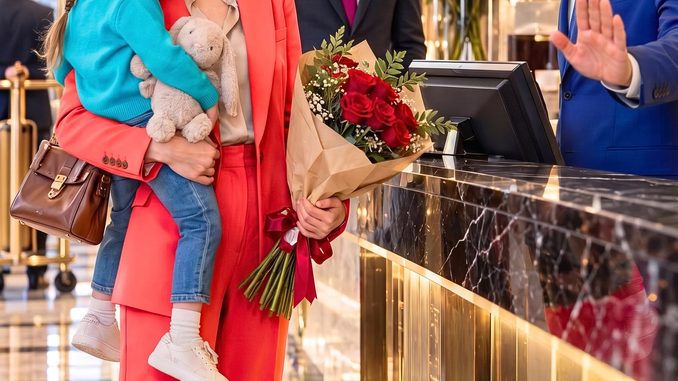
I stared at the receptionist, struggling to believe what I’d just heard. My six-year-old daughter was asleep against my shoulder, and I was holding a battered bouquet of red roses. The man behind the counter had apparently decided that I couldn’t afford a room in the luxury hotel where I was standing.
What he didn’t realize was that I owned the hotel.
My name is Clara Vance, founder and CEO of Vance Hospitality Group, the company that operated Chicago’s Grand Regent Hotel. Eleven years earlier, I’d started with a struggling twenty-eight-room property outside Denver and gradually built it into a successful hospitality business.
That evening, however, I looked nothing like a corporate executive. I wore an old leather jacket, comfortable boots, and carried a backpack while supporting my exhausted daughter, Lily, who had fallen asleep shortly before our arrival.
We’d spent almost nine hours traveling from Denver after our flight was delayed. Lily had barely eaten dinner, and her favorite stuffed rabbit, Mr. Buttons, was still clutched tightly in her hand.
I wasn’t interested in arguing. All I wanted was to get my daughter into bed.
“I have a reservation under Clara Vance,” I explained.
The receptionist, Patrick, searched his computer before announcing that he couldn’t find my booking. His colleague Karl watched with an amused expression, occasionally exchanging knowing looks with him.
“Please check the executive reservation block,” I requested. “The corporate office arranged everything.”
Patrick barely glanced at the screen again.
“We’re completely booked, ma’am. There’s a major corporate gala tonight, and every available room has been reserved.”
I knew about the event because I’d personally approved the partnership agreement supporting it six months earlier. Still, I chose not to reveal my identity.
When I repeated that my reservation was confirmed, Karl laughed quietly.
“Some people think complaining loudly enough will magically produce a luxury suite.”
Patrick suggested another budget motel, while Karl continued watching as though my situation were entertainment.
Behind them, the Grand Regent’s company motto was engraved into the marble wall:
EVERY GUEST DESERVES TO FEEL SEEN.
I’d written those words when my business was still small. Now two employees were standing beneath them while treating a tired mother as someone who didn’t belong.
Lily stirred against my shoulder, and I gently reassured her before she fell asleep again.
The roses I carried were for a deeply personal reason. The following day marked three years since my husband Daniel had died of cancer at thirty-seven, leaving Lily fatherless at just three years old.
Every anniversary, we placed red roses in a vase and shared a happy memory of him. I had bought the flowers before our flight because I wanted to preserve that tradition, no matter how difficult the journey became.
When I requested the general manager, Patrick refused, claiming he was too busy supervising the gala. Karl added that management wouldn’t be disturbed over a missing reservation.
Then a housekeeper named Lupita emerged from a nearby corridor. She noticed my sleeping daughter, the damaged flowers, and the tension at reception.
“Have you checked the secondary corporate booking system?” she asked Patrick.
He snapped that he knew how to do his job, but Lupita refused to retreat.
“A mother carrying an exhausted child needs help. That should concern all of us.”
Reluctantly, Patrick opened another screen. Seconds later, his expression changed.
“Suite 904,” he murmured. “Executive reservation. Confirmed two weeks ago.”
He immediately apologized and blamed a technical problem, but I corrected him.
“The system wasn’t the problem. You decided I didn’t belong here before checking properly.”
Patrick handed me the keycards, and Lupita offered to carry my backpack. I accepted, grateful that someone had finally shown us genuine kindness.
As we entered the elevator, I heard Karl mutter behind us.
“Some people just enjoy making a scene.”
I said nothing as the doors closed. My daughter needed rest, and I had no intention of frightening her with a confrontation.
But I had already made a decision.
The following morning, those men would discover exactly who they’d been insulting, and why their behavior was about to become a much bigger problem.
Part 2: The Housekeeper Who Knew the Truth
Lupita accompanied us to the ninth floor without saying much. When we reached Suite 904, she opened the door and helped carry our belongings inside. The spacious suite overlooked downtown Chicago, with two bedrooms, a comfortable living area, fresh fruit, and a handwritten welcome card from corporate headquarters.
The message read, “Welcome back, Ms. Vance.”
Lupita stared at the card before turning toward me.
“Wait… are you Clara Vance? The woman who owns this hotel?”
I nodded and explained that I’d founded Vance Hospitality Group. Her expression changed immediately, and she looked toward the door as though she needed to warn the reception staff.
“Please don’t tell anyone,” I said.
She hesitated, so I explained that I wanted to understand how employees treated ordinary guests when they believed nobody influential was watching. Lupita nodded slowly, recognizing why I had arrived without announcing myself.
After settling Lily into bed, I returned to the kitchenette and began arranging the damaged roses in a vase. Lupita helped straighten the stems, carefully trimming one that had bent during our journey.
When she asked whether the flowers were for a special occasion, I told her about Daniel and the anniversary of his death.
“My husband passed away eleven years ago,” she replied quietly. “He was forty-nine. You learn to keep going because someone still needs breakfast.”
Her words made me smile. For the first time that evening, I felt understood rather than judged.
Before leaving, Lupita mentioned that she’d worked at the Grand Regent for eight years and had previously helped train new housekeeping employees. When I asked whether she enjoyed her job, she answered cautiously.
“I like taking care of the guests.”
Something about her response suggested there was more she wasn’t saying, but I didn’t press her.
Later, I received a message from David Mercer, my chief operating officer. He confirmed that the general manager, Robert Haines, believed I wouldn’t arrive until Sunday, leaving my unannounced inspection undisturbed.
I instructed David not to contact the property and opened my notebook.
I recorded what had happened at reception, separating Patrick’s refusal to investigate my reservation, Karl’s mocking behavior, and Lupita’s willingness to help. But I also reminded myself not to judge anyone’s entire character from a single encounter.
Daniel had always encouraged me to examine situations fairly, even when I was angry.
Shortly after two in the morning, Lily woke crying from a dream about her father. She imagined him waiting at an airport while we boarded a plane without him.
I held her until she calmed down, promising that we would still honor our tradition with the roses.
Then she asked something that hurt more than the insults downstairs.
“Mommy, why were those men so mean to us? Did we do something wrong?”
I assured her that we hadn’t. I explained that sometimes people make unfair assumptions based on appearances, even when they know nothing about someone.
“Are they going to get in trouble?” she asked.
“Tomorrow, I’ll find out what happened. Then I’ll decide what’s fair.”
The next morning, Lupita surprised us with blueberry pancakes from the hotel kitchen. Lily was delighted, and I thanked the housekeeper for another thoughtful gesture.
At eight-fifteen, I left Lily with Marisol, a trusted childcare professional from our Chicago office. Then I put on the same worn leather jacket, slipped my corporate identification into my pocket, and returned downstairs.
Patrick and Karl were standing behind reception, just as they had been the previous evening.
But this time, someone else was waiting beside them.
It was Robert Haines, the Grand Regent’s general manager, a man who had met me twice before when I was dressed in expensive business suits.
He glanced at my old jacket, then at Patrick, and frowned.
“Is this the woman who caused the problem last night?”
At that moment, I realized the hotel’s problems might reach much further than two disrespectful receptionists.
And I was about to discover whether its manager was part of the reason.
Part 3: The Manager Who Failed to Recognize His Own Boss
Robert Haines had managed the Grand Regent for eighteen months, and his performance reports had always impressed me. Revenue was increasing, operating expenses were controlled, and guest satisfaction scores appeared strong. During our previous meetings, he had seemed confident, professional, and perfectly suited to managing one of our most prestigious properties.
But those meetings had taken place when I was wearing expensive business suits. Standing before him in jeans and my old leather jacket, I was apparently just another troublesome guest.
“I understand there was a misunderstanding with your reservation last night,” Robert began. “I’ve already reviewed the situation.”
“Then perhaps you can explain what happened,” I replied.
He glanced at Patrick before telling me that a technical error had prevented the reception team from locating my booking. According to him, the problem had been resolved, and there was no reason to continue discussing it.
“Did the technical error also cause your employees to suggest I find a cheaper motel?” I asked. “And was it responsible for Karl laughing at me?”
Robert’s smile tightened. He insisted that no offense had been intended, then suggested that Lupita should never have interfered because housekeeping employees were expected to remain within their assigned responsibilities.
His response disturbed me more than Patrick’s original insult. Instead of questioning why a guest had been mistreated, he was criticizing the only employee who had offered assistance.
While we spoke, an elegantly dressed woman approached reception. Patrick immediately greeted her by name, asked about her stay, and offered transportation assistance. Karl hurried forward to help with her luggage.
I watched them provide the attentive service they had denied me.
They clearly understood how to treat guests respectfully. They simply reserved that courtesy for people who appeared wealthy or important.
When the woman left, I asked Robert whether he’d examined my complete reservation profile. He admitted that he’d only read the incident report because the booking issue had already been resolved.
I reached into my jacket and placed my corporate identification on the counter.
CLARA VANCE
FOUNDER & CHIEF EXECUTIVE
VANCE HOSPITALITY GROUP
Robert stared at the card. Patrick leaned forward, his face draining of color, while Karl stood completely motionless.
“Clara?” Robert whispered.
“Yes, Robert. We’ve met before.”
He immediately began apologizing.
“If I’d known who you were…”
I interrupted him.
“If you’d known I owned this hotel, would you have treated me differently?”
He hesitated before admitting that he would.
“Then that is precisely the problem,” I said. “I’m not upset because you failed to recognize me. I’m upset because you believe my identity should determine whether I deserve respect.”
The lobby had grown unusually quiet. Several employees were listening, but I kept my voice controlled because I wanted answers, not a public spectacle.
I explained that a hotel existed to make travelers feel welcome and safe, regardless of their clothing, financial circumstances, or social position. Lupita had understood that without knowing anything about me.
Then I ordered Robert to preserve the previous evening’s security footage and provide reception activity logs, employee training records, and six months of guest complaints involving reservations or staff behavior.
His expression changed when I mentioned the complaints.
“Is there something I should know?” I asked.
“No, absolutely not,” he answered much too quickly.
I told him that no disciplinary decisions would be made until the evidence had been reviewed. I also warned him that Lupita was not to face retaliation for helping me.
As I prepared to leave, Karl approached and apologized. He admitted that he’d assumed I was trying to obtain a room I couldn’t afford and acknowledged that his behavior had been unfair.
Then he mentioned Lily, saying he regretted that she’d overheard his remarks. His apology didn’t erase what happened, but it suggested he was beginning to understand the consequences.
Near the elevators, Lupita appeared carrying fresh linens. She noticed Robert’s expression and immediately looked frightened.
“Ms. Vance,” she asked quietly, “am I going to be punished?”
I stopped and turned toward her.
“Punished for helping my daughter and me?”
She didn’t answer. Instead, she glanced nervously at Robert, who suddenly avoided my eyes.
That reaction told me something important.
Lupita wasn’t simply worried about what might happen. She seemed to recognize a punishment she’d experienced before.
Part 4: The Hidden Cost of Doing the Right Thing
I invited Lupita into a private conference room near the executive offices. She sat nervously across from me, her hands clasped together, looking as though she expected to be reprimanded at any moment.
“Lupita, you’re not in trouble,” I assured her. “But I need to understand why you thought helping me might cost you your job.”
She hesitated before explaining that management had previously warned her about assisting guests outside her housekeeping responsibilities. Sometimes travelers needed directions, help locating family members, or someone willing to listen. But every minute spent helping them counted against the strict productivity targets imposed on housekeeping staff.
As she spoke, I felt increasingly uncomfortable. Those targets had been introduced following a corporate efficiency review, and I had personally approved them.
I’d believed the new standards would improve operations. Instead, they had created an environment where employees feared consequences for showing basic kindness.
Lupita eventually admitted that certain guests received better treatment than others. Clothing, luggage, payment methods, accents, and sometimes even skin color influenced how quickly employees offered assistance.
“Did you ever report this?” I asked.
“Once. My supervisor told Mr. Haines, but afterward he held a meeting reminding everyone to stay within their departments.”
She didn’t believe Robert deliberately encouraged discrimination. According to her, he simply valued efficiency, favorable reports, and avoiding complaints more than investigating why problems occurred.
Her explanation troubled me because it revealed something larger than individual misconduct.
For the next four hours, I reviewed security recordings, reservation activity, and complaint records. The footage confirmed that Patrick had spent only eleven seconds searching for my booking before dismissing me. He hadn’t opened the executive reservation system until Lupita intervened.
The complaint records were even more revealing.
During the previous six months, twelve guests had reported dismissive reservation handling, while seven described feeling judged because of their appearance or payment method. Patrick appeared in three complaints and Karl in two.
Instead of investigating the repeated behavior, management had closed the cases with complimentary breakfasts, loyalty points, upgrades, or other gestures.
That afternoon, I confronted Robert in his office.
“Why did you keep compensating guests without addressing the problem?” I asked.
He admitted that when he arrived eighteen months earlier, the property had been struggling financially. He focused heavily on faster service, profitable corporate accounts, VIP satisfaction, and impressive performance statistics.
“I never instructed anyone to mistreat ordinary guests,” he insisted.
“No,” I replied. “But you made it clear which guests mattered most.”
He lowered his eyes before admitting that Patrick had received informal warnings twice. Those incidents were never documented because Patrick was fast, successful at selling upgrades, and particularly effective with wealthy customers.
Then I asked about Lupita.
Robert reluctantly revealed that she’d been reprimanded six months earlier after helping an elderly guest locate his wife during a medical emergency. Because she stayed with him until security arrived, her housekeeping assignments fell behind schedule.
I stared at him, stunned that an act of compassion had been treated as poor performance.
After considering the evidence, I placed Patrick and Karl on suspension pending a formal HR investigation. Robert received ninety days of performance probation under corporate supervision, along with instructions to cooperate with an independent review of the hotel’s service culture.
I also ordered a reassessment of housekeeping targets and an end to language that encouraged employees to classify certain travelers as more valuable than others.
Robert accepted the decisions without arguing.
Before leaving, I met separately with Patrick and Karl. Patrick acknowledged his behavior and became emotional, while Karl admitted that he’d joined in because he wanted Patrick’s approval.
Neither received an immediate final decision. I wanted the investigation completed before determining consequences.
That evening, I returned to Suite 904, where Lily was waiting with Mr. Buttons and our vase of red roses.
“Did you decide what was fair?” she asked.
“Some of it,” I answered.
“Did you fire those men?”
“Not yet, sweetheart. Being fair means listening to everyone, even when you’re upset.”
Lily considered that before admitting she didn’t particularly like the idea. I laughed and told her that sometimes I didn’t either.
Then she asked whether we could share our memory of Daniel a day early because she missed him.
We sat beside the roses and remembered the time he’d tried making pancakes in a hotel suite, burned nearly every one, and blamed the little electric skillet. Lily laughed as I described the smoke detector going off, and soon I was laughing through tears.
For the first time since arriving in Chicago, I felt peaceful.
Then my phone rang.
It was our corporate HR director.
“Clara, we’ve finished the preliminary review of Patrick’s employment records.”
I glanced toward Lily before asking what they’d discovered.
The director paused.
“What happened to you wasn’t his first incident. We’ve uncovered earlier complaints that were never reported to corporate.”
I looked at the roses on the table, realizing the final decision could no longer wait.
Part 5: Every Guest Deserves Respect
The HR director’s findings confirmed what I’d begun to suspect. Patrick had been involved in two earlier incidents where guests were treated unfairly after their reservations were questioned. One complaint came from a young couple celebrating their anniversary, while another involved a woman traveling with her elderly mother.
Both complaints had remained within the Grand Regent’s management office. Robert had spoken privately with Patrick, offered compensation to the guests, and closed the cases without notifying corporate headquarters.
Karl’s record, however, showed no previous disciplinary problems. He was relatively new and had apparently allowed himself to follow Patrick’s example.
Three days later, the formal investigation concluded.
Patrick’s employment was terminated because of his repeated misconduct and failure to improve after previous warnings. Karl received a final written warning, mandatory retraining, and sixty days of supervised shifts.
Robert remained general manager under ninety days of probation, during which corporate operations would closely monitor the hotel’s progress.
Some executives believed I’d been too lenient with Robert. Others worried that dismissing Patrick would frighten employees into avoiding difficult guests. But my decisions weren’t intended to satisfy anyone’s anger.
I wanted consequences that reflected the evidence, along with meaningful changes that would prevent similar incidents.
Over the following weeks, we revised the Grand Regent’s complaint procedures, improved employee training, and required managers to investigate recurring problems rather than simply offering compensation. We also adjusted housekeeping expectations so employees wouldn’t be penalized for reasonably assisting guests.
Then I invited Lupita to meet with me before Lily and I returned to Denver.
She entered my office with a suspicious expression.
“Before you say anything, I’m not interested in becoming general manager.”
I laughed.
“I wasn’t going to offer you Robert’s position.”
“Good. I don’t want extra responsibilities just because I helped someone.”
Instead of proposing a job immediately, I asked what she actually enjoyed doing. Lupita explained that she loved housekeeping but missed training new employees, a responsibility she’d previously held before management changes.
I offered her the vacant Housekeeping Training Lead position, which included higher pay and opportunities to mentor colleagues while continuing practical work.
She initially refused, then reconsidered after learning the position already existed. Two days later, she accepted.
On our final morning in Chicago, Lily and I entered the lobby carrying our luggage, Mr. Buttons, and the vase of roses.
Karl was working a supervised shift. When he noticed us, he approached cautiously and apologized directly to Lily.
“I said something unkind when you and your mother were exhausted. I was wrong.”
Lily studied him.
“Why did you do it?”
Karl looked embarrassed.
“Because I wanted someone else to think I was funny.”
“It wasn’t funny,” she replied.
“No,” he admitted. “It wasn’t.”
After considering his answer, Lily introduced him to her stuffed rabbit. It was a small gesture, but enough to show that she had heard his apology.
Near the entrance, Lupita was waiting. I handed her an envelope containing a photograph of Lily and me beside Daniel’s roses.
On the back, I’d written:
For the woman who chose kindness before knowing who I was.
Lupita read the message twice before embracing me. Lily joined us, wrapping her little arms around both of us.
“Your husband would be proud of you,” Lupita whispered.
I looked at the roses and hoped she was right.
Outside, our car waited beneath the bright Chicago morning sky. As I helped Lily inside, she suddenly asked whether I really owned the entire hotel.
“Yes, sweetheart.”
“Even the beds?”
“Technically.”
“And the pancakes?”
I laughed and explained that the people making pancakes still needed to be paid.
Then her expression became serious.
“Mommy, why didn’t you tell those men you owned the hotel?”
I glanced back through the glass entrance, watching employees greet arriving travelers.
“Because I wanted to see how they treated someone they believed wasn’t important.”
Lily frowned.
“But you’re not nobody.”
I crouched beside her and gently held her hands.
“Neither is anyone else, Lily.”
As our car pulled away, I thought about everything that had happened. Patrick had lost his position, Karl had received an opportunity to change, and Robert had been forced to confront the culture he’d allowed to develop.
Lupita, meanwhile, had demonstrated the values our company was supposed to represent without ever needing recognition or authority.
My phone vibrated with a message from Robert.
First staff briefing under the new service standards completed. Lupita corrected me twice.
A second message followed.
Possibly three times.
I smiled and replied with two words.
Listen carefully.
Beside me, Lily had fallen asleep with Mr. Buttons tucked beneath her chin. The roses rested safely between us, their stems uneven and several petals damaged from the journey.
They weren’t perfect anymore, but they had survived.
I realized that building a successful hotel company meant more than impressive architecture, strong revenue, or polished marble walls. Those things mattered, but they meant little if the people entering our buildings were made to feel unwelcome.
Daniel had understood something I’d nearly forgotten during years of expansion and business decisions.
Respect isn’t something people should have to earn by revealing their wealth, title, or influence. It should be offered before anyone knows who they are.
And that was the lesson I hoped Lily would carry with her long after she forgot the unpleasant night at the Grand Regent.
Leave a Reply