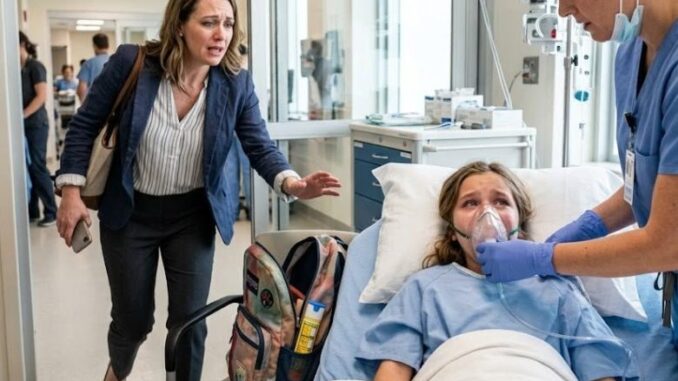
By the time I reached St. Agnes Children’s Hospital, my ten-year-old daughter had a plastic oxygen mask over her face and two IV lines taped across the backs of her hands.
Lily looked impossibly small beneath the white emergency-room blanket.
A nurse met me at the glass door before I could push through it.
“Stay steady until she sees you,” she said quietly. “She needs to know you’re here.”
Every part of me wanted to break.
I wanted to scream so loudly that the whole floor would understand someone had left my child struggling to breathe and gone on with a day trip.
Instead, I put one hand against the glass and forced my knees to hold.
The monitor beside Lily’s bed kept chirping in quick, clean notes.
The oxygen mask fogged faintly each time she pulled in another breath.
I had spent the drive to the hospital imagining every possible ending, and now I was looking at the one fact that mattered: she was still fighting.
Three hours earlier, I had been standing in a downtown Seattle conference room presenting quarterly numbers.
There were spreadsheets on the screen, paper coffee cups on the table, and six people waiting for me to explain a variance that suddenly seemed like the least important thing in the world.
My phone had been on silent.
When the meeting ended, I looked down and saw twelve missed calls from Lily’s school.
There was one voicemail from the school nurse and one text from my sister-in-law, Claire.
Lily got into something with peanuts. We handled it. Don’t make a scene.
I read the message twice because my mind refused to accept the calmness of it.
Lily’s peanut allergy was not a preference, a sensitivity, or a family disagreement.
It was documented in her school records.
There was an action plan.
There was an EpiPen in her backpack.
Every adult responsible for her had been told what to do.
I called the school nurse first.
She answered so quickly that I knew she had been waiting.
“Mrs. Carter, Lily left campus with your mother-in-law,” she said.
Her voice was tight and unsteady.
“She was wheezing. I told them to use the EpiPen and call 911. They said they had plans and would take care of it.”
The conference room seemed to tilt around me.
I asked when Lily had left.
The nurse gave me the sequence as clearly as she could: Lily had shown signs of a severe reaction, the school had contacted the family member who arrived for her, and the nurse had explicitly said emergency care was necessary.
Patricia had taken Lily anyway.
I called Patricia.
No answer.
I called my brother-in-law, Mark.
No answer.
I called Claire once, then again.
On the third try, she picked up.
Children were laughing behind her.
Water splashed.
Someone shouted that they wanted another turn.
“Where is Lily?” I asked.
Claire did not answer immediately.
Then she said, “Relax. She’s with Mrs. DeLuca from next door. We couldn’t cancel the lake club reservations. The other kids were so excited.”
For a second, I could not form words.
I had expected confusion, panic, maybe even an apology.
I had not expected the sound of a luxury day trip continuing in the background while my daughter was somewhere else struggling to breathe.
“You left my daughter with a neighbor during anaphylaxis?”
Claire sighed as though I were making the conversation difficult.
“She was breathing when we left.”
That sentence became the dividing line between the person I had been that morning and the person I became afterward.
Breathing was not proof that Lily was safe.
Breathing was the emergency.
I ended the call and dialed 911.
The dispatcher asked for the address.
I gave Mrs. DeLuca’s street, described Lily’s allergy, explained that an EpiPen should be in her backpack, and said the adults responsible for her had left.
The dispatcher sent paramedics and stayed on the line while I ran for the elevator.
I do not remember crossing the office lobby.
I remember the hard pressure of my keys in my palm.
I remember getting into the car and hearing the dispatcher repeat that help was on the way.
I remember Seattle traffic closing around me while every red light felt personal.
The dispatcher kept me focused on facts.
Lily was ten.
Peanut allergy.
Possible anaphylaxis.
Unknown exposure.
EpiPen available but possibly unused.
No responsible family member present.
Each answer made the situation sound more impossible.
Mrs. DeLuca later told me she had found Lily curled on the couch.
Lily’s breathing was strained.
Her lips were turning blue.
Her backpack was on the floor nearby, and the EpiPen was still inside it.
Patricia had apparently said she did not want to overreact.
Then Patricia, Claire, Mark, Daniel, and the other children had left for the lake club.
Mrs. DeLuca had not understood how serious the reaction was until Lily’s condition worsened.
By the time paramedics arrived, there was no longer any room for anyone to call it drama.
At the hospital, the doctor told me another ten minutes might have changed everything.
He did not make the statement dramatic.
He did not need to.
The words landed with the weight of a door closing.
When the nurse finally let me enter, I walked to Lily’s bed slowly because I did not want her to see terror on my face.
Her eyes opened only partway.
I touched one finger to her palm.
She squeezed it.
The pressure was weak, but it was deliberate.
“I’m here,” I told her.
I kept my voice low.
“You’re safe. I’m right here.”
The mask made it impossible for her to answer.
Her fingers tightened once more, then relaxed.
I kissed her forehead and stood beside the bed until the doctor said her breathing was beginning to respond.
Only then did I step into the hallway.
I did not call the family first.
I called my attorney.
I explained the timeline without embellishment.
The school had warned Patricia to use the EpiPen and call 911.
Patricia had removed Lily from campus.
The family had left Lily with a neighbor.
Claire had texted that they had handled it.
Daniel had ignored my messages because his mother told him I was being hysterical.
My attorney told me to preserve everything.
So I did.
I took screenshots of Claire’s text and the unanswered calls.
I saved the school nurse’s voicemail.
I requested copies of the allergy action plan and the relevant school records.
I kept the hospital intake paperwork.
I wrote down the sequence while it was still fresh enough to hurt.
Then I called Daniel.
He was still at the lake.
That fact should have shocked me, but by then shock had become something cold and useful.
He answered with irritation in his voice.
Before I could finish telling him where I was, he said his mother had already explained that Lily had reacted to something and that everyone had taken care of it.
“Our daughter is in the emergency room,” I said.
The background noise on his end changed.
I could still hear children, but the adults had gone quiet.
Daniel said Patricia believed Lily had been improving.
I asked whether he had listened to my messages.
He said his mother told him I was being hysterical and would ruin the day for everyone.
There are moments when a marriage does not end with a confession, an affair, or a slammed door.
Sometimes it ends when you hear the person you trusted explain why your fear for your child was inconvenient.
I let Daniel talk until he ran out of softer words for what had happened.
Then I said, “You were told Lily was having trouble breathing, and you stayed.”
He tried to correct me.
He said he had not personally seen how bad it was.
He said Patricia was the one who picked Lily up.
He said Claire had assured everyone that Mrs. DeLuca was watching her.
Every explanation moved responsibility somewhere else.
None of them moved Daniel toward the hospital.
“Do not come here and ask me to calm down,” I said. “Do not call this a misunderstanding.”
He said he was leaving the lake club.
I ended the call before he could make his decision sound noble.
My next call was to the police.
I did not need to raise my voice because the timeline was already louder than anything I could say.
I gave them the school nurse’s name, the address where Lily had been left, the hospital information, and the names of the adults involved.
I explained that there was a documented allergy action plan and that an emergency medication had remained unused.
When an officer arrived, I handed over copies of what I had.
Claire’s text sat at the center of it.
Lily got into something with peanuts. We handled it. Don’t make a scene.
The officer read it twice.
Then he listened to the school nurse’s voicemail.
The contrast was impossible to miss.
The nurse had described wheezing and ordered emergency action.
Claire had described the same crisis as something handled.
The timestamps showed which message came first.
The adults at the lake could not claim they had never been warned.
I watched the officer look through the glass toward Lily’s bed.
“Where are they now?” he asked.
I gave him the lake club address.
By sunset, the trip was over.
The family had spent the day acting as though the reservation mattered more than the emergency.
Now they were returning phone calls they had ignored and answering questions they had hoped no one would ask.
Patricia was interviewed by dinner.
Her first defense was the one she had used from the beginning: she did not want to overreact.
But the school nurse had already told her the reaction was severe.
The EpiPen had been available.
The ambulance had not been called.
The decision to leave had not happened in confusion.
It happened after a clear warning.
Claire’s message made the family’s attitude visible.
Daniel’s ignored calls made his choice visible.
The hospital report made the consequence visible.
No one document told the entire story alone, but together they formed a timeline no one could talk around.
Daniel called again while I was sitting beside Lily.
His voice was quieter.
“Mom said she was still breathing,” he said.
I looked at the oxygen mask covering our daughter’s face.
“She was turning blue,” I answered.
He said he had not known that part.
I reminded him that he had chosen not to listen to the messages that would have told him.
He said I was being unfair.
That word almost made me laugh.
Unfair was a canceled reservation.
Unfair was a child missing a day at the lake.
This was a ten-year-old girl nearly dying because adults did not want their plans interrupted.
Daniel began describing it as a family mistake.
I stopped him.
“A mistake is forgetting the sunscreen,” I said. “This was a warning, a choice, and then another choice.”
He asked whether he could come to the hospital.
I told him Lily needed calm, and I was not going to let him enter the room only to defend his mother beside her bed.
He said he was her father.
“So act like it,” I said.
Then I ended the call.
The rest of the evening moved in hospital time.
Nurses checked Lily’s breathing.
The IV bags slowly emptied.
The monitor settled into a rhythm that no longer made every person in the room move faster.
I sat beside her with one hand resting near hers.
When she woke more fully, I told her nothing was her fault.
I did not explain the police interview.
I did not tell her what Daniel had said.
A child recovering from an allergic reaction should not have to carry the weight of adult cowardice.
She needed to breathe.
She needed to sleep.
She needed to know I had arrived.
My attorney stayed in contact and reminded me not to argue by text.
That advice suited me.
I had no interest in winning a family debate.
I wanted a clear record of what had happened and a safe place for Lily to recover.
By late evening, Daniel began sending messages that moved through the same pattern as his phone call.
First, he blamed his mother.
Then he blamed Claire.
Then he blamed the confusion.
Finally, he blamed me for making the situation worse by involving police.
I saved every message.
I did not answer most of them.
The one answer I sent was simple.
You will not be coming home tonight.
Daniel replied that I could not punish him for something Patricia had done.
I looked at the missed-call list again.
He had made his own decision long before I made mine.
He had chosen not to listen.
He had chosen to stay.
He had chosen his mother’s version of events because it protected the day he wanted to have.
“No,” I wrote back. “I’m protecting Lily from everyone who chose not to protect her.”
Near midnight, Daniel called from our front porch.
His key had not opened the door.
I remained beside Lily’s bed and watched his name light up on my phone.
For years, I had believed keeping peace meant giving people one more chance to explain themselves.
That night, peace meant keeping the door closed.
I let the first call ring.
Then he sent a message asking whether I truly intended to lock him out over one bad decision.
One bad decision.
As though the school nurse had not warned them.
As though the EpiPen had not remained unused.
As though Lily had not been abandoned on a neighbor’s couch while the family drove away.
As though he had not ignored my calls because his mother found my fear embarrassing.
By morning, the people involved were learning that my silence had not been surrender.
I had not raised my voice in the hospital corridor.
I had not threatened anyone at the lake.
I had not posted accusations or begged relatives to take sides.
I had collected the voicemail, the text, the school records, the allergy plan, the intake report, and the timeline.
Patricia had spent the day deciding what counted as an emergency.
Claire had spent it deciding what counted as handled.
Daniel had spent it deciding whose voice deserved his attention.
Now those decisions existed outside the family’s version of events.
They existed in records.
They existed in timestamps.
They existed in the hospital room where Lily had fought for every breath.
The family had expected me to make a scene because a scene can be dismissed.
A scene can be called emotional.
A scene can be retold until the person who caused the harm sounds reasonable.
Evidence is harder to reshape.
It does not care who had reservations.
It does not care who felt accused.
It does not care whether someone says a mother was hysterical.
It records who was warned, what they chose, and what happened next.
That was why I stayed calm.
Not because I forgave them.
Not because I was weak.
Not because I was unsure.
I stayed calm because my daughter needed me steady, and because the truth was already speaking in five different places at once.
By morning, Patricia had been interviewed.
Daniel was still outside the home he had assumed would always open for him.
Claire’s message had become part of a record she could no longer reduce to a careless text.
And Lily was alive.
That was the only outcome that mattered more than everything else.
I went back to her bedside, took her small hand, and waited for her eyes to open.
When they did, I smiled before she could see anything else on my face.
“I’m here,” I said again.
This time, her fingers closed firmly around mine.
The people who abandoned her had believed my silence meant they could control the story.
They were wrong.
I had chosen something louder.
Evidence.
Leave a Reply