Part 1: A Poor Farmer Found an Abandoned Baby—And Made a Decision That Changed His Life
The newborn was crying in a muddy ditch when Michael Carter found him at the edge of a rented field. The baby was wrapped in a faded blue blanket, soaked from the afternoon rain, with no parents or anyone else in sight.
Michael was forty-eight years old, a struggling farmer who barely earned enough to support himself. He didn’t own the land he worked, his tractor belonged to someone else, and the roof of his little farmhouse leaked whenever a storm passed through.
He stood frozen, looking down at the helpless child.
Formula, diapers, doctor visits, winter clothes, and eventually school expenses flashed through his mind. Michael sometimes skipped dinner because he couldn’t afford groceries, and raising a baby seemed impossible.
Then the newborn cried again.
Michael dropped his hoe, knelt in the mud, and carefully lifted the child against his chest.
“You’re not alone anymore, little man,” he whispered. “Someone’s going to take care of you.”
That evening, Michael arrived at the county hospital with mud on his boots and a trembling baby in his arms. A nurse immediately approached him.
“Sir, is this your child?”
“I found him beside my field,” Michael explained. “There wasn’t anyone around.”
The nurse contacted the authorities, and a sheriff’s deputy arrived to take his statement. Michael answered every question, describing exactly where he’d discovered the infant and explaining that he hadn’t seen anyone leaving the area.
County child protective services opened an investigation the following morning.
Michael understood that he couldn’t simply take an abandoned baby home without permission. Nevertheless, he told the social worker that if the child needed a family, he wanted to be considered.
“You understand how difficult this could be?” she asked.
Michael looked through the nursery window.
“I know I don’t have much money. But I have a home, and I can work.”
Over the following weeks, he cooperated with the required checks and assessments. When the authorities eventually approved a temporary placement while the child’s circumstances were investigated, Michael prepared the only bedroom in his farmhouse.
He bought secondhand baby clothes, borrowed a crib, and purchased diapers on credit at the corner store.
News spread quickly through the small North Carolina farming community.
At the local convenience store, two men whispered loudly enough for him to hear.
“He can’t even afford to fix his roof.”
“And now he wants to raise somebody else’s baby? That child will bring him nothing but trouble.”
Michael paid for his supplies without responding.
He named the boy Noah.
The name reminded him of surviving storms, and Michael hoped the child would grow strong enough to overcome whatever difficulties life placed before him.
One week after Noah came home, Michael’s younger sister, Sarah, arrived unexpectedly.
She stood on his porch with her arms crossed, watching him gently rock the sleeping baby.
“Michael, you still have time to change your mind,” she said. “Let child services find him a proper family.”
“He has a family willing to care for him right here.”
Sarah looked around the modest farmhouse.
“You’re nearly fifty, you barely make ends meet, and you don’t even know who his parents are. Why would you throw away your future for a child who isn’t yours?”
Michael tightened his arms around Noah.
“He was alone in the mud, Sarah. I couldn’t leave him there.”
“You could have taken him to the hospital and walked away.”
“I could have,” Michael admitted. “But I didn’t want to.”
Sarah shook her head.
“One day he’ll grow up, find his real family, and forget everything you’ve done. Then you’ll understand how foolish this was.”
Michael looked down at the baby sleeping peacefully against his shoulder.
“Maybe,” he replied. “But until then, he’ll know someone wanted him.”
Sarah left without saying goodbye.
That night, Michael sat at his kitchen table warming a bottle in a saucepan. His dinner consisted of two slices of bread, and a stack of overdue bills waited beside the saltshaker.
He knew Sarah wasn’t entirely wrong about the difficulties ahead.
But when Noah opened his tiny hand and wrapped his fingers around Michael’s thumb, the farmer smiled.
He had no idea how much this child would change his life.
And as the years passed, Sarah would continue reminding everyone that Noah wasn’t Michael’s biological son—until one day, the boy heard her say something that he would never forget.
Part 2: My Sister Said My Adopted Son Would Never Love Me Like a Real Father
By the time Noah turned six, I had learned how to survive on very little sleep and even less money. I was still working rented farmland in rural North Carolina, but every decision I made now revolved around the little boy who called me Dad.
The adoption process had taken time, with home visits, paperwork, and questions about my finances. When everything was finally approved, I held the official documents in my hands and cried harder than I had the day I found Noah.
He was legally my son.
But my sister Sarah refused to accept it.
At family gatherings, she rarely called him Noah. Instead, she referred to him as “that boy,” as though saying his name would make him part of our family.
One Christmas, she handed him a pair of socks while the other children received toys.
“You shouldn’t spoil him, Michael,” she whispered. “You don’t even know what kind of people he comes from.”
I heard every word.
“His name is Noah,” I reminded her. “And he’s my son.”
Sarah rolled her eyes.
“You can change his last name, but you can’t change his blood.”
I didn’t argue. I took Noah into the kitchen, made him hot chocolate, and listened while he told me about the toy tractor he’d seen in a store window.
When he was six, Noah brought home a drawing from school.
It showed a tall man standing beside a tractor, holding a little boy’s hand. Above the man’s head, Noah had written one word in crooked blue letters.
Dad.
I hung that picture beside the kitchen window, where I could see it every morning before leaving for work.
Three years later, Noah came home from school with a torn shirt and a swollen cheek.
His principal called me into the office.
“Mr. Carter, Noah was involved in a fight,” she explained. “Another student made a comment about his family.”
I turned toward my son.
“What happened?”
Noah stared at his shoes.
“He said nobody wanted me. He called me the ditch baby.”
My chest tightened.
“And what did you do?”
“I pushed him. Then we fought.”
I told Noah that fighting wasn’t the answer, but I also made sure he understood something important.
“Being abandoned doesn’t mean you weren’t worth loving,” I said. “You were left alone once, son. But you’ve had a father ever since.”
That evening, Noah sat beside me on the porch.
“Dad, why did my real parents leave me?”
I thought carefully before answering.
“I don’t know, Noah. Maybe one day we’ll learn more. But whatever happened, it wasn’t because you did anything wrong.”
He leaned against my shoulder.
“Are you my real dad?”
I wrapped an arm around him.
“I’m the man who raised you, and I’ll always be your dad.”
As Noah grew older, he began noticing things I’d tried to hide.
He noticed when the refrigerator was nearly empty and when I claimed I’d already eaten dinner. He noticed the winter I repaired my boots with tape but somehow found enough money to buy him basketball shoes.
One evening, he caught me eating crackers after telling him I’d eaten at work.
“Dad, you lied.”
I looked up.
“About what?”
“You didn’t have dinner.”
I tried to laugh it off, but Noah pushed half his sandwich toward me.
“Then we’re sharing.”
I couldn’t remember ever feeling prouder of him.
At seventeen, Noah graduated from high school with excellent grades and an opportunity to continue his education away from home.
I hosted a small celebration with grocery-store cake and homemade lemonade.
Sarah attended, along with two neighbors.
I was carrying plates into the kitchen when I heard her speaking near the porch.
“He turned out all right, I suppose,” she said. “But Michael still wasted the best years of his life raising somebody else’s child.”
I stopped.
Noah had been standing nearby with a slice of cake in his hand.
His expression changed.
For the first time, he looked ready to confront his aunt.
I gently touched his elbow.
“Not today, son.”
He swallowed his anger, but I could see that her words had hurt him.
Later that night, he found me washing dishes.
“Dad, do you ever regret taking me home?”
I turned off the faucet.
“Not for one second.”
“But Aunt Sarah says you could’ve had a better life.”
I dried my hands and faced him.
“Noah, before I found you, I had a farmhouse and a job. After I found you, I had a reason to come home.”
His eyes filled with tears.
Neither of us said anything for a while.
A few months later, I drove him to the bus station with one duffel bag, his school records, and the last forty dollars in my wallet.
I folded the bills into his palm.
“Take this. A father should send his son into the world with something.”
“Dad, you need it more.”
“Let me do this for you.”
Noah hugged me tightly before boarding the bus.
I stood watching until it disappeared around the corner.
That evening, Sarah arrived at my farmhouse.
“He’ll forget you by Christmas,” she said.
I didn’t answer.
But as the years passed and Noah’s visits became less frequent, even I began wondering whether Sarah’s cruel prediction might someday come true.

Part 3: My Son Left Home With My Last Forty Dollars—And My Sister Said He Would Never Return
The first Christmas after Noah left home, I sat beside the kitchen telephone waiting for his call. I’d spent the morning repairing a broken fence, but I kept coming inside because I was afraid I might miss him.
At four that afternoon, the telephone finally rang.
“Merry Christmas, Dad!”
Hearing his voice made the empty farmhouse feel warm again.
“Merry Christmas, son. Are you eating properly?”
Noah laughed.
“You ask me that every time.”
“Then you’d better keep giving me the right answer.”
He told me about his classes, his part-time job, and the friends he’d made. Before hanging up, he promised to visit when he could afford the trip.
Afterward, I sat smiling at the telephone.
Sarah had predicted that Noah would forget me by Christmas.
She was wrong.
But the years that followed weren’t easy.
Noah worked hard to finish his education and build a career. Sometimes he called every Sunday, and sometimes several weeks passed before I heard from him.
I understood that he was busy, but understanding didn’t make the house feel less empty.
His childhood drawings still hung near the kitchen window. His old basketball sat beneath the stairs, and I kept his bedroom almost exactly as he’d left it.
Whenever Sarah visited, she noticed those things.
“You’re still keeping that room for him?” she asked one afternoon.
“It’s his room.”
“Michael, he’s a grown man. He has his own life now.”
“I know.”
“Then stop waiting for someone who doesn’t need you anymore.”
I turned back toward the dishes.
“Being needed isn’t the only reason to love somebody, Sarah.”
She shook her head and changed the subject.
A few months later, Noah mailed me a check.
Inside the envelope was a short note.
Dad, you’ve worked hard enough. Please use this to fix the roof. Love, Noah.
I stared at the money for a long time.
The roof had been leaking for years, and the repairs would have made life easier. But I knew Noah was still trying to establish himself, and I couldn’t bear the thought of taking money he might need.
I mailed the check back.
Save this for your future, son. I’m doing fine.
Two weeks later, another envelope arrived.
Noah had sent the money again.
This time, his note said:
Dad, you spent eighteen years making sure I had what I needed. Please let me do something for you.
I kept enough to repair the worst section of the roof and returned the rest.
It became our quiet disagreement over the years.
He wanted to help me.
I wanted him to have every opportunity I’d never had.
Meanwhile, my body began reminding me that I wasn’t young anymore.
My knees hurt after long days in the fields, and my hands sometimes shook when I tried to button my work shirts. I could no longer carry heavy equipment without stopping to catch my breath.
Eventually, I reduced my hours and took smaller jobs repairing fences and maintaining neighboring farms.
Money became tighter.
One winter, the landlord mentioned that he might sell the farmhouse. I’d lived there for decades, but the property had never belonged to me.
I asked whether he’d consider selling it to me.
He named a price I couldn’t possibly afford.
For several nights, I lay awake wondering where I would go if the house changed hands.
I didn’t tell Noah.
He was building his future, and I didn’t want him worrying about problems an old farmer should have solved years earlier.
Sarah, however, found out.
“You see?” she said when she visited. “If you hadn’t spent everything raising that boy, you might own a home by now.”
I looked toward Noah’s graduation photograph.
“Maybe,” I answered.
“You could’ve saved money, traveled, found someone to marry. Instead, you gave everything to a child who barely visits.”
I felt the familiar sting of her words.
But I also remembered Noah at six, proudly showing me the picture he’d drawn of us beside the tractor.
I remembered the little boy pushing half his sandwich across the table because he didn’t want me going hungry.
Those memories were worth more than Sarah understood.
Twenty-five years after the evening I found Noah in the ditch, I was sitting on my sagging porch when Sarah arrived with two neighbors.
She began talking about my finances as though I couldn’t hear her.
“Michael wasted his whole life,” she declared. “And what does he have to show for it?”
I lowered my eyes toward my coffee.
Then she added the words that hurt most.
“That boy was never really his.”
Before I could respond, tires crunched along the gravel driveway.
A dark SUV approached the farmhouse and stopped near the porch.
The driver’s door opened.
A tall man wearing work boots stepped out.
I recognized him immediately.
“Noah?”
My coffee cup slipped from my trembling hands.
Sarah gave a dismissive laugh.
“Well, look who finally remembered where he came from.”
But Noah didn’t answer her.
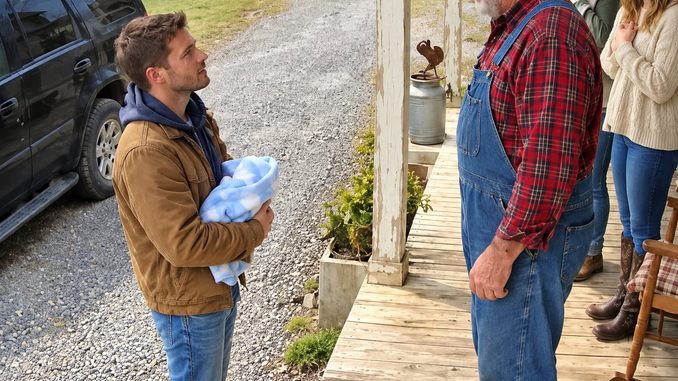
He walked around to the passenger side, opened the door, and carefully lifted something from the seat.
At first, I couldn’t understand what he was holding.
Then I saw the faded blue fabric.
It was the blanket I’d wrapped around him twenty-five years earlier—and when Sarah recognized it, her face suddenly went pale.
Part 4: My Son Returned After Twenty-Five Years—And Brought the Blanket I Thought Was Lost
I stood frozen on the porch as Noah approached with the faded blue blanket folded carefully across his arms. The fabric was worn, its edges frayed, but I recognized the crooked stitching near one corner.
I’d sewn that patch myself when Noah was three years old.
“Where did you find that?” I whispered.
Noah smiled.
“I never lost it, Dad. I took it with me when I left home.”
My hands began trembling.
For twenty-five years, that blanket had represented the evening my life changed forever. I’d found Noah crying beside a muddy field, wrapped in the same blue fabric, with nobody there to protect him.
Now the baby I’d carried into the hospital was standing before me as a grown man.
Sarah stepped forward.
“You brought an old blanket all this way?” she asked. “What exactly is that supposed to prove?”
Noah turned toward her.
“That I remember where I came from.”
Sarah folded her arms.
“A blanket doesn’t change the fact that Michael isn’t your biological father.”
I felt the familiar ache in my chest.
I’d heard those words for twenty-five years, but hearing them while Noah stood beside me was somehow worse.
Before I could speak, my son reached into his jacket.
“Actually, Aunt Sarah, there’s something else I brought.”
He removed a brown envelope and placed it on the porch railing.
Across the front were the words County Adoption Records.
Sarah frowned.
“What is that?”
“The paperwork Dad completed when I was little. The final adoption order, along with the records from the hospital and child protective services.”
Noah carefully opened the envelope.
He showed Sarah the documents confirming that I’d legally adopted him years earlier.
“You’ve spent my entire life telling people I wasn’t his real son,” Noah said. “But he’s been my father in every way that matters, including legally.”
Sarah glanced at the papers.
“I didn’t know he’d actually adopted you.”
“You never asked,” Noah replied. “You just decided what you wanted to believe.”
One of the neighbors looked away.
Sarah’s expression tightened.
“I’m only saying that blood matters.”
Noah nodded slowly.
“Then let me tell you what else matters.”
He turned toward the porch.
“When I was little, Dad worked before sunrise so I could eat breakfast. He wore boots with holes in them so I could have school shoes. And when people made fun of me for being abandoned, he was the one who showed up.”
I covered my mouth.
Noah continued, his voice trembling.
“When I left home, he gave me his last forty dollars. He didn’t tell me it was all he had, but I knew.”
“Son,” I whispered, “you don’t have to explain any of that.”
“Yes, Dad. I do.”
He looked directly at Sarah.
“You keep saying he wasted his life on me. But everything good I’ve accomplished started with someone who decided I was worth raising.”
Sarah lowered her eyes.
For once, she had nothing to say.
Noah climbed the porch steps and placed the blanket in my hands.
I pressed it against my chest, remembering the newborn who’d stopped crying when I first picked him up.
“I thought you might have thrown this away,” I admitted.
“Never.”
He reached into the envelope again.
“There’s another reason I came home.”
I watched him unfold a second document.
It looked official, with signatures and a property description printed across several pages.
Noah handed it to me.
I adjusted my glasses.
At the top, I recognized the address of the farmhouse where I’d lived for decades.
My heart began pounding.
“What is this?”
“Read the owner’s name, Dad.”
I looked down.
For a moment, I couldn’t understand what I was seeing.
Then I found the name.
Michael Carter.
I stared at Noah.
“Son, this must be some kind of mistake.”
He shook his head.
“No mistake. I bought the house and arranged for the deed to be transferred into your name.”
Sarah gasped.
“You bought this property?”
Noah nodded.
“The owner agreed to sell. I worked with an attorney to complete the purchase and transfer.”
I looked from the document to the sagging porch, the cracked driveway, and the old farmhouse I’d spent most of my adult life renting.
“But Noah, you shouldn’t have spent your money on me.”
He smiled through tears.
“Dad, you spent eighteen years making sure I had a home. I wanted to make sure you’d always have one too.”
My knees weakened, and I lowered myself into the porch chair.
For years, I’d worried that the landlord might sell the property and leave me with nowhere familiar to go.
Now Noah was telling me that the house belonged to me.
But before I could find the words to thank him, Noah took another envelope from his jacket.
“And Dad,” he said quietly, “the house isn’t the only thing I’ve taken care of.”
I looked at the second envelope, realizing my son had returned with another surprise—and I had no idea what he was about to reveal.

Part 5: My Son Gave Me the Home I Could Never Afford—Then Said Something That Broke My Heart
I stared at the second envelope in Noah’s hand, still struggling to believe that the farmhouse I’d rented for decades now belonged to me.
“Son, what else could you possibly have done?” I asked.
Noah sat beside me on the porch and opened the envelope.
Inside were copies of receipts, bank confirmations, and a contractor’s estimate. He spread them carefully across the small wooden table.
“The overdue property charges have been settled, Dad. And I’ve already arranged for someone to repair the roof, replace the damaged porch boards, and fix the heating system before winter.”
I looked at the papers without speaking.
For years, I’d placed buckets beneath the leaking ceiling whenever it rained. During winter, I’d worn two sweaters indoors because I couldn’t afford to replace the old heating equipment.
Now my son was telling me those worries were over.
“Noah,” I whispered, “you’ve already done too much.”
He shook his head.
“Not nearly as much as you did for me.”
Sarah stood beside the porch railing, watching us with an expression I couldn’t read.
“You must be doing very well for yourself,” she finally said.
Noah looked at her.
“I’ve worked hard, Aunt Sarah. I finished school, built my career, and saved what I could. Dad taught me that money matters, but what you do with it matters more.”
Sarah glanced toward the farmhouse.
“I suppose Michael was lucky you turned out successful.”
Noah’s expression changed.
“Lucky?”
She hesitated.
“Well, you know what I mean.”
“No,” he answered. “Dad didn’t take me home because he expected me to become successful. He didn’t know whether I’d ever have a good job or enough money to help him.”
Sarah looked down.
“He took me home because I needed someone,” Noah continued. “He loved me when I had absolutely nothing to offer him.”
I reached for his hand.
“That’s enough, son.”
But Noah gently squeezed my fingers.
“Dad, I’ve wanted to say this for years.”
He turned toward me.
“When I was eighteen, you gave me your last forty dollars at the bus station. You told me a father should send his son into the world with something in his hand.”
I remembered that morning perfectly.
The bus had been waiting, and I’d tried desperately not to cry as Noah prepared to leave.
He smiled through his tears.
“Well, a son should be able to send his father into old age knowing he’ll always have a roof over his head.”
Something inside me finally gave way.
I leaned forward, wrapped my arms around him, and cried against his shoulder.
I’d spent twenty-five years trying to be strong for Noah. I’d hidden my worries, skipped meals, and pretended that every sacrifice was easy because I never wanted him to feel like a burden.
Now he was holding me the same way I’d once held him.
“Thank you, son,” I whispered.
“No, Dad. Thank you for choosing me.”
Behind us, Sarah began crying.
“Michael, I didn’t understand,” she said. “I thought you were throwing your life away.”
I looked at my sister.
“You told me that often enough.”
She wiped her cheeks.
“I was wrong.”
Noah turned toward her.
“You were wrong about what makes someone family.”
Sarah nodded but didn’t try to defend herself.
For the first time, I believed she understood how much her words had hurt us.
Later that afternoon, the neighbors went home, and Sarah quietly said goodbye.
Noah stayed.
We carried the faded blue blanket into the kitchen and placed it beside his old school photograph, the one where he was missing a front tooth and smiling proudly at the camera.
He noticed the childhood drawing still hanging near the window.
“You kept that?”
“Of course.”
The paper had yellowed, but the word Dad was still visible above the stick figure beside the tractor.
Noah laughed softly.
“I wasn’t much of an artist.”
“You were the best artist in my house.”
After supper, he went outside with a toolbox and began repairing the loose porch step.
I sat nearby with a warm cup of coffee, watching him work.
“You know,” I said, “I used to wonder whether I gave you enough.”
Noah stopped tightening a screw.
“Dad, you gave me everything that mattered.”
I looked across the fields where I’d spent so many years working.
For most of my life, I’d measured each day by what I could afford. I’d worried about rent, groceries, electricity, and whether my son would have enough to eat.
But sitting on that porch, I finally understood that my life hadn’t been defined by what I lacked.
It had been defined by the little boy I’d chosen to love.
Noah finished repairing the step and tested it with his boot.
“That should hold for years,” he said.
I smiled.
“Just like us.”
He sat beside me as the evening settled over the farmhouse.
Inside, the faded blue blanket rested on the kitchen table. Outside, the house was finally mine, and my son was home.
Twenty-five years earlier, I’d found an abandoned baby in the mud and carried him toward a future I couldn’t possibly predict.
I hadn’t saved him because I expected anything in return.
I simply couldn’t leave him alone.
And now, after all those years, the child I’d once held against my chest had returned to make sure I would never face old age alone.
I had spent my life believing I’d rescued Noah. But the greatest gift was discovering that, in loving him, I’d been given a family worth more than anything money could buy.
Leave a Reply