Part 1: The Seat Beside My Daughter
My son Oliver was only six weeks old, and this was my first flight alone with him and my ten-year-old daughter, Emma. I had tried to make the journey as manageable as possible, so I paid extra to reserve two seats together with more legroom. Emma would sit beside me while Oliver stayed secured against my chest in his baby carrier.
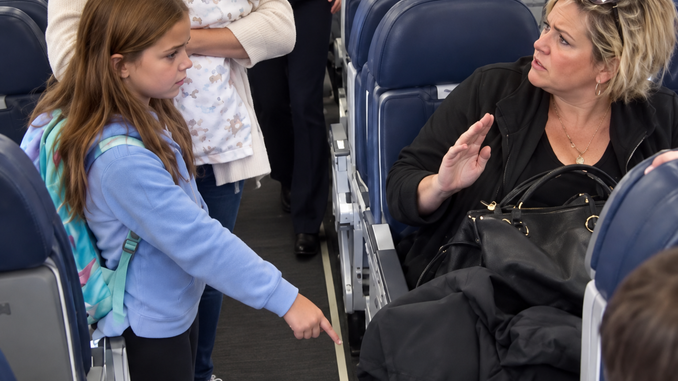
When we reached row eleven, a woman was already sitting in Emma’s assigned seat. Her coat occupied the space beside her, an oversized handbag blocked part of the aisle, and she had taken off her shoes.
“Excuse me,” I said. “I believe that’s one of our seats.”
The woman glanced at Oliver, who was asleep against my chest. Then she put her headphones back on and said she was already settled.
I showed her our boarding passes and explained that I had paid to reserve both seats. She pulled one headphone away.
“Women traveling with babies always expect everyone else to change their plans,” she said loudly. “You chose to bring two children onto this flight. That isn’t my problem.”
Passengers nearby turned toward us. Emma stood beside me, holding both straps of her backpack, while Oliver shifted in his carrier. I had expected a seating mistake we could clear up quickly; now the aisle was filling behind us.
A flight attendant arrived and compared our boarding passes with the woman’s ticket. Somehow, Emma’s seat appeared to have been assigned twice. The attendant told me there was an empty seat three rows behind us and asked whether I would take it so boarding could continue.
I looked at Emma. “You want me to leave my ten-year-old daughter beside a complete stranger?”
The attendant promised to check on her. The woman asked why she should move and pointed at Oliver as though my sleeping baby were the cause of the delay. Behind us, passengers sighed and complained.
“It’s okay, Mom,” Emma whispered. “I can stay here.”
I did not want to agree. I had reserved adjoining seats precisely so I could look after both children without leaving Emma on her own. But the attendant repeated her promise, the aisle remained blocked, and Oliver was beginning to stir. At last, I helped Emma into the seat.
As she sat down, she noticed something caught beneath the woman’s leg. Her expression changed.
“Ma’am, I think you might be sitting on—”
“Stop bothering me,” the woman snapped without looking at her.
I kissed Emma’s forehead and moved back to row fourteen with Oliver. Three rows did not sound far, but from my seat I could see my daughter only through gaps between the headrests. She gave me a reassuring smile, though she looked uncomfortable beside the woman.
About ten minutes after takeoff, the seatbelt sign went off. The woman stretched her legs into the extra space I had paid for. Then Emma spoke clearly enough for the nearby rows to hear.
“Ma’am, my mother taught me that embarrassing someone in front of strangers is wrong. That’s why I tried to tell you quietly before the plane took off.”
The woman told her to keep quiet. Emma unfastened her seatbelt, opened her backpack, and stepped into the aisle. As a flight attendant approached, my daughter took out a small object—the thing she had noticed trapped beneath the woman’s leg.
The attendant looked at what Emma was holding. Then she turned to the woman and asked her to stand.
Part 2: What Emma Found Beneath Her Seatmate
From row fourteen, I could see Emma bending toward her backpack, but I could not tell what she was doing. Oliver had just begun to fuss, and I was trying to settle him without losing sight of my daughter between the headrests.
The woman beside Emma had stretched both legs into the extra space. She was looking at her phone, apparently finished with the argument now that I had been moved away. Emma, meanwhile, kept glancing toward the edge of the woman’s seat.
I remembered the sentence she had tried to say before takeoff. She had seen something beneath the woman’s leg, and the woman had refused to let her finish. Now that the woman had shifted, Emma seemed able to reach it.
She slipped one hand down beside the seat and drew something small into her palm. She looked at it closely, then placed it in the front pocket of her backpack. I nearly called out to ask what she was doing, but she looked up at the woman first.
“Ma’am,” Emma said, “I tried to tell you about something before we took off.”
The woman pulled off one headphone. “Are you still talking about that?”
Emma kept her voice even. “My mom taught me to tell someone quietly if I can save them from being embarrassed.”
Several people nearby turned toward them. I leaned forward, wishing I were close enough to see Emma’s face.
“Then you should have stayed quiet,” the woman said.
Emma opened her backpack and took out the object. At first, I saw only a flash of silver between her fingers. She unfastened her seatbelt and stepped into the aisle so the woman could see it properly.
“Is this yours?” Emma asked.
The woman went still. Her eyes moved from the object to Emma, then toward the passengers watching from the opposite row.
“Where did you get that?” she asked.
“It was trapped under your leg. I saw it when I sat down.”
A flight attendant started toward them. I rose halfway from my seat, but the passenger beside me had her tray down, and Oliver was restless against my chest. The attendant reached Emma first.
Emma held out the object. The attendant bent to examine it, and her expression grew serious.
The woman crossed her arms. “I didn’t put anything there.”
“I didn’t say you did,” Emma replied.
That was my daughter: frightened enough to grip her backpack strap with her free hand, yet still careful about what she accused someone of doing. She had tried to warn the woman privately. Only after being dismissed twice had she shown the attendant what she found.
The attendant turned the little silver object in her hand. A red symbol was engraved on one side; on the other was a narrow plate with writing too small for me to read from where I stood. She asked Emma to remain beside the row, then addressed the woman quietly.
The woman shook her head.
The attendant repeated herself, loud enough this time for me to hear. “Ma’am, please stand so I can check the seat.”
Emma stepped back. The woman gripped the armrest but did not rise. Across the aisle, a man who had been looking under his seat since takeoff leaned forward to see what the attendant held.
Then the attendant read the name engraved on the silver plate, and he was on his feet before she finished saying it.

Part 3: The Name on the Silver Bracelet
“Sophie Harris,” the flight attendant read.
The man across the aisle reached for the seat in front of him to steady himself. A little girl beside him held her bare wrist against her chest.
“That’s my daughter’s,” he said. “We’ve been searching for it since we boarded.”
The attendant showed him the bracelet. Its silver plate carried Sophie’s name and information about a serious allergy. Her father explained that she wore it whenever they traveled, in case she needed help and could not speak for herself.
Emma held it out to him. Sophie’s father fastened it around his daughter’s wrist and checked the clasp twice. Sophie looked at Emma and whispered, “Thank you.”
The woman in Emma’s seat had finally stood, though she stayed close enough to take it again. “I didn’t know that thing was there,” she said. “Don’t look at me like I took it.”
“No one said you took it,” Emma replied.
“Then why make a scene?”
Emma glanced at me. By then I had reached row eleven with Oliver, who had settled against my chest again. I put my hand on her shoulder.
“She tried to tell you before takeoff,” I said.
The flight attendant asked Emma exactly where she had found the bracelet. Emma pointed to the edge of the cushion, where it had been caught beneath the woman’s leg. She explained that she had been able to pick it up only after the woman stretched out when the seatbelt sign went off.
The attendant thanked her. Then she asked the woman to remain in the aisle while she checked the seating issue again. I watched her read the paper pass more slowly than she had during boarding. She called another crew member over, and the two of them spoke quietly near the galley.
Sophie’s father sat beside his daughter again. “I should have searched that side of the aisle,” he told Emma.
“You couldn’t see it,” she said. “I almost couldn’t either.”
The crew member returned with the attendant. There was an available seat in row fourteen—the seat I had taken so Emma would not have to move. He asked the woman to go there while Emma and I occupied the two seats I had reserved together.
The woman opened her mouth, looked around at the passengers watching, and began gathering her belongings. She pulled her coat off the armrest, lifted her bag from the floor, and followed the crew member down the aisle.
I sat beside Emma at last. For the first time since boarding, I could tend to Oliver without twisting around to check on her. Across from us, Sophie raised her wrist so Emma could see that the bracelet was secure.
Emma gave her a small wave. She looked tired, and I wondered how much of the flight she had spent worrying about that silver band while I thought she was worrying only about the seat.
The attendant came back with an apology. She said she would document the dispute and left the woman’s paper boarding pass on our tray table while she checked a detail with her colleague. I took out my phone to compare the seat numbers again.
Emma leaned toward the paper. “Mom,” she whispered, pointing above the row number. “Why does her ticket have my name on it?”
Part 4: The Ticket That Wasn’t Hers
The name above the seat number was Emma Walker.
For a moment, I wondered if the attendant had left one of our own boarding passes on the tray table. Then I remembered the paper the woman had handed her during boarding. The attendant had compared its seat number with ours and concluded that row eleven had been assigned twice.
I opened the airline app on my phone. Emma’s boarding pass was still there, showing the same seat printed on the paper.
I called the attendant back before she reached the galley. “Is this the pass that woman showed you?”
She took the paper and checked the name. The look on her face told me she recognized the mistake before she answered.
“Yes. I’m sorry—I checked the seat number when we boarded, but I didn’t check the passenger’s name.”
Across the aisle, Sophie’s father looked up. Emma sat very still beside me. She had endured the woman’s comments, spent the first part of the flight away from me, and found Sophie’s bracelet. Now the paper in the attendant’s hand raised a different question.
“How did she get a pass with my daughter’s name on it?” I asked.
The attendant said she needed to speak with the other passenger. She asked a colleague to stay near our row, then walked back to row fourteen. I could hear the woman say there must have been a mix-up at the gate.
The attendant asked to see identification and any other boarding documents she had. After some rustling, the woman produced a second pass. This one carried her own name and assigned her to the seat she was now occupying in row fourteen.
“She had a ticket for that seat all along?” I asked when the attendant returned.
“Yes.” She paused. “We’re still establishing how Emma’s paper pass came into her possession.”
I remembered the moment at the gate when my phone had frozen. A staff member had printed a copy of Emma’s pass while I adjusted Oliver’s carrier and reached for my bag. I had assumed I’d put the paper away, but I could no longer picture doing it.
The attendant wrote down what I recalled. She said the crew would file a report and ask gate staff to review the boarding records after we landed. She also apologized directly to Emma for leaving her apart from me.
Sophie’s father leaned across the aisle. “There was a loose paper near the gate,” he said. “I saw it on the floor when we were lining up. I didn’t see what happened to it.”
The attendant added that detail to her notes. It suggested how the pass might have been lost, but it did not explain who had picked it up.
For the rest of the flight, Emma rested against me while Oliver slept. I wanted to ask whether she had seen anything at the gate. She had been beside me then, and she had noticed the bracelet when no one else did. But she was exhausted, so I let her rest.
When we landed, the attendant gave me a report number and asked us to wait near the front of the plane. The woman from row fourteen passed us on her way out, carrying her coat over one arm.
Emma watched her go. Then she tugged my sleeve.
“Mom,” she said, “I saw her pick up the paper before we boarded.”

Part 5: What My Daughter Had Seen
Emma kept her eyes on the doorway where the woman had disappeared.
“She picked it up near your bag,” she told me. “I thought she was going to hand it back, but she put it in her coat pocket.”
I remembered struggling with Oliver’s carrier at the gate while the agent printed the pass. It could have slipped from my hand without my noticing.
“Why didn’t you say anything?” I asked.
“I didn’t know it was our ticket.” Emma looked worried. “Did I do something wrong?”
“No. You’re telling me now.”
The flight attendant listened while Emma described where the woman had stood and what she had done. She asked us to wait as the other passengers left, then called a gate supervisor to the plane.
Sophie and her father passed our row on their way out. Sophie stopped long enough to show Emma the silver bracelet fastened securely around her wrist. Her father thanked us again, and I watched Emma smile for the first time since boarding.
A few minutes later, the supervisor arrived. The attendant showed her both the written report and Emma’s paper pass. I told her what I remembered about the gate; Emma explained what she had seen. We were careful to separate what we knew from what we suspected.
The supervisor said she would speak with the woman and check the boarding records. She could not promise an answer while we stood on the plane. She could confirm something simpler: the woman’s own ticket had always assigned her to row fourteen. The pass she used to claim Emma’s seat carried Emma’s name.
“I’m sorry we moved your daughter away from you,” the supervisor said.
I glanced at Emma. During boarding, I had felt the impatient line of passengers behind us and Oliver beginning to wake. I had accepted a solution that left my daughter beside a woman who had already been unkind to her. Whatever the supervisor found out, I wished I had asked her to check the name on the ticket before we took off.
The supervisor arranged a refund of the extra seat charge and gave me a number for following up. She also told Emma that she had done the right thing by bringing Sophie’s bracelet to the attendant.
We finally left the plane. In the terminal, the woman was speaking with an airline employee near the gate desk. She looked up when we passed. I kept walking with Oliver against my chest and Emma beside me.
On the ride home, Emma watched the traffic through the window. After a while, she asked whether the woman would be angry with her for telling us about the pass.
“She may be,” I said. “That doesn’t mean you should have kept quiet.”
Emma thought about that. “I didn’t want everyone looking at us again.”
“I know.” I reached for her hand. “Next time something’s wrong with our seats, I’ll stay with you until it’s sorted out.”
She squeezed my fingers. Oliver slept through the rest of the drive, and Emma leaned against my shoulder. When we reached home, I carried him inside while she held the door open for us.
Leave a Reply