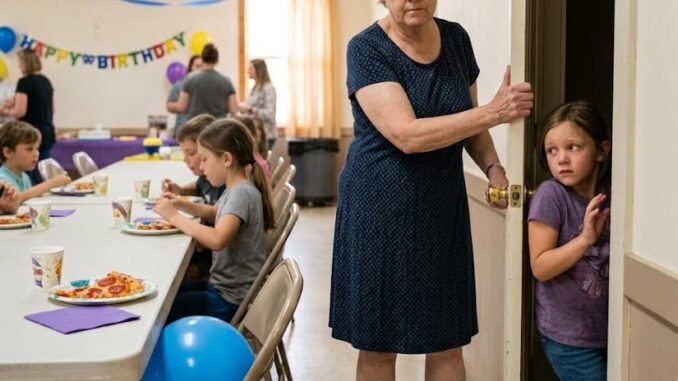
The first thing I noticed at Greg’s birthday party was not the sheet cake, the blue balloons, or the relatives crowding around the gift table.
It was the empty chair beside the children’s plates.
The rented hall smelled like pizza, burnt coffee, and the lemon cleaner someone had used on the beige carpet before we arrived.
Fluorescent lights hummed overhead while Greg’s father told a fishing story with a plastic fork in his hand.
Amber, Greg’s 15-year-old daughter, was laughing with her cousins.
Mason, his 12-year-old son, was stealing chips from her plate and pretending he was not.
They were Greg’s children from his first marriage, and they looked exactly the way children should look at their father’s birthday: comfortable, distracted, and certain they belonged.
June’s paper cup was still beside an untouched slice of pizza.
Her purple napkin was folded into the triangle she had proudly made five minutes earlier.
But June was gone.
“Where’s June?” I asked.
Mason looked beneath the table.
Amber frowned and said, “I thought she was with you.”
That was when the room stopped feeling ordinary.
I checked the hallway first, expecting to find June by the vending machine or washing frosting from her hands.
The smaller side room had been set aside for extra coats, paper goods, and anything the family did not want cluttering the main space.
Its door was almost closed.
Through the gap, I saw the toe of one small sneaker swinging under a round table.
When I pushed the door open, June stopped moving.
She sat alone behind a stack of paper plates with both hands flat in her lap.
She was not crying.
She was not angry.
She was trying to disappear.
“Hey, bug,” I said, crouching beside her. “Did you want a break from the noise?”
She shook her head.
“Did someone tell you to sit in here?”
She nodded once.
“Who?”
“Grandma Janet.”
My body went very still.
“Why did Grandma Janet tell you to sit here?”
June glanced toward the door before answering.
“She said the other room was for Daddy’s real children.”
She repeated the sentence carefully, as though she had been worried she might get in trouble if she quoted it wrong.
Then she placed both hands on her own shoulders.
“I tried to go back, but she held me here and moved me out.”
Her fingers pressed harder than they needed to.
“Then she shut the door.”
The party was only ten feet away.
People were laughing, pouring coffee, and deciding which corner of the cake had the most frosting while my 7-year-old sat behind a wall of paper plates wondering whether she counted as family.
“Mom,” she whispered, “am I not Daddy’s real child?”
I took both of her hands.
“You are Daddy’s daughter,” I said. “You are my daughter. You belong at that table.”
She stared at my face, looking for doubt.
Children do that when an adult has handed them a cruelty too large to understand.
They search the next adult for confirmation.
I made sure she found none.
Inside, I wanted to drag Janet into the hallway and demand that she repeat the sentence while looking at June.
I wanted every person in the main room to hear what she had done.
Instead, I asked June whether Janet had hurt her.
June said no, but her shoulders remained tucked close to her ears.
That told me enough.
I kissed her forehead and said, “Stay here for one minute. I am getting Daddy.”
She grabbed my wrist.
“Is he going to be mad at me?”
The question nearly broke me.
“No, sweetheart,” I said. “Not at you.”
Greg was near the cake table while Steve, his father, pointed at the frosting as though the fish from his story might still be swimming through it.
I touched Greg’s arm.
“I need you for a second.”
He saw my face and followed me behind a stack of folding chairs.
“June is in the side room,” I told him. “Your mother said the main room was for your real children.”
Greg blinked once.
I kept going.
“June says Janet put her hands on her shoulders, moved her out, and closed the door when she tried to come back.”
Greg did not say June must have misunderstood.
He did not ask me to wait until after the cake.
He did not tell me it was his birthday and beg me not to make a scene.
He looked at the nearly closed door.
“She said that to June?”
“Yes.”
His jaw tightened.
“Show me.”
That response mattered because Janet had been surviving on doubt for years.
When Greg and I met, he was still legally married, which was the only part of the story Janet ever wanted to repeat.
The rest was less useful to her.
Greg and Michelle had already separated.
He lived in a small apartment above a dentist’s office, and Michelle stayed in the family house during the school week.
They shared a calendar, bills, and responsibility for Amber and Mason.
They did not share a life.
On our third coffee, Greg told me the divorce was not final and that he had two children.
“I’m not looking for a secret,” he said.
“Then we go slow,” I answered. “Or we do not go at all.”
He agreed.
Six months later, Michelle met me at a school concert.
The conversation was stiff but honest.
“The kids know who you are,” she said. “I need adult behavior from everyone.”
“That is what I want too,” I told her.
Amber and Mason were never pushed into calling me Mom.
I learned their routines quietly.
I learned which snacks disappeared first, which school pickup line moved faster, and which hoodie Mason would insist was lost while it sat in plain sight.
I treated progress like something delicate.
Janet treated the entire relationship like evidence.
At the first family cookout, Greg introduced me as his girlfriend.
Janet smiled with only half her face and said, “Oh, your friend.”
Later, she told her sister that some people moved on quickly.
She said it loudly enough for me to hear and softly enough to deny aiming it at me.
That became her method.
She would say something sharp.
Greg would object.
Janet would insist the sharp thing had never been sharp at all.
By dessert, everyone would be drinking coffee and pretending the argument had evaporated.
Small cruelty survives because families keep mistaking quiet for peace.
When I became pregnant with June, Greg called Janet from our kitchen.
He was smiling so widely that his eyes almost disappeared.
“Mom, we are having a baby.”
There was a pause.
Then Janet said, “Well, that was fast.”
Greg’s smile fell.
“We are happy,” he said. “You can be happy for us.”
“Of course,” Janet answered. “Do not be sensitive.”
After June was born, the differences became harder to ignore.
Amber and Mason received warm hugs, wrapped gifts, and private jokes.
June received polite smiles and whatever happened to be easiest.
At one dinner, Janet gave the older children presents and handed June a coloring sheet from the restaurant.
Greg called her the next morning.
“You do not get to make one child feel like a guest,” he said.
Janet accused me of creating problems.
Greg told her the problem had happened in front of him.
For a while, we shortened visits.
We stopped leaving June alone with Janet.
Greg stayed in the room whenever possible.
Janet behaved when he was watching.
She was careful, not kind.
After Thanksgiving, Greg confronted her in our driveway.
“You can dislike how my life changed,” he said, “but you cannot punish June for existing.”
Janet cried.
Steve looked uncomfortable.
Then Janet said she loved all of her grandchildren.
“Then act like it when nobody is applauding,” Greg told her.
We had three quiet months after that.
Janet returned with polite texts and a promise to move forward.
By the time Greg’s birthday arrived, I wanted to believe she meant it.
She hugged Amber first.
She asked Mason about basketball.
She touched June’s shoulder and said, “You are getting tall.”
I remember telling Greg, “Maybe she is trying.”
Ten minutes later, June’s chair was empty.
In the side room, Greg pulled out the chair beside June and sat down.
He lowered himself until they were eye to eye.
“Junie,” he said, “your mom told me Grandma said something that hurt you. Can you tell me what happened?”
June looked at me and then at him.
“Grandma said the other room was for your real children.”
Greg placed his hand over hers.
“What did she do after that?”
“She pushed me by my shoulders and shut the door.”
A muscle moved in his cheek.
“Listen to me,” he said. “You are my daughter. You are my real child. Nothing anyone says can change that.”
June searched his eyes.
Then she nodded.
Greg stood and held out his hand.
“Come with me.”
He walked back into the main room with June beside him.
Not behind him.
Not hidden.
Beside him.
People glanced over because the birthday boy had stopped smiling.
At the children’s table, two folding chairs sat open.
One held a gift bag.
The other held Mason’s hoodie.
There had never been a space problem.
Greg moved the gift bag to the floor.
Amber pulled June’s chair out.
Mason pushed the roll basket toward her.
Then Greg tapped his glass with a fork.
The clink was small, but it cut through every conversation.
People turned toward him expecting a thank-you speech.
Greg thanked everyone for coming.
He told Amber and Mason he was proud of them, making it clear they had done nothing wrong.
Then he rested one hand on June’s shoulder.
“I am grateful for my youngest daughter,” he said, “who should never have to wonder whether she belongs in a room with her family.”
The room changed.
Greg looked at Janet.
“A few minutes ago, my mother told my daughter to sit in another room because she was not my real child.”
Forks stopped moving.
A paper cup hovered near Aunt Carol’s mouth.
Coffee continued dripping into the plastic tray beneath the urn.
One cousin stared at the gift bag on the floor.
Nobody moved.
“Mom,” Greg said, “I am asking you to leave.”
Janet went pale before she went red.
Embarrassment reached her faster than shame.
“What?” she said with a small laugh. “I did not say it like that.”
Greg did not argue over tone.
He did not give her a dozen details to twist.
He simply waited.
“There was not enough space at the children’s table,” Janet said. “I thought June would be more comfortable in the other room.”
Everyone could see the two empty chairs.
One cousin picked up the gift bag and then froze, realizing that even moving it admitted the truth.
A paper plate slid from a stack and slapped the carpet.
“Please leave,” Greg said.
The softer he spoke, the harder the sentence landed.
Steve stepped forward.
“Do not talk to your mother like that.”
Greg looked at him.
“Please do not make this harder.”
Steve glanced at June.
For once, he stopped.
Janet tried another direction.
“This is humiliating,” she said. “At your own birthday party?”
Greg held June’s hand.
“What you did to her was humiliating.”
Janet reached for her purse.
Then she turned toward Amber and Mason.
“I hope you two know I love you.”
The sentence was aimed like a weapon.
Greg stepped between the words and the children.
“Amber and Mason are not part of this,” he said. “Do not use them to make yourself look wounded.”
Amber looked up sharply.
Mason stopped tearing the corner of his napkin.
In that moment, Greg protected all three children without asking any of them to compete for it.
Janet collected her coat slowly.
She checked the pockets and smoothed the sleeves as though dignity could be restored by careful folding.
Steve put down his plate and followed her.
At the door, Janet turned back.
“You will regret doing this in front of everyone.”
Greg’s face did not change.
“No,” he said. “I regret not doing it sooner.”
The hallway light framed them for one second.
Then Steve opened the door, and they left.
The party did not restart immediately.
Truth does not land in the middle of a sheet cake and then politely excuse itself.
Aunt Carol asked who wanted coffee.
Someone moved the gift bag.
Amber pulled June’s chair closer to hers.
Mason passed her another roll.
Greg cut the cake and gave June the first corner slice.
It was not a prize.
It was a correction.
Before we left, Amber leaned toward June.
“You can sit by me next time,” she whispered.
June nodded without looking up from the frosting.
At home, the balloons sagged in the hallway while the leftovers sat untouched on the kitchen counter.
June sat on the living room rug changing her doll’s dress.
Greg lowered himself beside her.
“I want to say it again while it is quiet,” he said. “You are my daughter. You are Amber’s sister and Mason’s sister. You belong with us.”
June kept working a tiny plastic shoe onto the doll’s foot.
“Grandma sounded sure,” she said.
“Grandma was wrong,” I told her. “Adults can be wrong loudly.”
That earned the smallest hint of a smile.
Greg opened his arms but did not pull her in.
After a few seconds, June crawled into his lap.
Later, she asked whether she had to call Janet the next day.
“No,” Greg said. “You do not have to fix what an adult broke.”
After June fell asleep, Greg opened his laptop at the small desk in our bedroom.
The screen showed his banking app and the recurring-payment list.
For the previous year, he had sent his parents money every month to help cover the mortgage they had never finished paying.
The transfer was scheduled for the first of the month.
The memo line said “family help.”
Greg stared at it.
“I kept telling myself it was for Dad too,” he said. “And because they are my parents.”
I sat on the edge of the bed.
“What are you thinking?”
He clicked into the transfer details.
“I am thinking my daughter was removed from a family room by someone whose mortgage I help pay.”
He canceled the recurring transfer.
Then he downloaded the bank’s cancellation confirmation and saved it in a plain folder.
Real consequences often arrive without music.
Sometimes they are a checkbox, a confirmation number, and a person finally refusing to finance their own humiliation.
Greg opened a message to Janet and Steve.
“After what happened today, I will no longer cover any portion of your mortgage,” he wrote. “June will not have unsupervised contact with Mom. Any future visits with her will be supervised.”
He read it twice.
Then he sent it.
The screen showed Delivered.
Neither phone rang.
For once, Janet had no immediate script.
The next afternoon, Steve called first.
Greg let the call go to voicemail and listened while we folded laundry at the kitchen table.
“Your mother is upset,” Steve began.
Then his voice changed.
“What she said was wrong. I should have said that yesterday.”
Greg did not call back immediately.
He sent one text.
“I am willing to talk later. The boundary stands.”
Other relatives reached out quietly.
One cousin wrote, “I saw the chairs. You did the right thing.”
Aunt Carol left a message saying June could sit beside her at every future party.
Amber texted Greg to ask whether June was okay.
Michelle sent me one sentence.
“I am glad he handled it without putting the older kids in the middle.”
The story Janet had controlled for years began to collapse because too many people had finally seen the same thing at the same time.
She had not been misunderstood.
She had been witnessed.
A year later, Greg still does not pay his parents’ mortgage.
Steve reaches out on his own and sees June only when Greg or I are present.
Janet remains at a careful distance.
Public visits.
Supervised contact.
No closed doors.
No separate rooms.
She never gave the kind of apology people expect in movies.
But the unequal gifts stopped.
The little comments stopped.
The ranking stopped.
June is eight now.
She walks into family rooms as though she has a right to a chair because she does.
Sometimes she saves seats for Amber, Mason, Greg, and me before anyone else arrives.
Greg always notices.
He goes quiet for a second, then sits wherever she points.
That birthday could have taught her to ask permission to belong.
Instead, her father made the room answer her.
I do not call what happened forgiveness.
I call it a boundary that held
Leave a Reply