Part 1: Thirteen Minutes Before the Wedding
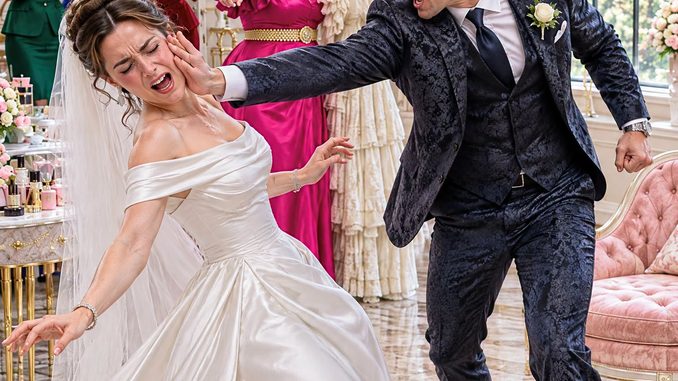
Thirteen minutes before my wedding ceremony, my fiancé demanded that I remove my late grandmother’s wedding dress and replace it with his mother’s gown. When I refused, he struck me across the face while his mother stood nearby, watching with a satisfied smile.
My name is Hazel Reyes, and I was supposed to marry Grant Whitaker on October 17 at Hollister House in Worthington, Ohio. One hundred and sixty-four guests were waiting downstairs, unaware that the relationship I had spent five years protecting was about to collapse.
Forty minutes earlier, my father had carefully fastened the thirty-two silk-covered buttons running down the back of my grandmother’s ivory wedding dress. His hands trembled slightly as he worked, and he counted each button in Spanish to make sure he didn’t miss one.
The gown had belonged to Nana Ruth, who wore it when she married my grandfather in 1962. She had passed away two years earlier, leaving me the dress and a handwritten message reminding me to marry someone patient enough to appreciate those thirty-two buttons.
I had treasured that advice since childhood, and wearing her gown was my way of keeping her close on the most important day of my life. Unfortunately, Grant’s mother, Lorraine Whitaker, had other plans.
Grant entered the bridal suite carrying a clear garment bag containing Lorraine’s old wedding dress. Its yellowed sequins, oversized sleeves, and stiff satin looked nothing like the delicate gown I had dreamed of wearing.
“Take that dress off, Hazel. You’re wearing my mother’s gown, or there won’t be a wedding.”
Lorraine stood against the closed door, her arms folded across her champagne-colored dress. She made no effort to calm her son, although she knew how much my grandmother’s gown meant to me.
“Grant, please. The ceremony starts in thirteen minutes, and this dress belonged to Nana Ruth.”
He accused me of disrespecting Lorraine and claimed she had spent the entire morning crying because I refused to honor their family tradition. I reminded him that I had explained my decision respectfully months earlier, but he continued moving closer.
“My mother sacrificed everything for me. You could show her some respect for once.”
Before I could answer, Grant slapped my left cheek with enough force to turn my head. My pearl earring fell onto the wooden floor, and I stood motionless, struggling to comprehend what had just happened.
When I looked toward the mirror, I saw Lorraine smiling behind him. She hadn’t appeared surprised or concerned, and her expression made me realize that humiliating me had been the purpose of their confrontation.
For five years, I had overlooked Grant’s controlling behavior and excused Lorraine’s constant interference. I had convinced myself that patience and compromise would eventually earn their respect, but the events of that afternoon finally destroyed that illusion.
I removed my engagement ring and dropped it onto the garment bag Grant was holding. He stared at it in disbelief before threatening that I would lose everything if I walked away.
“You’ll have no husband, no house, and no family. You’ll have nothing!”
“Time will tell.”
I gathered my grandmother’s skirt and walked toward the door, forcing Lorraine to step aside. Neither of them followed as I entered the hallway and headed toward the grand staircase.
As I passed the mirror, I remembered something I had noticed immediately after Grant struck me. A small black camera was positioned on the bookshelf, and its red indicator light had been glowing throughout our confrontation.
Lorraine had arranged for the wedding to be livestreamed, but she and Grant apparently hadn’t realized that the bridal suite camera was already operating. I understood that their behavior might have been recorded, although I had no idea how many people had witnessed it.
There was another secret they knew nothing about, one hidden inside the forty-seven pages I had signed eleven months earlier. Grant had ignored those documents while talking to his mother in a parking lot, never imagining how important they would become.
As I approached the staircase, I knew the wedding was over. What Grant and Lorraine didn’t understand was that walking away wouldn’t leave me with nothing, and the truth about what I owned would eventually change everything.
Part 2: Five Years of Compromise and a Family Tradition
Five years before my wedding, I was a twenty-four-year-old physical therapist working at a sports rehabilitation clinic in Columbus, Ohio. Grant Whitaker entered my treatment room with an injured shoulder and a charming story about rescuing a neighbor’s barbecue grill during a storm.
I later discovered that he had actually injured himself during a company softball game, but his humor made the exaggeration seem harmless. At twenty-eight, he was a successful regional sales director at Talbot Mechanical, and his confidence made him difficult to resist.
Grant remembered my favorite coffee, brought soup when I was sick, and learned a few Spanish phrases to impress my father. Every morning, he sent an affectionate message that made me feel cherished.
“Good morning, my girl.”
I believed those words represented devotion, never considering how possessive his affection might become. The first warning appeared five months into our relationship, when Grant introduced me to his mother.
Lorraine Whitaker was a fifty-six-year-old hospital billing supervisor who had raised Grant alone after her divorce. Her condominium contained forty-one framed photographs of him, and she constantly reminded everyone of the sacrifices she had made.
During our first dinner, Lorraine deliberately called me Haley instead of Hazel. I corrected her twice, but she continued using the wrong name for another eight months.
“You’re adorable, sweetheart. Grant always did have a soft spot for a project.”
Grant laughed at her remark, and I pretended it didn’t bother me. Looking back, I recognize that evening as the beginning of a pattern in which Lorraine insulted me while Grant dismissed my feelings.
After we moved in together, Grant secretly gave Lorraine a key to our apartment. She entered whenever she pleased, rearranged our belongings, and even threw away homemade salsa my mother had prepared.
She monitored Grant’s location, interrupted our anniversary dinner, and expected him to answer her messages immediately. Whenever I complained, he accused me of being unreasonable.
“She raised me alone, Hazel. Why can’t you appreciate everything she’s done?”
Grant gradually became controlling in other ways, insisting that we share our locations while keeping his own phone private. He selected my clothes for business dinners and embarrassed me with jokes in front of his colleagues.
Two years into our relationship, I suggested spending Easter with my parents instead of Lorraine. Grant responded by gripping my wrist so tightly that faint marks remained the following morning.
He cried when he saw them, apologized repeatedly, and bought me a silver bracelet. I accepted his explanation and promised myself that I would leave if he ever behaved that way again.
Throughout those difficult years, memories of Nana Ruth remained a source of comfort. She had helped raise me, taught me to cook and sew, and encouraged me to value patience and kindness.
When I was sixteen, she allowed me to try on her 1962 wedding dress. As we admired its delicate lace and thirty-two silk-covered buttons, she shared a memory of my grandfather carefully unfastening every button on their wedding night.
“Any man who has the patience for thirty-two buttons has the patience for a marriage.”
Nana Ruth died at eighty-four, leaving me the gown and $138,000 from the sale of her home. Her handwritten note reminded me that I should wear the dress only if it genuinely made me happy.
When Grant proposed on our fourth anniversary, Lorraine was secretly seated nearby, recording everything. She immediately announced that she had helped select my engagement ring, turning our private milestone into another celebration of her influence.
Two days later, Lorraine presented her yellowed wedding gown and asked me to wear it. I politely explained that I had always intended to honor Nana Ruth by wearing her dress.
Lorraine’s expression hardened, although she continued smiling.
“Of course, Hazel. Your family’s traditions always seem to matter more.”
Grant remained silent, leaving me to manage his mother’s disappointment alone. I didn’t realize that my refusal would become the center of an eleven-month campaign designed to make me surrender.
Part 3: Forty-Seven Pages and the Wedding Dress They Tried to Destroy
Throughout our engagement, Lorraine repeatedly pressured me to wear her wedding gown. She circulated old photographs, complained to relatives, and falsely claimed that I had insulted her dress.
By the time our invitations were mailed, several members of Grant’s family believed I had deliberately humiliated his mother. Grant reinforced that impression by repeatedly asking why I couldn’t wear her gown for just one hour.
Meanwhile, we began searching for a house, and Lorraine insisted that any property we purchased include a separate living area for her. She eventually found a four-bedroom colonial on Brookside Lane in Hilliard, listed for $465,000.
I loved its maple tree and bright kitchen, while Grant appreciated his mother’s approval. We submitted our financial information to mortgage officer Phil Gentry, who soon requested a private conversation with Grant.
When Grant returned, he looked deeply embarrassed. Phil explained that my fiancé had a credit score of 538, approximately $41,000 in delinquent debt, and a previously repossessed pickup truck.
Grant had concealed those problems throughout our relationship. Because of his financial history, the mortgage couldn’t be approved with him as a borrower.
“Put the house in your name for now, Hazel. We’ll refinance after we’re married.”
I agreed, using $93,000 from Nana Ruth’s inheritance for the down payment. Grant promised to reimburse his share, although he never followed through.
At the closing office on Sawmill Road, I carefully reviewed and signed forty-seven pages. Grant remained outside in his truck, talking to Lorraine and complaining that legal documents gave him headaches.
The deed identified the owner clearly.
“Hazel Marie Reyes, a single woman.”
Neither Grant nor Lorraine asked to review the paperwork. They simply assumed the house would eventually belong to both of us.
Nine days before the wedding, Lorraine moved into the basement suite without my permission. She had sold her condominium and convinced Grant that allowing her to stay was our responsibility.
“Where else is she supposed to go? She sold her home for us!”
I reluctantly tolerated the arrangement, hoping everything would improve after the ceremony. Unfortunately, Lorraine’s campaign against my grandmother’s gown soon became more disturbing.
Three weeks before the wedding, I discovered that Nana Ruth’s dress had disappeared from its cedar chest. Grant casually explained that his mother had taken it to be professionally cleaned.
That evening, Bettina Krauss, the seamstress who had previously restored the gown, called me in alarm. Lorraine had brought the dress to her shop and requested alterations that would permanently destroy its original appearance.
“She wanted the sleeves removed, all the lace stripped away, and the skirt shortened above the knee. I refused to touch it without your permission.”
I immediately collected the gown and discovered that Lorraine had signed the alteration request herself. When I confronted Grant with the written instructions, he dismissed my concerns.
“Mom was only trying to help. Why do you always assume the worst?”
I moved the dress to my maid of honor Tasha Green’s apartment, where it remained until the wedding morning. Although I considered canceling everything, Grant spent the following days apologizing and behaving affectionately, persuading me to give him another chance.
On October 17, I arrived at Hollister House and prepared for the ceremony. Lorraine had hired Ravi Desai to livestream the wedding and display photographs on a twelve-foot screen in the grand hall.
She also insisted on placing a camera inside the bridal suite. I initially objected but eventually agreed because my eighty-eight-year-old Great-Aunt June, recovering from surgery in Arizona, desperately wanted to see Nana Ruth’s dress.
Ravi explained that Lorraine had instructed him to activate the bridal suite camera at 3:58 p.m. and project the feed downstairs. However, Aunt June requested an earlier glimpse of the gown, so I asked him to begin streaming privately at 3:31.
At 3:41, Lorraine sent Tasha downstairs with a fabricated floral emergency. Four minutes later, Grant entered carrying his mother’s dress, and at 3:47, he struck me.
Neither Grant nor Lorraine noticed that the camera had already been broadcasting for sixteen minutes. As I walked downstairs, I realized that their confrontation might have been witnessed by people beyond the bridal suite.
Part 4: The Twelve-Foot Screen That Exposed Everything
When I entered the grand hall alone, the musicians stopped playing and the guests turned toward me. My father immediately noticed the mark on my cheek, while my mother covered her mouth in shock.
I approached Pastor Glenn Hartley, took the microphone, and announced that the wedding was canceled. Then I explained what had happened upstairs.
“Grant demanded that I remove my grandmother’s wedding dress. When I refused, he struck me, and his mother watched.”
Before the guests could respond, Lorraine stepped forward and claimed that I had fallen in the bathroom. She insisted that I was overwhelmed by wedding preparations and needed a few minutes to recover.
Grant appeared shortly afterward, repeating her explanation with an expression of exaggerated concern. Some relatives initially believed them, especially those who had heard Lorraine describe me as emotionally unstable.
Rather than argue, I turned toward Ravi and asked how long the bridal suite camera had been operating. He confirmed that the stream had begun at 3:31 and that 143 people were watching online.
“Ravi, please show everyone what happened at 3:44.”
He switched the twelve-foot projection screen from Lorraine’s slideshow to the recorded bridal suite footage. The guests watched Grant enter with the garment bag while Lorraine positioned herself against the door.
They heard him demand that I change dresses and watched him strike me when I refused. The recording also captured Lorraine smiling for several seconds while I stood in shock.
Ravi paused the footage on her expression, leaving her reaction visible to everyone. Grant immediately claimed the video had been manipulated, but Ravi explained that the incident had been broadcast live.
Gary Talbot, Grant’s employer, rose from his seat and approached him. After witnessing the recording, he delivered a brief statement.
“Don’t bother coming in on Monday.”
Gary left the hall, followed by five employees from Talbot Mechanical. Lorraine sank into a chair as relatives and church acquaintances began questioning everything she had told them.
Before I could leave, two police officers entered the venue. Great-Aunt June had witnessed the confrontation from Arizona and called emergency services, prompting local authorities to respond.
Officer Paula Kent approached Grant and instructed him to place his hands behind his back. Lorraine protested that I had provoked her son, but the officer explained that police had already reviewed the footage.
Grant was escorted away while my father placed his jacket around my shoulders. Tasha brought my phone, my missing pearl earring, and an ice pack before accompanying me to receive medical attention.
At Riverside Emergency, Dr. Helen Brandt documented the injuries to my cheek and lip. The following morning, attorney Monica Hale reviewed the footage and helped me prepare a request for a protective order.
By Monday, the video had spread widely online, with Lorraine’s smile becoming the image viewers discussed most. Gary formally terminated Grant’s employment, and the court issued an order prohibiting him from contacting or approaching me.
That weekend, I also received a message from Alyssa Moore, a woman who claimed she had previously been engaged to Grant. She explained that Lorraine had demanded she wear the same gown and that Grant had shoved her during a disagreement before their wedding.
Alyssa had ended their engagement, after which Lorraine falsely accused her of cheating. She also revealed that Grant’s father had described marrying Lorraine at a courthouse in 1991 while she wore a navy-blue skirt suit.
Then Tasha discovered something inside the lining of Lorraine’s supposed family heirloom. A faded tag identified it as a gown purchased from Second Chance Bridal Resale in March 2011 for $85.
The dress had never been Lorraine’s treasured wedding gown. It appeared to have been a tool she repeatedly used to test whether Grant’s partners would obey her.
On Tuesday morning, I made arrangements concerning my house on Brookside Lane. By that afternoon, Grant had discovered what I had done, and my phone began ringing repeatedly.
Part 5: Fifty-Three Calls and the House That Was Never His
Grant began calling at 4:12 p.m. on Tuesday, only one day after the court issued its protective order. I followed Monica’s advice and ignored every attempt to contact me.
By 9:38 that evening, my phone displayed fifty-two missed calls. Nine minutes later, Grant called again, and I decided to answer while preserving a recording of the conversation.
“Hazel, please don’t hang up. I’ve lost everything!”
He explained that Gary had fired him, the company truck had been reclaimed, and the video had received millions of views. Lorraine had also lost her leadership position in the church prayer chain, while Grant faced criminal charges.
He begged me to persuade prosecutors to abandon the case, but I explained that the decision belonged to the authorities. The investigation already involved medical records, witness testimony, and footage of the incident.
Then Grant asked whether I had known the camera was operating during our confrontation. I confirmed that I had noticed the red light after he struck me.
He attempted to defend Lorraine again, claiming she had merely wanted me to respect an important family tradition. I finally told him what Alyssa and Tasha had uncovered.
“Your mother married your father in a navy-blue suit, Grant. That dress came from a resale shop, and it cost eighty-five dollars.”
Grant fell silent when I mentioned Alyssa, the former fiancée he had never admitted existed. I explained that Lorraine had apparently used the same supposed tradition to control both women.
Then he revealed the reason behind his desperate calls. Lorraine had returned to Brookside Lane and discovered that her key no longer worked, her belongings had been moved, and a legal notice had been posted.
I explained that, with legal assistance, I had arranged for her possessions to be placed in a climate-controlled storage unit. The first month’s fees had been paid, and she had been provided information for retrieving everything.
“That’s our house, Hazel! You can’t take it away!”
I reminded him of the mortgage meeting and the forty-seven pages he had refused to read. The $93,000 down payment had come entirely from Nana Ruth’s inheritance, and the property had been purchased solely in my name.
“The deed says Hazel Marie Reyes, a single woman. Your name isn’t on it.”
Grant began begging again, but I reminded him that the protective order prohibited contact. His fifty-two missed calls and the conversation we were having would be provided to Monica.
“Three days ago, you promised I’d have no husband, no house, and nothing if I walked away.”
I allowed him a moment to remember his threat before answering.
“You were right about the husband.”
I ended the conversation and turned off my phone. The following morning, Monica presented the call records and supporting evidence to the court.
Grant’s bond was revoked after the court determined that he had violated the protective order. Three months later, he pleaded guilty and received a nine-month county jail sentence, followed by probation and mandatory counseling.
His professional reputation had collapsed, and he struggled to find another position in the commercial heating and cooling industry. Lorraine also faced serious consequences as the recording circulated through her workplace and church community.
Her hospital placed her on administrative leave, and she eventually entered early retirement. After spending much of the money from her condominium sale on Grant’s legal expenses, she moved into a small apartment outside Columbus.
I later heard that Grant had stopped accepting Lorraine’s calls from jail. Their relationship, once presented as an unbreakable example of family devotion, had deteriorated under the consequences of their own decisions.
Meanwhile, spring arrived on Brookside Lane, and I began transforming the house into a home that reflected my choices. I converted Lorraine’s basement suite into a bright studio and guest room, replacing her photographs with a framed picture of Nana Ruth and Grandpa Walt on their wedding day.
Bettina carefully cleaned and preserved my grandmother’s gown before returning it to its cedar chest. I started wearing red lipstick again, stopped sharing my phone location, and enjoyed the peace of making decisions without seeking anyone’s approval.
For years, I had believed love required constant compromise, even when those compromises cost me my independence. Now I understood that a healthy relationship should never demand that I abandon my identity or tolerate mistreatment.
I didn’t know whether I would ever marry, and I no longer felt pressured to decide. If someone eventually entered my life, I wanted a partner who respected my choices, understood my boundaries, and appreciated the people who had shaped me.
Most importantly, I wanted someone who possessed the quality Nana Ruth had valued throughout her marriage. I wasn’t searching for grand promises or extravagant demonstrations of affection.
I simply wanted someone with the patience for thirty-two buttons.
Leave a Reply