Part 1: Twenty-Two Cherry Logs Worth Six Hundred Dollars
When I returned to my logging truck at Lindholm Lumber Company in Hemlock Run, Pennsylvania, my eighty-year-old father was sitting in the passenger seat, holding a check with both hands. He had remained inside the cab throughout the grading process, claiming his knees hurt, although I suspected he simply didn’t want anyone watching his reaction.
The check was made out to Arvid Lindholm for six hundred dollars. On the memo line, my cousin Lyle had written a single word that explained everything.
“Pallet.”
My name is Pete Lindholm, and I’ve spent twenty-six years hauling timber throughout northern Pennsylvania. I knew immediately that something was wrong because the twenty-two black cherry logs we’d delivered were among the finest I’d ever transported.
They were twelve to fourteen feet long, measuring sixteen to twenty-two inches across at their smaller ends. My father had personally cut every one from the hillside behind his barn, where those trees had grown for nearly eighty years.
Lyle operated the family sawmill, established in 1961 by his father, my uncle Walt. Walt had built his reputation on honest grading, and farmers throughout McKean County trusted him to pay a fair price for their timber.
After Walt died nine years earlier, Lyle took over the operation. Although the lumber market had become difficult, I’d never imagined he’d deliberately undervalue timber belonging to his own uncle.
That morning, his workers had arranged our twenty-two logs on the grading deck. Lyle examined them briefly before marking every single one with a yellow P, classifying them as low-quality pallet wood.
Pallet grade was reserved for timber unsuitable for valuable lumber, often because of defects, decay, or irregular growth. Seeing those beautiful cherry logs classified that way was almost impossible to believe.
The trees had a history that made their value far greater than money alone. My grandfather, Nils Lindholm, immigrated from Sweden in 1922 and purchased our family farm in 1938.
The hillside had been cleared shortly before he bought the property, allowing young cherry trees to grow. Dad remembered walking there as a small boy while his father pointed toward a sapling and told him it would someday provide for his old age.
For decades, Dad watched those trees mature and repeatedly insisted he’d never cut them. But circumstances changed when my seventy-eight-year-old mother, Ingrid, needed extensive dental treatment.
Her dentist estimated that four implants, a bridge, and two crowns would cost $11,400. Their Medicare Advantage plan covered only $1,500 annually for dental expenses, leaving them responsible for nearly everything.
Dad decided to harvest the trees himself rather than ask his children for money. Throughout October, he worked on the steep hillside with his old Stihl chainsaw and Ford tractor, cutting and dragging the timber down toward the barn.
My nineteen-year-old son, Mason, helped whenever he could after his shifts at the Walmart distribution center. Most days, however, Dad worked alone while Mom watched anxiously from the kitchen window.
Now Lyle was offering six hundred dollars for the results of that exhausting labor. I returned to the grading deck and confronted him about the price.
“We’re not selling these logs for that.”
“That’s your decision, Pete. Nobody’s paying much for cherry this season. You won’t find a better offer around here.”
I didn’t argue further because I knew a grader could defend almost any classification with enough excuses. Instead, I turned toward Mason, who was already climbing into the hydraulic loader mounted behind my truck.
He carefully lifted every log back onto the trailer while Lyle retreated into his office. Forty minutes later, all twenty-two logs were secured, and we drove away without accepting the payment.
Dad folded the check and placed it inside his plaid coat. He never cashed it, and I knew we needed someone willing to show us what those trees were actually worth.
Part 2: The Man Who Agreed to Saw Them Open
We drove the twelve miles back to Dad’s farm without speaking. Mason sat quietly with his arms crossed while Dad watched the hills through the windshield, and I struggled to understand how Lyle could have treated his own family that way.
Mom was waiting on the porch when we arrived. She saw the logs still loaded on my trailer, took one look at Dad’s expression, and returned to the kitchen to prepare coffee.
We gathered around the table with the remaining rhubarb pie. Dad placed Lyle’s folded check in front of Mom, and she immediately noticed the word written on the memo line.
“Lyle,” she said quietly.
“The mill’s having trouble, Ingrid. It’s not entirely his fault.”
“I don’t care how much trouble that mill is in. Those were your father’s cherry trees.”
I understood Dad’s reluctance to condemn his nephew. Lyle had been part of our lives for decades, and he’d supported us during difficult times, including when Dad suffered a heart attack in 2015.
Still, financial hardship couldn’t justify dishonesty. Lyle had borrowed heavily to install a new band saw and kiln in 2022, and falling hardwood prices had placed his business under increasing pressure.
That afternoon, I called an Amish sawmill operator named Levi Yoder, who lived near Smicksburg in Indiana County. I’d delivered oak to his mill several times and knew he understood valuable hardwood.
Levi didn’t have a telephone inside his home, so I called the shared phone booth near his lane. After several unanswered rings, a young woman agreed to fetch him from the barn.
When Levi finally answered, I explained what had happened. I described twenty-two black cherry logs harvested from an old north-facing hillside, their dimensions, and Lyle’s six-hundred-dollar offer.
“How large are the logs?” Levi asked.
“Sixteen to twenty-two inches at the small end, mostly twelve and fourteen feet long.”
“North-facing hillside?”
“Yes. The trees started growing there around 1937.”
After considering the information, Levi gave me a simple instruction.
“Bring them Saturday morning, Pete. And bring your father.”
We left before sunrise on the first Saturday in November. Mom packed sandwiches, coffee, and a rhubarb pie, while Mason followed in his pickup so we’d have another vehicle available if Dad needed assistance.
Dad insisted on riding beside me in the logging truck because he wanted to remain with the timber he’d harvested. We traveled south through Kane, Ridgway, and Brockway, passing bare autumn hills and cold mountain streams.
During the journey, Dad began humming “Children of the Heavenly Father,” an old Swedish hymn Mom played every Sunday on their Baldwin piano. His mother, Hanna, had sung it to him when he was young.
Eventually, Dad told me something about the largest cherry tree that I’d never heard before.
“My father planted the first one himself. Did I ever tell you that?”
“I thought all those cherries grew naturally after the hill was cleared.”
“Most did. But the biggest one near the stone wall came from a seed he brought from Sweden.”
Dad explained that Nils had carried the seed from his mother’s farm in Småland when he immigrated in 1922. He planted it during the spring of 1945, the year Dad was born.
“He told me that when a son is born, you plant a tree for his old age.”
I realized that the largest log on our trailer represented something far more important than lumber. It came from a tree my grandfather had planted to provide for a son he could never have imagined would still be harvesting timber eighty years later.
When we reached Levi’s farm, the sun was rising above the surrounding hills. His open-sided sawmill stood near a white farmhouse, with Belgian draft horses grazing nearby.
Levi was waiting beside the saw carriage. He examined the logs carefully, running his hands along their bark and studying their ends before asking Mason to unload them.
He chose the largest log first, the one my grandfather had planted. As the diesel-powered saw began cutting through the timber, I knew we were finally about to learn the truth.
Part 3: The True Value of My Grandfather’s Trees
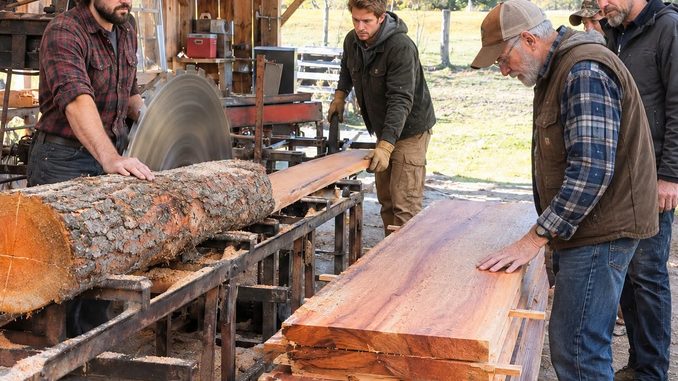
Levi’s sawmill was a simple wooden structure with an open front, a metal roof, and a large circular blade powered by a diesel engine. He operated it with the assistance of his two sons, who worked quietly beside the carriage.
After Mason unloaded the logs, Levi positioned the largest one on the saw. It measured twenty-two inches across and came from the tree my grandfather had planted when Dad was born.
Levi removed the outer slabs before cutting the first full board. The freshly exposed cherry wood was beautifully colored, with a straight grain and almost no visible defects.
The board measured fourteen feet long and eleven inches wide. It was clear from end to end, without knots or other imperfections that would significantly reduce its value.
One of Levi’s sons carried it to a nearby stack. Dad slowly approached, placed his hand on the smooth surface, and remained there for several moments without speaking.
I noticed his shoulders trembling. He was looking at wood from a tree his father had planted eighty years earlier, and I understood why the moment meant so much to him.
Levi continued sawing while Mason helped carry the finished boards. Some were sixteen or twenty inches wide, and most displayed the same rich color and remarkably clean grain.
A few pieces contained knots, gum deposits, or internal checks, but Levi separated those into a different pile. Much of the remaining lumber qualified for the highest hardwood grade, known as FAS, or firsts and seconds.
By early afternoon, all twenty-two logs had been processed. Levi carefully measured and counted every board, recording the results in a small notebook.
When he finished, he approached Dad with the figures.
“Arvid, you have forty-six hundred board feet. Thirty-one hundred are firsts and seconds, and the remaining fifteen hundred are number one common.”
Dad listened quietly while Levi explained the prices. The clear cherry was valuable enough for a Lancaster cabinetmaker who regularly purchased high-quality lumber from his mill.
“I can pay two dollars and eighty cents per foot for the clear lumber and one dollar and forty cents for the common. That’s the same price I’d offer anyone.”
Levi calculated the total aloud.
“Ten thousand, nine hundred and eighty dollars.”
For several seconds, none of us spoke. Lyle had offered six hundred dollars for timber that Levi valued at nearly eleven thousand after sawing.
Dad finally found his voice.
“That’s more than those trees were worth standing.”
“Standing timber and finished boards have different values. You cut the trees, your son hauled them, and my saw revealed what was inside.”
Levi offered to pay immediately, either by check or cash. Then he studied the widest boards and suggested that Dad keep something from the sale.
He pointed toward seven extraordinary boards cut from my grandfather’s tree. They were fourteen feet long, exceptionally wide, and among the finest cherry lumber Levi had encountered in forty years.
“Arvid, I don’t think you should sell these seven boards. Your father planted that tree, and you should make something from it.”
Dad looked at the lumber thoughtfully. Levi offered to kiln-dry those boards without charge and pay $9,400 for the remainder.
After a long silence, Dad asked a question that had clearly troubled him since leaving Lyle’s mill.
“Why would my own nephew deliberately grade those logs as pallet wood?”
Levi considered his answer carefully.
“Sometimes a man in financial trouble believes the people closest to him will forgive him, so he takes advantage of them first.”
He reminded Dad that Lyle had inspected the trees in August and offered four thousand dollars for them standing. Their quality hadn’t changed between August and November.
“Something changed in your nephew, Arvid. Not in the trees. Cherry doesn’t lie once you saw it open.”
Dad accepted Levi’s offer. One of Levi’s sons counted $9,400 into a brown paper envelope, and we began the journey home with an empty trailer.
For the first time since receiving Lyle’s check, Dad seemed able to think about the future rather than the betrayal.
Part 4: The Confession That Cost My Cousin His Mill
During the drive home, Dad sat quietly with the money tucked inside his coat. Eventually, he looked toward me and spoke about the reason he’d cut the trees in the first place.
“Your mother can finally get her teeth fixed. All of them, properly.”
He also wanted to give each of his five grandchildren two hundred dollars for Christmas. Beyond that, he hoped to set aside something for Mason’s education.
I was surprised because Mason had never mentioned wanting to attend college. Dad explained that my son had confided in him while they were cutting timber together in October.
“He wants to study forestry at Penn State DuBois. He says he wants to understand timber well enough that nobody can cheat his grandfather again.”
When we reached the farm, Mom was waiting beneath the porch light. Dad handed her the envelope, and she began crying when she saw the money.
“I let an honest man saw the logs open,” Dad explained.
In January, Mom received the dental treatment she’d postponed for years. Dr. Hensley in Bradford completed her four implants, bridge, and crowns, and Dad paid the remaining cost after their insurance contribution.
The following Sunday, Mom played “Children of the Heavenly Father” on her old Baldwin piano. For the first time in years, she sang along in Swedish, just as Dad’s mother once had.
But before that happened, Lyle returned to our farm two weeks before Christmas. I was stacking firewood near the porch when his pickup arrived during the first heavy snowfall of winter.
He remained inside the vehicle for several minutes before walking toward the barn. Dad noticed him from the kitchen and went outside, with me following a short distance behind.
Lyle looked exhausted and ashamed. He held a printed sales ticket from Levi’s mill, showing the actual quantity and quality of the cherry lumber.
“I heard what Levi paid you, Uncle Arvid.”
Dad waited without responding. Eventually, Lyle admitted that the bank was preparing to foreclose on his sawmill.
He owed $312,000 on the band saw and kiln, and the bank had given him until March. To keep making payments, he’d begun deliberately grading valuable logs below their true quality.
“I’ve been doing it since August. Mostly to older farmers who don’t know what their timber is worth.”
He explained that he’d bought their logs cheaply and sold the resulting lumber at much higher prices. He’d convinced himself that the deception would last only until his finances improved.
Then he admitted that he’d known Dad’s cherry was exceptional.
“I knew those were some of the best logs I’d seen in years. But by November, I’d already cheated so many people that I told myself one more wouldn’t matter.”
Dad reached into his coat and removed the folded six-hundred-dollar check. He handed it back to Lyle, explaining that he’d never cashed it.
“Your father built that mill on honest grading. I helped him pour the concrete for the first saw pad in 1961.”
He reminded Lyle of something Walt had once told him.
“The only thing a sawmill really sells is a man’s word. The wood is just what comes wrapped around it.”
Then Dad told Lyle what he needed to do.
“Visit every person you cheated. Tell them the truth and repay the difference, whatever it takes.”
Lyle protested that he couldn’t afford restitution and would probably lose the mill. Dad refused to accept that as an excuse.
“Then lose it honestly. A man can recover from losing a sawmill, but he may never recover from losing his good name.”
Lyle eventually followed that advice. Throughout January and February, he visited eleven farmers across McKean, Elk, and Potter counties and admitted how he’d manipulated their timber grades.
Some refused to forgive him, while others listened after expressing their anger. One elderly farmer in Smethport made Lyle split a cord of firewood before agreeing to hear his explanation.
Lyle sold his pickup and hunting camp to repay as much as possible. He arranged installments for the remaining debts and continued making payments even after the bank foreclosed on his mill in March.
His business was gone, but his efforts to repair the damage had finally begun.
Part 5: The Tree Planted for His Old Age
After the bank took Lyle’s sawmill, the equipment was auctioned to a company from West Virginia. The old pole barn beside the railroad tracks, where Uncle Walt had operated for forty years, remained empty throughout the spring.
In April, Lyle traveled sixty miles south to Levi Yoder’s farm. He waited at the shared telephone booth until Levi returned from the fields, then walked to the sawmill and confessed everything he’d done.
He asked whether Levi needed someone to roll logs, carry boards, or sweep sawdust. Lyle made it clear that he wasn’t asking for a position as a grader.
Levi listened carefully before offering him a pair of work gloves.
“Cherry doesn’t lie. Neither does a man who travels sixty miles to admit he was wrong. Start Monday, and I’ll teach you to grade honestly again.”
Lyle began working three days a week for fifteen dollars an hour. He told me later that despite the modest wages and physical labor, it was the most satisfying job he’d ever held.
Meanwhile, Dad had been working on a project of his own. In January, he and Mason collected the seven boards Levi had dried from my grandfather’s tree.
Dad carried them into his workshop behind the barn and spent the winter shaping the cherry wood with hand planes, chisels, and an old table saw. Mason helped on Saturdays, learning woodworking techniques that Dad had learned from his own father.
He refused to tell anyone what he was making. Even Mom had to wait until April, when Mason and I helped him carry the finished piece into the house.
It was a beautiful piano bench designed for her old Baldwin. The cherry wood had been polished until its grain glowed deep red and gold, and the hinged seat opened to provide storage for her hymnals.
Inside the lid, Dad had burned an inscription into the wood.
“Planted 1945 by Nils Lindholm for his son’s old age. Cut 2025 by Arvid Lindholm for his wife. Barn tack är Gud.”
The Swedish words came from the hymn “Children of the Heavenly Father,” connecting the bench to the song that had been part of our family for generations.
Mom sat on it for the first time on Easter Sunday. She gently examined the wood before opening the piano and playing the familiar hymn while Dad stood beside her with his hand resting on her shoulder.
A few weeks later, on the first warm Saturday in May, Dad asked Mason and me to visit the farm early. When we arrived, he was waiting beside the barn with a cardboard box containing twenty-two young black cherry seedlings.
“One for every log,” he explained.
He’d purchased them from the state nursery in Spring Mills for two dollars each. We carried the seedlings up the hillside where the original trees had grown, along with tools and wire cages to protect the new plants from deer.
The old stumps remained scattered across the slope, surrounded by fresh spring grass. Mason prepared the planting holes while Dad positioned each seedling and I secured the protective cages.
We worked throughout the morning until only one tree remained. Dad carried it to the top of the hill, beside the stone wall and the stump of the cherry his father had planted eighty years earlier.
He knelt carefully and handed the final seedling to Mason.
“You plant this one.”
Mason hesitated, looking toward his grandfather.
“My father planted the first tree when I was born, for my old age. I’m eighty now, and I won’t live long enough to see this one grow tall.”
Dad pressed the seedling into Mason’s hands.
“But you will. This one’s for your old age.”
Mason planted it beside his great-grandfather’s stump, carefully pressing the soil around its roots. Dad placed a hand on his shoulder and reminded him of the lesson they’d learned.
“Someday, someone will offer you money for these trees. Some people will be honest, and others won’t. Remember what Levi told us. Cherry doesn’t lie.”
He encouraged Mason to learn how to evaluate timber properly rather than blindly trusting another person’s assessment.
“Take your logs to someone willing to saw them open in front of you. Then you’ll know what they’re really worth.”
“Yes, Grandpa.”
Afterward, the three of us sat together on the stone wall, looking down over the twenty-two seedlings. We represented three generations of Lindholm men, surrounded by trees that would hopefully continue growing long after we were gone.
From the farmhouse below, we could hear Mom playing the Swedish hymn on her piano. She was sitting on a bench made from the tree Nils Lindholm had planted for his son eighty years earlier.
Dad began singing softly in Swedish, while Mason and I hummed along because we didn’t know all the words. The moment felt like a quiet celebration of everything our family had preserved.
Then I noticed a pickup turning into the farm lane. It was Lyle, arriving on his day off from Levi’s sawmill.
He had brought a beautiful fourteen-foot cherry board, the first piece of timber he’d personally graded honestly since the previous August. He stood at the bottom of the hill holding it, uncertain whether he should approach us.
Dad noticed him and stopped singing. For a moment, I wondered whether he would turn away from the nephew who’d betrayed his trust.
Instead, he raised his hand in greeting.
“Come on up, Lyle. We saved you a seat.”
As Lyle started toward us, I looked again at the young cherry trees growing beside the old stumps. My grandfather had planted a tree for his son’s future, and eighty years later, that same tree had helped my parents, taught my son an important lesson, and given my cousin an opportunity to rebuild his integrity.
I realized that the most valuable thing we’d carried away from Levi’s sawmill hadn’t been the money. It was the understanding that honesty, forgiveness, and the things we leave for future generations are worth more than any price someone writes on a check.
Leave a Reply