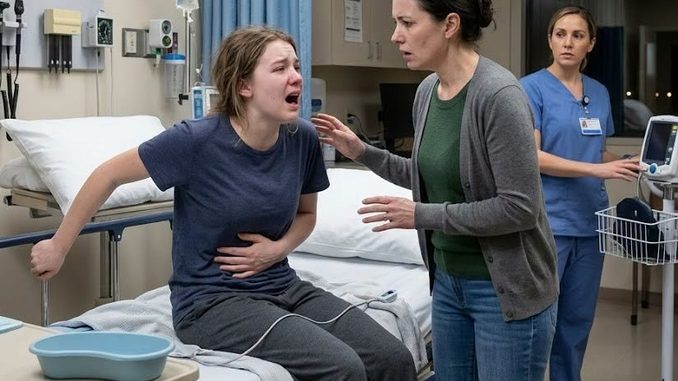
MY DAUGHTER WHISPERED “HE KNOWS WHY IT HURTS” IN THE ER—THEN SHE UNLOCKED THE PHONE HER FATHER HAD TRIED TO DESTROY
Emily unlocked the phone again and placed it in the social worker’s palm.
Her hands were shaking so badly that the screen clicked against the woman’s ring.
The social worker introduced herself as Dana and asked Emily whether she wanted me to stay.
Emily nodded.
Then she looked at me.
“Mom, you can’t make excuses for him this time.”
The words hurt because she already knew me well enough to expect that I might.
I pulled my chair closer.
“I won’t.”
Emily stared at the blanket for a long time before she spoke.
“It started Saturday.”
That was one day before she began vomiting.
Michael had been angry because Emily came home twenty minutes later than expected from studying at her friend Hannah’s house.
She had texted me.
I remembered the message.
Hannah’s mother is driving me. Traffic is bad.
I had responded with a heart.
Michael apparently had not cared.
Emily said he was waiting in the kitchen when she got home.
He asked where she had really been.
She told him.
He called her a liar.
When she tried to walk upstairs, he grabbed her arm.
Emily stopped talking.
Dana did not rush her.
“What happened next?”
Emily swallowed.
“He pushed me against the counter.”
I felt something cold spread through my chest.
She kept speaking.
“He said I was becoming disrespectful because Mom lets me get away with everything.”
Michael had said versions of that for years.
About my cooking.
About money.
About what Emily wore.
About how often she talked to her friends.
About whether she should be allowed to close her bedroom door.
I had heard those sentences and mistaken control for parenting.
Emily pressed her lips together.
“When I told him to let go of me, he hit me in the stomach.”
I closed my eyes.
Not because I wanted to stop hearing.
Because my body had forgotten how to breathe.
Dana leaned slightly forward.
“With his hand?”
Emily shook her head.
“His fist.”
My chair moved against the floor when I stood.
I did not remember deciding to stand.
The doctor was beside me almost immediately.
“Mrs. Carter.”
I realized I was staring toward the hallway.
Toward the place security had taken Michael.
Dana spoke quietly.
“Emily needs you here.”
That brought me back.
I sat again.
Emily looked terrified.
Not of Michael.
Of me.
Of what I might do with the truth.
I reached for her hand.
“I’m here.”
She continued.
Michael had hit her once.
Then again.
The second strike made her fall against the kitchen cabinet.
He told her if she screamed, he would tell me she had attacked him first.
She believed him.
Why wouldn’t she?
Michael had spent years teaching us that whatever happened in our house became whatever version he told afterward.
If he threw a plate, I had provoked him.
If he punched a wall, I had pushed him too far.
If he called Emily useless, he was “trying to motivate her.”
He had built a world where his anger always belonged to somebody else.
Emily said the pain became worse the next morning.
She felt sick.
She vomited.
Michael told her she was trying to avoid school.
When she told him her stomach hurt where he had hit her, he warned her not to tell me.
“He said you’d leave him,” Emily whispered.
My voice came out barely audible.
“I should have.”
Emily started crying.
“So I thought it would be my fault.”
“No.”
The word came out so quickly that Dana looked at me.
I squeezed Emily’s hand.
“No. None of this is your fault.”
Her face crumpled.
For the first time since we arrived at the hospital, she cried like a child instead of someone trying to survive as quietly as possible.
I leaned over the bed and held her carefully.
“I’m sorry,” I whispered.
Over and over.
“I’m sorry. I’m sorry.”
Emily gripped the back of my sweater.
“I tried to tell you.”
I froze.
“When?”
“Last year.”
The room went silent.
She reminded me of a night I had almost forgotten.
Michael had grounded her after they argued about her phone.
Emily came into my bedroom later and asked whether I ever felt scared of Dad.
I had laughed nervously.
Not because it was funny.
Because I was scared of the question.
I told her Michael had a temper but loved us.
I told her every family argued.
I told her not to exaggerate.
The memory landed like a physical blow.
Emily had tried to tell me.
And I had repeated Michael’s language back to her.
Dana must have seen what happened on my face.
“You can deal with that later,” she said gently. “Right now, your daughter is talking because she believes you’re listening.”
So I listened.
Emily explained that Saturday had not been the first time Michael hurt her.
There had been grabbing.
Shoving.
A slap once when I was at work.
He had never injured her badly enough that she thought anyone would believe her.
And afterward, he would become strangely kind.
He would order pizza.
Buy her something.
Tell her he hated when she “forced him to lose control.”
Then he would remind her how much stress he was under.
Emily had started recording him three months earlier.
Not every argument.
Only when she could.
There were nine recordings on the phone.
Nine.
Dana asked permission to listen to another.
Emily nodded.
The second recording was from six weeks earlier.
Michael’s voice said:
“You tell your mother I touched you and I’ll tell everyone you attacked me.”
Then Emily’s voice:
“I didn’t do anything.”
Michael responded:
“You’re a child. Who do you think they’ll believe?”
I turned toward the wall because if I looked toward the hallway again, I knew security would have another problem.
The social worker documented every recording.
A police officer arrived shortly afterward.
Then another.
By 6:10 that morning, Michael was no longer allowed anywhere near Emily’s room.
By 6:40, the surgeon came in.
The infection had progressed.
Emily needed surgery immediately.
Everything else stopped mattering.
They wheeled her away beneath fluorescent lights while I walked beside her until a nurse gently blocked the double doors.
Emily reached toward me.
“Mom?”
“I’m here.”
“Don’t let him take my phone.”
“I won’t.”
“Promise?”
“I promise.”
The doors closed.
I stood there alone.
Then my legs gave out.
I sat against the hallway wall and cried so hard I could barely make a sound.
Dana eventually found me.
She sat beside me without saying anything.
After several minutes, I asked the question that had been eating through me.
“How did I not know?”
Dana answered carefully.
“People who control families are often very good at making each person doubt what they’re seeing.”
That did not erase my responsibility.
But it helped me understand something.
Michael had not only taught Emily to fear him.
He had taught me to fear my own judgment.
Every time I questioned him, he called me irrational.
Every time I objected, he said I was emotional.
Every time I protected Emily, he accused me of undermining him.
And somewhere along the way, keeping the peace had become more important to me than asking who was paying the price for that peace.
Emily had been paying it.
The surgery lasted nearly two hours.
The appendix had perforated.
The infection had spread, but the surgeon told me they had treated it aggressively and expected her to recover.
I thanked him until my voice broke.
Then I went into the restroom and threw up.
When I returned to the waiting area, a police officer was there.
He asked whether I was ready to give a statement.
I said yes.
For the next hour, I told him everything.
The years of intimidation.
Michael controlling money.
Breaking things.
Punching walls.
The threats.
The way I hid cash in towels.
The way I measured every sentence by how angry it might make him.
The officer asked whether Michael had ever hit me.
I said no.
Then I corrected myself.
“Not with his fist.”
There had been grabbing.
Blocking doors.
Throwing objects near me.
Taking my keys.
Once, during an argument, he had squeezed my wrist until I had bruises.
I had called it stress.
The officer called it something else.
By noon, Michael had been arrested.
Not because of one sentence.
Not because I demanded it.
Because there was evidence.
Medical documentation.
Photographs.
Emily’s statement.
The recordings.
Hospital witnesses.
And the message Michael had sent me before he arrived:
You’ll regret bringing her there.
For years, Michael had always controlled the story.
That morning, the story finally had witnesses.
When Emily woke after surgery, the first thing she asked was whether he was gone.
“Yes.”
“Really?”
“Yes.”
Her eyes closed again.
Then she whispered:
“Good.”
I stayed beside her for three nights.
On the second day, Michael’s mother called.
I almost did not answer.
Then I did.
She started crying immediately.
“Please don’t let them ruin his life.”
I looked at Emily sleeping with an IV taped to her arm.
“His life?”
“He made a mistake.”
“A mistake is forgetting an appointment.”
“He was angry.”
“He hit a fifteen-year-old girl hard enough that she needed emergency surgery.”
“That surgery was for appendicitis.”
There it was.
The excuse.
The technicality she thought might make everything smaller.
I felt strangely calm.
“Yes,” I said. “And he knew she was in severe pain afterward and tried to stop me from getting medical help.”
Silence.
Then:
“He’s still her father.”
I looked at Emily.
“No. He is the man who taught her she needed evidence to feel safe telling the truth.”
I ended the call.
I never answered another one.
The next few weeks happened quickly.
Rebecca, the attorney who handled our house closing years earlier, referred me to a family-law specialist.
An emergency protective order was filed.
Michael was prohibited from contacting Emily directly.
I was included too.
For the first time in sixteen years, I slept in my own house without listening for his footsteps.
Except I did not really sleep.
Neither did Emily.
When she came home from the hospital, she wanted every door locked twice.
She jumped when the garage made noise.
She carried her phone everywhere.
Even into the bathroom.
One night, I found her sitting on the kitchen floor at 2:00 a.m.
The same kitchen where Michael had hurt her.
She was staring at the cabinet.
I sat beside her.
She asked:
“Are you mad I recorded him?”
That question nearly destroyed me.
“No.”
“He said recording family was betrayal.”
I looked directly at her.
“Protecting yourself from someone hurting you is not betrayal.”
She nodded.
Then asked the question I had been afraid of.
“Why didn’t you leave before?”
There was no answer that would make me look good.
So I gave her the true one.
“I was scared.”
“Of him?”
“Yes.”
“Then why did you keep telling me everything was okay?”
I looked down.
“Because I thought if I could keep him calm, things wouldn’t get worse.”
“But they did.”
“Yes.”
Emily stared at me.
I forced myself not to defend myself.
Not to explain.
Not to ask her to understand.
“I was wrong,” I said. “And you paid for it.”
She started crying.
So did I.
“I should have protected you sooner.”
For a long time, neither of us spoke.
Then Emily leaned her head on my shoulder.
“You are now.”
That did not absolve me.
But it gave me somewhere to begin.
The legal process took months.
Michael denied deliberately injuring her.
Then his attorney suggested the recordings were “taken out of context.”
That argument became difficult once investigators recovered deleted messages from Michael’s phone.
One message to a friend said:
Emily better keep her mouth shut about Saturday.
Another said:
Sarah is stupid enough to believe she’s sick from school stress.
Sarah.
Me.
His wife of sixteen years.
The woman he thought was stupid enough to keep explaining away what was happening directly in front of her.
At the preliminary hearing, I saw Michael for the first time since the hospital.
He looked smaller.
Not physically.
Somehow the room around him had changed.
There were deputies.
Attorneys.
A judge.
People he could not intimidate by lowering his voice.
He looked toward me.
I looked away.
Because the most powerful thing I could give him now was nothing.
No argument.
No defense.
No opportunity to rewrite reality through me.
Months later, Michael accepted a plea agreement involving charges connected to the assault and obstruction of medical care.
There were court-ordered restrictions.
Mandatory counseling.
Supervised conditions attached to any future attempt at contact.
I did not celebrate.
There was nothing to celebrate.
My daughter had still been hurt.
But consequences mattered.
Truth mattered.
Documentation mattered.
And Emily mattered more than protecting the appearance of a family that had already been broken long before the police arrived.
A year later, the cracked phone still sits in a small fireproof box in my closet.
Emily has a new one.
She almost threw the old one away once.
Then she changed her mind.
“Maybe I’ll keep it,” she said.
“Why?”
She turned it over in her hands.
“Because he always said nobody would believe me.”
I waited.
“And I believed me.”
I smiled.
“Yes, you did.”
Emily is sixteen now.
She laughs more.
She plays volleyball again.
She complains about homework.
Leaves cereal bowls in the sink.
Borrows my sweaters without asking.
Normal things.
Beautifully normal things.
Sometimes she still freezes when a man raises his voice nearby.
Sometimes she checks the locks.
Healing is not a straight line.
But she no longer walks through our house listening for Michael.
Neither do I.
Last month, she had another hospital appointment.
Just a routine follow-up.
When we walked past the emergency department, Emily slowed.
For a moment, I thought she might want to turn around.
Instead, she looked through the glass doors.
“That’s where I finally told you.”
I swallowed.
“Yes.”
She shook her head.
“No.”
I looked at her.
“That’s where you finally listened.”
There was no accusation in her voice.
Just truth.
And I realized that was the difference between the life we had escaped and the one we were building.
In Michael’s house, truth was something dangerous.
Truth caused anger.
Truth had consequences.
Truth had to be hidden inside a cracked phone.
In our house now, truth can sit at the kitchen table.
It can cry.
It can be ugly.
It can make us uncomfortable.
But it does not have to hide.
I put my arm around Emily.
“I’m listening now.”
She leaned against me.
“I know.”
Then we walked past those emergency room doors together.
The same doors I had been afraid to enter because Michael told me not to.
The same doors that separated the last night we lived by his rules from the first morning we stopped.
For years, I believed keeping a family together meant enduring whatever threatened to pull it apart.
I understand something different now.
Sometimes protecting your family means admitting who has been hurting it.
Sometimes love does not look like forgiveness.
Sometimes it looks like evidence.
A locked door.
A hospital wristband.
A police report.
A mother finally believing her daughter.
And sometimes the sentence that destroys the family you thought you had—
“He knows why it hurts”—
is the sentence that finally saves the family you still can.
Leave a Reply