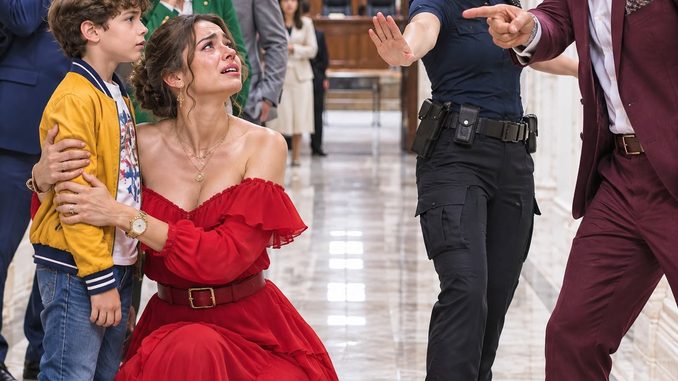
Part 1: My Husband Won Custody of Our 7-Year-Old Son—Then My Little Boy Revealed a Terrifying Secret About His Baby Sister
“The court is granting temporary custody of your son to his father.”
The judge’s words made my stomach drop.
Across the courtroom, my husband smiled as though he’d just won a prize. Our seven-year-old son sat beside him, staring at his shoes.
“Your Honor, please,” I begged. “My son is afraid of his father. You can’t send him back there.”
The judge reminded me that the decision was temporary and could be reconsidered if additional evidence emerged.
But all I could think about was losing my little boy.
My name is Danielle Harris. I’m thirty-two years old, and I live in Charlotte, North Carolina.
For eight years, I was married to Richard Harris, a successful auto-parts business owner who seemed charming and dependable when we first met.
Everything changed after our son, Matthew, was born.
Richard gradually took control of our finances, questioned my friendships, and monitored my phone calls. Whenever I challenged him, he threatened to take Matthew away.
His mother, Olivia, supported him.
“A good wife knows when to listen to her husband,” she often told me. “And a good mother doesn’t turn a child against his father.”
I worked from home doing clothing alterations, earning just enough to cover basic expenses.
When I finally filed for divorce, Richard hired an expensive attorney and produced statements from acquaintances claiming I was emotionally unstable.
He argued that his income, property, and established business made him the more suitable parent.
I had sold the last pair of earrings my late mother left me to pay my attorney.
Even that wasn’t enough to overcome the evidence Richard’s legal team presented at our temporary custody hearing.
The judge explained that my allegations against him hadn’t yet been sufficiently substantiated.
I looked desperately toward Matthew.
He sat with his shoulders hunched, his hands tightly clasped in his lap.
“Sweetheart, please tell them what happens at home,” I whispered.
Richard placed a hand on his shoulder.
Matthew immediately lowered his head.
That small movement broke my heart.
My son had learned that remaining silent was sometimes the safest way to avoid his father’s anger.
As the hearing approached its conclusion, another painful memory returned.
Six months earlier, I’d given birth to a baby girl at a private medical clinic outside Charlotte.
Richard had insisted that doctors discovered complications requiring an emergency cesarean section.
When I woke from anesthesia, he told me our daughter hadn’t survived.
I never saw her.
Whenever I asked for hospital records or documentation, Richard became furious.
“Stop asking questions, Danielle. She’s gone. Nothing will change that.”
I grieved for months, unable to understand why I hadn’t been allowed to hold my daughter even once.
Now Richard leaned toward me.
“It’s over,” he whispered. “Matthew’s coming home with me. You can go back to that miserable little apartment.”
I clenched my fists.
“I won’t let you hurt him.”
“Then prove it.”
The judge began organizing her papers.
Suddenly, Matthew raised his hand.
“Your Honor?”
Everyone turned toward him.
The judge paused.
“Yes, sweetheart?”
Matthew looked at his father, then at me.
His eyes filled with tears.
“If I have to live with Daddy, can I tell you something first?”
The judge gave him permission to speak.
Matthew took a shaky breath.
“My daddy has kept my baby sister in Grandma’s old refrigerator for six months.”
The courtroom fell silent.
Richard’s smile disappeared.
I stared at my son, unable to understand what I’d heard.
Then Matthew began crying.
“Daddy said if I ever told Mommy where my sister was, I would disappear too.”
Richard abruptly stood.
“THAT’S A LIE!”
A court security officer moved toward him.
But I barely heard the commotion.
For six months, I’d believed my daughter had died during childbirth.
Now my seven-year-old son was describing something hidden at his grandmother’s property.
And the terror on Richard’s face made me realize that Matthew might know far more about his sister’s disappearance than anyone had ever told me.
Part 2: My Son Revealed Where His Father Hid His Baby Sister—Then a Nurse Exposed the Lie About Her Birth
“THAT’S NOT TRUE!” Richard shouted, knocking his chair backward.
A court security officer immediately approached him.
“Mr. Harris, sit down,” the judge ordered. “Your son is speaking.”
I couldn’t move.
For six months, I’d mourned the daughter Richard claimed had died during childbirth. Now Matthew was saying his father had hidden something connected to her at his grandmother’s house.
The judge arranged for a child psychologist to help Matthew explain what he remembered without unnecessary pressure.
My son was trembling.
“It happened when it was still cold outside,” he whispered. “Daddy brought a black bag to Grandma’s house and put it inside an old refrigerator.”
I covered my mouth.
“Grandma moved the refrigerator into her storage shed and locked the door,” Matthew continued. “One day, she sent me to get some tools, and the shed was open.”
Richard shook his head.
“He doesn’t understand what he saw.”
The judge warned him not to interrupt.
Matthew wiped his cheeks.
“There was something very small wrapped in a blanket. When I asked Daddy, he said it was my baby sister.”
My chest tightened.
“He told me never to tell Mommy. He said something bad would happen to me if I did.”
Matthew looked toward me.
“I’m sorry, Mommy. I wanted to tell you.”
I hurried to him as the court personnel guided us through the interruption.
“You have nothing to apologize for,” I whispered, holding him close.
The judge suspended the custody proceedings and requested that the appropriate authorities investigate Matthew’s disclosure.
An investigator named Laura Sanders arrived to gather information.
“Mrs. Harris, do you remember which clinic delivered your daughter?”
I shook my head.
“Richard arranged everything. I was almost nine months pregnant when he took me there. He said I needed an emergency C-section.”
“Did you receive a death certificate?”
“No.”
“Any medical records?”
“Richard wouldn’t let me see them.”
Laura wrote down my answers.
Later that afternoon, investigators located Olivia’s property outside Charlotte.
Richard’s mother initially denied having an old refrigerator in her storage shed.
Then she claimed it contained nothing but spoiled food.
During an authorized search, investigators found a locked outbuilding behind the house.
Inside stood an aging green refrigerator.
Investigators discovered a concealed package containing what appeared to be human remains.
Laura called me afterward.
“Danielle, we’ve found something that may be connected to your daughter. We need forensic testing before we can confirm anything.”
I leaned against the wall.
“Please tell me Matthew was mistaken.”
“I can’t tell you that yet.”
I barely slept that night.
Matthew remained with specialized support personnel while the court reconsidered the immediate safety concerns raised by his disclosure.
The following morning, Laura contacted me again.
Investigators had located a nurse who’d worked at the private clinic where I’d delivered my daughter.
She remembered my emergency surgery.
More importantly, she’d preserved a copy of a medical note after being instructed to change the original record.
Laura placed the document in front of me.
“Your husband told you the baby was stillborn?”
I nodded.
“Then you need to see this.”
The handwritten note identified a female newborn who had been born alive, breathing independently but showing signs of distress.
It recommended immediate pediatric evaluation.
I read the words repeatedly.
“My daughter was alive?”
“The record indicates that she was born alive,” Laura answered. “We’re investigating what happened afterward.”
The nurse lowered her eyes.
“I kept something else,” she admitted.
She reached into her bag and took out her phone.
“Someone threatened me that night. I was afraid to report what happened, but I saved a recording of a conversation between your husband and the doctor.”
My hands began shaking.
“What’s on it?”
The nurse hesitated.
“Your husband discussing what he wanted done with the baby.”
She pressed play.
A man’s voice warned that my newborn daughter was having trouble breathing and needed urgent hospital treatment.
Then I heard Richard.
And the first question he asked wasn’t whether our daughter would survive.
It was how much saving her would cost.
Part 3: My Husband Paid a Doctor to Hide Our Daughter’s Birth—Then DNA Evidence Revealed What Happened to Her
“How much is this going to cost me?” Richard asked in the recording.
A doctor answered firmly.
“Mr. Harris, your daughter is having difficulty breathing. She needs to be transferred to a hospital immediately.”
There was a brief silence.
Then Richard said something I would never forget.
“I already paid to make sure my wife believes the baby was stillborn. I’m not spending another dollar on a daughter I never wanted.”
I gripped the edge of the table.
The nurse’s recording continued.
“Without treatment, she could die,” a woman warned.
“Then that’s your problem,” Richard replied. “I’m taking her, and none of you will mention this again.”
There was a commotion, followed by a door closing.
The recording ended.
For several moments, I couldn’t speak.
My daughter had been born alive. She had needed medical attention, and while I was unconscious after surgery, Richard had refused to let the doctors transfer her.
“Why?” I finally asked. “Why would he do that?”
The nurse wiped her eyes.
“Your husband wanted another son. He said only boys could carry on his family name. The doctor accepted money to falsify the records.”
“And you knew?”
She lowered her head.
“They threatened me. I resigned shortly afterward, but I kept the recording because I knew what happened was wrong.”
I stared at her.
“You knew for six months that my daughter was born alive.”
She couldn’t answer.
Investigator Laura Sanders explained that the recording would need to be authenticated before it could be used as evidence.
Investigators also discovered financial transfers from Richard to the physician who had handled my delivery. Recovered communications contained instructions about altering medical records.
Two days later, Laura called me back to her office.
The forensic results had arrived.
DNA testing confirmed that the remains recovered from Olivia’s refrigerator belonged to my daughter.
I covered my face and cried.
For six months, I’d believed she had died during childbirth from unavoidable complications.
Now I knew she had been born alive and needed treatment that Richard had deliberately refused.
The medical examiner explained that the passage of time made determining the exact cause and timing of her death difficult.
But the hospital records, witness statements, and recording established that she had required urgent medical care.
That night, Matthew and I stayed in temporary accommodation arranged after investigators learned of threats connected to Richard.
My son was asleep beside his teddy bear when he suddenly opened his eyes.
“Mommy, is my baby sister angry with me?”
I sat on his bed.
“Why would she be angry?”
“Because I didn’t tell you where she was. Daddy said he’d make me disappear.”
I held him close.
“Matthew, you were frightened because someone threatened you. None of this was your responsibility.”
He began crying.
“I wanted to help her.”
“You helped us find her, sweetheart. You told the truth when you were very scared.”
We stayed together until he fell asleep again.
Later, I remembered the name I’d chosen during my pregnancy.
Stella.
Richard had mocked it, insisting there was no point choosing a girl’s name when he wanted another boy.
But my daughter had existed.
She deserved to have her own name, regardless of what her father had wanted.
I told Laura I wanted her remembered as Stella Harris.
Over the following weeks, investigators gathered enough evidence to bring charges against the doctor for his role in the falsified records and the circumstances surrounding my daughter’s treatment.
Olivia also came under investigation after messages showed she knew what had been hidden on her property.
When questioned about her involvement, she claimed she’d only been trying to protect her son.
Laura asked whether her granddaughter hadn’t deserved protection too.
Olivia had no answer.
Eventually, Richard was taken into custody while the criminal proceedings continued.
Through his attorney, he requested a supervised conversation with me.
At first, I refused.
But one question had haunted me since hearing the recording.
I wanted to know whether Richard felt any remorse for what he’d done.
When I finally agreed to speak with him, he appeared behind the visitation glass looking thinner and exhausted.
He picked up the telephone.
And instead of asking about our daughter, his first words were:
“None of this would have happened if Matthew had kept his mouth shut.”
Part 4: My Husband Blamed Our 7-Year-Old Son for Exposing His Secret—Then the Court Finally Heard the Truth
“None of this would have happened if Matthew had kept his mouth shut.”
I stared at Richard through the visitation glass.
He was facing criminal charges connected to our daughter’s death, yet the first person he blamed was our seven-year-old son.
“Don’t you dare blame Matthew,” I said.
Richard leaned closer.
“He destroyed this family, Danielle. If he’d stayed quiet, none of us would be here.”
“Our daughter was born alive, Richard. She needed medical treatment, and you refused to let her have it.”
He looked away.
“The doctor said she was weak.”
“Then you should have let them take her to a hospital.”
“We already had enough financial problems.”
I couldn’t believe he was still making excuses.
“You had money for expensive lawyers, a new truck, and payments to a doctor who falsified our daughter’s records.”
Richard pressed his lips together.
“You don’t understand. My mother wanted another grandson. So did I.”
I felt sick.
“Because she was a girl, you decided she wasn’t worth saving?”
He said nothing.
For years, I’d searched for ways to make Richard understand how much his behavior hurt our family. Sitting across from him, I finally accepted that no explanation he offered could justify what he’d done.
I put down the telephone.
“You’ll answer for your actions in court. My responsibility now is to protect Matthew and raise him to become a completely different man.”
I left without looking back.
Over the following months, my attorney asked the family court to reconsider the temporary custody order.
We submitted evidence from the criminal investigation, documentation of Richard’s threats, and information about Matthew’s fear of his father.
The court granted protective measures and eventually placed Matthew in my care.
He also began receiving counseling to help him process what he’d witnessed.
When I told him he wouldn’t have to return to his father’s house, he remained quiet for several seconds.
“Mommy, can I sleep without worrying that Daddy will come get me?”
I pulled him into my arms.
“We’re going to do everything we can to keep you safe.”
Meanwhile, the criminal proceedings continued.
I testified about my pregnancy, the clinic, and the six months I’d spent believing my daughter had been stillborn.
The nurse acknowledged her failure to report what she’d witnessed sooner. The doctor tried to shift responsibility entirely onto Richard, but the financial records and communications showed his own involvement.
After a lengthy trial, Richard received a prison sentence spanning several decades for the crimes established against him.
The physician was also convicted.
Olivia received a sentence for the concealment and related offenses the prosecution proved.
When the verdicts were announced, I didn’t feel victorious.
No sentence could bring Stella back.
But the truth about her birth and death could no longer be buried.
Outside the courthouse, my attorney embraced me.
“We finally got justice for your daughter.”
I looked toward the sky.
“At least someone finally listened to her story.”
I hoped the convictions would allow Matthew and me to begin healing.
Instead, our family tragedy appeared in local news reports.
Some journalists treated us respectfully, but others published sensational headlines. Strangers began questioning why I hadn’t discovered the truth sooner.
Then the rumors reached Matthew’s school.
One afternoon, his teacher called because several classmates had been repeating things they’d heard from adults.
When Matthew came home, his eyes were swollen from crying.
“Mommy, the kids said I’m the son of a murderer. They said nobody should play with me.”
I held him tightly.
He told me they’d also made cruel remarks about Stella.
The school intervened, but Matthew began having nightmares and refusing to attend classes.
One evening, he asked a question that frightened me more than anything he’d said since the trial.
“Mommy, if Daddy did terrible things, does that mean I’ll grow up to be like him?”
I sat beside his bed.
“Matthew, you aren’t responsible for your father’s choices. Being his son doesn’t mean you’ll become him.”
He looked at me uncertainly.
“So I can be different?”
“Absolutely. You get to decide what kind of person you become.”
He rested his head against my shoulder.
That night, I understood something painful.
The courts had punished the people responsible for Stella’s death, but my son was still suffering because of what his father had done.
And if I wanted Matthew to have a childhood without constant fear, winning custody was only the beginning.
We needed a place where he could finally feel safe enough to start over.
Part 5: My Son Exposed His Father’s Terrible Secret in Court—One Year Later, We Finally Found a Place to Call Home
After Richard’s conviction, I thought the hardest part of our lives was behind us. But watching Matthew struggle at school made me realize that escaping his father wasn’t enough.
My son needed somewhere he could be a child again, without classmates repeating cruel stories about his family.
I began searching for work outside our old neighborhood.
I didn’t have a college degree or office experience. For years, I’d earned money sewing and altering clothes from home, often working late into the night.
A counselor at the victim support center told me about a small clothing workshop that was hiring.
The owner, Veronica Reynolds, made school uniforms and children’s clothing.
I brought samples of my work to the interview, nervous that she’d recognize my name from the news.
Instead, she carefully examined the stitching.
“Your work is excellent, Danielle.”
“Thank you. I really need this job.”
When she asked about my availability, I explained that I was raising my son alone and needed to pick him up after school.
I expected her to turn me down.
Instead, Veronica smiled gently.
“Twenty years ago, I was starting over with a little boy, too. Someone gave me a chance when I needed one.”
She offered me a full-time position with a steady salary and benefits.
She also knew someone renting a modest apartment near the workshop.
It wasn’t charity. I would pay rent and earn my wages like everyone else.
But for the first time in years, I had a genuine opportunity to rebuild our lives.
Two weeks later, Matthew and I moved.
Our apartment had two small bedrooms, a simple kitchen, and a living room window overlooking a large oak tree.
Matthew walked through every room before turning toward me.
“Mommy, is this house really ours?”
“We’re renting it, sweetheart. But this is our home.”
He wrapped his arms around my waist.
“Then I love it.”
With help from the support center, I arranged for Matthew to continue counseling and transfer to a different school.
The first few weeks were difficult.
He worried that his new classmates would discover what had happened to Stella. Sometimes he asked me to wait outside his classroom until the teacher arrived.
But gradually, he began making friends.
One Friday afternoon, he came home carrying a drawing.
It showed a little house, two people holding hands, and a large yellow star above the roof.
“That’s us,” he explained.
I pointed to the star.
“And who’s this?”
He smiled shyly.
“Stella. So she can always find our house.”
I hugged him, unable to hold back my tears.
A year after the custody hearing, Matthew and I visited the place where Stella had been laid to rest.
We brought white flowers and a small colorful pinwheel.
Matthew carefully placed it beside her name.
“Hi, Stella,” he whispered. “I made new friends. And Mommy has a job she likes.”
I knelt beside him.
For months, I’d believed healing meant finding a way to stop feeling the pain.
Now I understood that it meant learning to live while carrying the memory of someone we’d lost.
I touched my daughter’s headstone.
“I’m sorry I never got to hold you, sweetheart. But I promise you’ll never be forgotten.”
Matthew slipped his hand into mine.
“Mommy, can we go home now?”
I looked at Stella’s name one last time.
“Yes, honey. Let’s go home.”
As we walked away, I remembered Richard smiling in the courtroom, convinced he’d taken everything from me.
I remembered how helpless I’d felt when the judge awarded him temporary custody.
Most of all, I remembered Matthew raising his trembling hand and telling the truth about his sister.
He’d been only seven years old, frightened of his father and terrified of what might happen if he spoke.
Yet he’d found the courage to reveal what the adults around him had hidden.
Our lives weren’t perfect.
Some nights, I still cried for Stella. Matthew still had moments when he needed reassurance that he was safe.
But he was laughing again, making friends, and beginning to imagine a future that wasn’t defined by his father’s actions.
One evening, as I tucked him into bed, he asked:
“Mommy, are you proud of me?”
I brushed his hair away from his forehead.
“More than you could ever imagine.”
He smiled and closed his eyes.
Standing in his doorway, I thought about everything my son had endured.
Richard had believed that money, threats, and silence would protect his secrets forever.
He hadn’t expected a frightened little boy to tell the truth.
And that truth had changed everything.
My son didn’t just help expose what happened to his sister. He gave us the chance to build a life where neither of us had to be afraid anymore.
THE END.
Leave a Reply