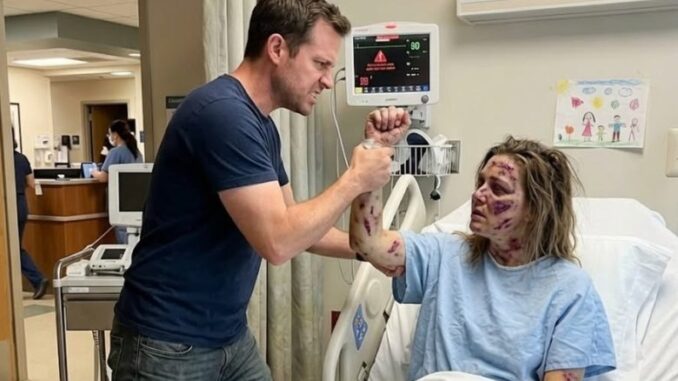
After a serious car accident, I was rushed to the hospital with both legs broken, fractured ribs, a swollen wrist, and stitches hidden beneath my hair.
Three weeks later, my husband finally came to see me.
He did not bring flowers, clean clothes, or the kind words I had spent twenty-one days hoping to hear.
Caleb stormed into my room looking furious.
“I’ve had enough of this,” he snapped. “Get out of that bed. I’m not paying another dollar for this.”
Then he grabbed my arm and tried to pull me up despite my injuries.
When I refused to move, he reacted in a way no one expected.
What happened next changed everything.
The hospital room smelled of antiseptic, stale coffee, and fresh bandages.
A paper cup had been left on the counter outside my room, and every time someone passed through the hallway, the faint smell of burnt coffee drifted in through the open doorway.
Beside my bed, the heart monitor repeated the same steady rhythm that had carried me through every painful night.
Beep. Breathe. Beep.
The sound had become part of my life.
It was there when nurses checked my blood pressure before sunrise.
It was there when medication made the ceiling blur above me.
It was there when I woke from nightmares about shattered glass and reached for a steering wheel that was no longer in front of me.
Both of my legs were locked inside heavy casts that ran from my thighs to my feet.
Even the slightest shift in the mattress sent pressure through my hips and pain across my ribs.
The doctors had warned me not to twist, reach suddenly, or try to sit up without help.
My ribs had been badly injured in the crash, and breathing too deeply still felt like pulling against a row of tight wires beneath my skin.
Stitches hid under the hair near my temple.
My wrist was swollen, stiff, and wrapped beneath the plastic hospital bracelet bearing my name.
REBECCA.
The letters were plain and black, but I had stared at them more times than I could count.
Some nights, that bracelet felt like proof that I was still here.
Three weeks earlier, the afternoon had begun like any other.
There had been errands to finish, laundry waiting at home, and a mental list of things Emma needed for school.
Then came the noise.
Tires.
Metal.
Glass breaking around me.
I remembered flashing emergency lights reflected across the road and a paramedic leaning close enough for me to see the concern in his eyes.
I remembered trying to ask about my phone because I needed someone to contact my family.
Most of all, I remembered thinking about my daughter.
Emma was the reason I fought to stay conscious inside the ambulance.
I kept repeating her name in my head as if it were a rope I could hold.
According to my chart, I was admitted at exactly 6:42 p.m.
That time appeared on every important page of my medical record.
It was printed beside the list of injuries, the first scans, the procedures, and the medications the doctors had authorized.
The hospital had documented what happened to my body with a level of detail that made the truth impossible to dismiss.
For twenty-one days, I waited for Caleb to visit.
At first, I told myself he was staying home because Emma needed him.
Then I told myself he was dealing with insurance calls, work, and the practical problems that arrive after an accident.
I imagined him walking into my room carrying a small bag of clean clothes.
I imagined him setting flowers near the window.
I imagined him sitting beside me and saying that he was sorry he had not come sooner.
By the second week, I had stopped expecting an apology.
I would have accepted one kind sentence.
I would have accepted a hand on my shoulder.
I would have accepted him asking whether I was scared.
Instead, when he finally appeared, he looked more upset about the hospital bill than the fact that I had survived.
He did not pause in the doorway.
He did not ask how I felt.
He did not look at the casts and wince the way strangers sometimes did when they passed my room.
He walked straight to the foot of the bed with his jaw tight and his shoulders rigid.
“Enough with this drama, Rebecca,” he said. “Get up. We’re going home.”
The medication made my thoughts slow, but I understood him perfectly.
I stared at him, waiting for some sign that I had misunderstood.
There was none.
“Caleb, I can’t.”
“Don’t start.”
“My legs are broken.”
He glanced at the casts as though they were props in a performance I had arranged to inconvenience him.
The look on his face was not concern.
It was irritation.
“The doctors said I’m not ready to leave,” I told him.
“They say whatever keeps the money coming.”
“That isn’t what’s happening.”
“You’ve been here three weeks.”
He said the number like it proved something against me.
I tried to explain that I had undergone procedures, that I still needed monitoring, and that I could not stand without medical assistance.
He dismissed every warning before I could finish.
He said I was exaggerating because he was tired of paying medical expenses.
The casts, fractured ribs, stitches, monitor, and medical chart outside my room all told a different story.
Caleb did not care.
He had always found a way to make my pain feel like something I had done to him.
We had been married for eleven years.
When we first met, his confidence had felt reassuring.
He always seemed certain about where we should live, how we should spend money, and what choices would be best for our future.
At first, I thought certainty meant stability.
I did not understand how easily certainty could become control.
After Emma was born, I left my accounting career because Caleb insisted one parent needed to stay home full time.
We talked about it as though it were a decision we had reached together.
In reality, he kept repeating the same argument until disagreeing felt selfish.
He said daycare would cost too much.
He said Emma needed her mother.
He said his income was enough and that my career could wait.
I told myself it was temporary.
I packed away my work clothes, stopped renewing professional contacts, and learned to organize every hour around our daughter and our home.
I handled school forms, groceries, meals, laundry, appointments, and the quiet emergencies that keep a household running.
Caleb called it staying home.
He rarely called it work.
Over the years, I became careful about how I spoke to him.
I learned to recognize the change in his expression when a conversation stopped going his way.
I learned which questions would be treated as accusations.
I learned that if I apologized quickly enough, the tension sometimes passed before Emma noticed.
Keeping the peace began as a choice.
Eventually, it became a habit so deeply rooted that I could no longer tell whether I was protecting my family or simply protecting Caleb from consequences.
Standing at the foot of my hospital bed, he expected that habit to save him again.
“I gave up everything for this family,” I whispered. “You’re my husband. You’re supposed to help me.”
He looked at me without warmth.
“You’re just making everything harder.”
The sentence landed differently than his other insults.
Maybe it was because I was too tired to soften it for him.
Maybe it was because the room contained too much visible proof of what I had endured.
Or maybe surviving the crash had stripped away the last excuse I could make for him.
I had spent years believing that if I explained myself clearly enough, Caleb would understand.
But understanding had never been the problem.
He understood that I was injured.
He understood that I could not walk.
He understood that moving me could cause more pain.
He simply believed his frustration mattered more.
The monitor continued beeping as he stepped closer.
I watched his shoes stop beside the bed rail.
For one second, I thought he might lower his voice and listen.
Instead, he reached down and yanked the blanket away.
The sudden movement exposed both casts and sent cold air across my legs.
His hand clamped around my upper arm.
“Get up.”
His fingers pressed into skin already tender from needles, blood pressure cuffs, and weeks of being repositioned by careful hands.
“Caleb, stop.”
He pulled.
Pain tore through my ribs as the weight of both casts shifted across the mattress.
My body moved only a few inches, but it felt as though something inside my chest had been ripped loose.
The heart monitor immediately began sounding faster.
Caleb tightened his grip instead of letting go.
I gasped and tried to brace myself with my swollen wrist, but the moment my palm touched the mattress, another sharp pain shot up my arm.
“You’re hurting me.”
“You’re doing this to yourself.”
The words were so familiar that, for an instant, I almost believed them.
That was how our marriage had worked.
Caleb acted, I reacted, and then he blamed my reaction for whatever came next.
If he shouted, I was too sensitive.
If he ignored me, I was too demanding.
If I asked about money, I was ungrateful.
If I stopped asking, he accused me of not caring.
There had never been a safe answer because the point was not to solve anything.
The point was to keep me uncertain enough that he remained in control.
For most of our marriage, I apologized whenever he became angry, even when I had done nothing wrong.
I swallowed insults because I was afraid of what an argument might do to Emma.
I told myself children needed two parents under one roof.
I told myself a tense home was still better than a broken one.
I told myself that patience could repair almost anything.
But patience had not brought Caleb to the hospital during the first week.
It had not brought him during the second.
It had brought him on the twenty-first day, furious about money and demanding that I leave against medical advice.
I looked down at his hand around my arm.
Then I looked at the casts covering my legs.
I had survived the crash.
I had survived procedures that left me shaking beneath thin hospital blankets.
I had survived sleepless nights when every breath hurt and the hours before sunrise felt endless.
I had survived the humiliation of needing help with things I had done alone since childhood.
I had begun learning how to sit upright without crying out.
I had begun learning how to trust my body again.
Somewhere during those twenty-one days, I had also begun remembering that my life belonged to me.
For the first time in years, I answered him quietly.
“No.”
Caleb froze.
He had clearly expected fear, bargaining, or another apology.
He had not expected refusal.
The word did not sound dramatic in the room.
It was barely louder than the monitor.
But it changed the space between us.
His expression hardened.
“What did you say?”
“I said no.”
My voice shook, but I did not take it back.
“I’m not leaving this bed until the doctors say it’s safe.”
For a moment, neither of us moved.
Then his expression changed again.
The anger became colder.
He jerked my arm harder.
The movement sent a crushing wave of pain through my ribs, and a cry escaped before I could stop it.
The monitor erupted into urgent alarms.
The steady beeping that had filled my room for three weeks became rapid and sharp.
Numbers changed across the screen beside my bed.
A warning light began flashing.
Caleb looked at the machine, but he did not release me.
“Turn that off,” he said, as though I controlled it.
“I can’t.”
“You’re making a scene.”
His name was already written in the visitor log.
The time he entered had been recorded at the nurses’ station.
My treatment schedule had been documented.
My chart clearly identified me as a patient recovering from serious injuries.
Everything about the room established the same fact: I could not simply stand up and go home because my husband had decided the bill was too high.
Yet Caleb continued acting as though I were an expensive problem standing in his way.
He pulled again, and the bed rail pressed painfully against my hip.
I looked toward the open doorway.
The hallway still sounded strangely ordinary.
A cart rolled past, its wheels rattling lightly against the floor.
Someone laughed near the nurses’ station.
A phone rang and stopped.
The abandoned paper coffee cup remained on the counter outside.
For a few seconds, the normal sounds made what was happening feel unreal.
How could the world continue so calmly while my husband tried to drag me from a hospital bed?
I opened my mouth to call for help, but breathing deeply enough to shout sent pain through my chest.
Only a broken sound came out.
Caleb leaned closer.
“Stop embarrassing me.”
The accusation almost made me laugh.
I was lying beneath fluorescent hospital lights with both legs in casts, a swollen wrist, stitches in my head, and alarms sounding beside me.
Still, he believed he was the person being humiliated.
Beside my bed, Emma’s drawing remained taped to the wall.
She had made it with thick crayons and folded the paper before someone brought it to me.
The picture showed our house beneath a bright yellow sun.
Three uneven figures stood in front of it, their arms stretched toward one another.
Above them, Emma had written five words in large, careful letters.
COME HOME SOON, MOMMY.
I stared at the drawing while Caleb’s fingers tightened around my arm.
I remembered the shattered glass.
I remembered the ambulance doors closing.
I remembered promising myself that I would make it home to my daughter.
At the time, home had meant the same house, the same driveway, and the same family arrangement I had spent years trying to preserve.
Now I understood that returning to a building was not the same as returning to safety.
Emma did need me to come home.
But she did not need me to prove my love by allowing Caleb to destroy what was left of me.
The thought settled inside me with more strength than I expected.
I stopped trying to pull my arm away because every movement hurt.
Instead, I looked directly at him.
“You need to let go.”
He gave a short, bitter laugh.
“You don’t tell me what I need to do.”
The monitor alarm continued.
Its sharp rhythm pushed through the room, louder than his voice and louder than the fear telling me to apologize.
I did not apologize.
Caleb released my arm only long enough to reposition his grip.
Red marks remained where his fingers had pressed into my skin.
He stepped closer to the side of the bed, blocking part of my view of the hallway.
For the first time, I saw uncertainty flicker behind his anger.
The alarm had created a record he could not talk over.
Someone would come.
He knew it, and so did I.
Instead of stepping back, he reached toward me again.
His hand hovered above my arm as if he were deciding whether to grab the same place or find another way to force me upright.
The alarm grew louder.
Footsteps sounded beyond the doorway.
Caleb’s eyes moved toward the hall.
My heart hammered beneath my injured ribs, each beat bringing another burst of pain.
I kept my gaze on Emma’s drawing.
COME HOME SOON, MOMMY.
For years, I had mistaken silence for peace.
Now the room was filled with alarms, and for the first time, I understood that noise could also mean someone had finally been warned.
The handle shifted.
Then the hospital room door slowly began to open.
Leave a Reply