I slid the playback marker back a few seconds and started the clip again, because I needed to know whether I had misunderstood the man I married—or finally understood him.
The hallway outside my friend’s bedroom was dim, but the phone screen was painfully bright in my hand.
I watched my mother-in-law lean toward my two-year-old daughter.
From my seat at the banquet, I had seen the slap.
From my husband’s cousin’s angle, I could see what happened before it.
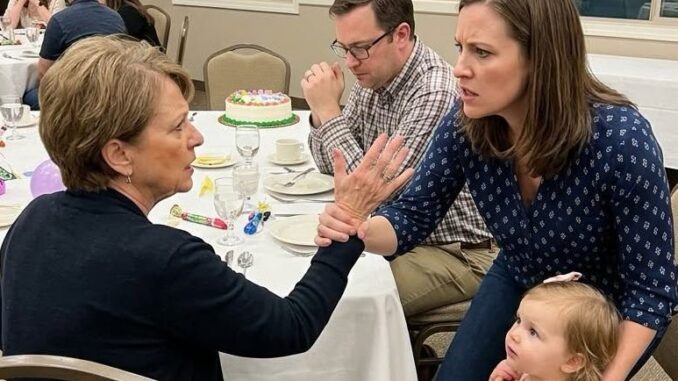
My mother-in-law had my daughter’s wrist trapped in her hand.
Not loosely.
Not in the casual way someone might stop a toddler from reaching for a plate.
Her fingers were wrapped around that tiny wrist while my daughter twisted toward her father.
And he saw it.
He was close enough that the whole thing happened almost directly in front of him.
I watched his head turn.
I watched his eyes move toward his mother.
Then I heard his voice beneath the restaurant noise.
“Mom, I told you—not in front of everyone.”
I played it again.
Then again.
The meaning didn’t change.
He hadn’t said, “Don’t touch her.”
He hadn’t said, “Let go of my daughter.”
He hadn’t even sounded shocked.
His problem was where it was happening.
In front of everyone.
That was the part he cared about.
I leaned against the hallway wall and stared at the frozen image on my phone.
His face was turned toward his mother.
My daughter’s wrist was still in her hand.
There was no confusion in that frame.
There was only a father who knew something was wrong and had chosen to manage the appearance of it instead of stopping it.
I thought about the parking lot outside the banquet room.
My daughter’s cheek had already been turning red beneath the light when she touched it and whispered, “Grandma mad.”
My husband had come running outside with broth on his shirt and no glasses on his face.
But he hadn’t rushed to the car seat.
He hadn’t bent down to look at her cheek.
He hadn’t asked whether she was scared.
He had told me I needed to come back inside because I had humiliated his mother.
At the time, I had thought that response was cowardice.
Now I wasn’t sure cowardice was a strong enough word.
Cowardice could mean freezing in the moment.
This was different.
He had seen the grip before the slap.
He had spoken before the slap.
He had known enough to warn his mother about witnesses.
I went back into the bedroom and looked at my daughter.
She was asleep sideways across the borrowed bed, one small hand curled near her face.
The T-shirt my friend had found for her was too big, and one sleeve had slipped almost to her elbow.
Her cheek was still faintly red.
I sat beside her and lowered the brightness on my phone.
For two years, I had been telling myself that my husband’s biggest failure was weakness.
His mother would criticize how I dressed our daughter, and he would tell me she was “just particular.”
She would complain about what I packed for her to eat, and he would say she meant well.
She would correct a toddler’s pronunciation as if a two-year-old were deliberately embarrassing the family, and he would ask me not to turn every comment into an argument.
Every gathering followed the same pattern.
His mother pushed.
He minimized.
I objected.
Then somehow I became the person creating tension.
Every time.
For a long time, I thought keeping the peace meant being mature.
Then I slowly realized the peace only existed because one person was required to absorb everything.
That person was usually me.
And once my daughter became old enough to understand tone, looks, and rejection, it started becoming her too.
That was why I had copied our important papers a month earlier.
That was why I had started putting part of my own paycheck into an account I controlled.
That was why there had already been a small overnight bag packed for my daughter.
I hadn’t been planning some dramatic escape.
I had been preparing for the possibility that one day my husband’s promises would stop being enough.
At the banquet, that day arrived.
The video simply showed me that it had arrived sooner than I understood.
My phone buzzed again.
Another message from my husband appeared on the screen.
I didn’t open it immediately.
There were already thirteen from earlier, and not one had asked whether our daughter was okay.
He had written about the ruined birthday banquet.
He had written about his mother’s embarrassment.
He had written about frightened guests and the scene I had caused.
He had warned me that people would start getting the wrong idea if I didn’t return.
But the little girl who had been slapped at the table barely existed in his messages.
I looked at the video again.
Then I looked at his message notification.
For the first time, I understood why his silence at the banquet had felt so familiar.
It wasn’t really silence.
It was a choice he had practiced for years.
When his mother insulted me, he chose her comfort over confronting her.
When she undermined me as a parent, he chose avoiding conflict over defending our home.
When I complained, he chose to reinterpret what I had experienced until I doubted whether I was being unreasonable.
And when his mother put her hand on our daughter, he chose the same thing again.
Only this time there was a camera.
I opened his newest message.
He wanted to know where I was.
I didn’t answer that question.
I didn’t give him my friend’s address.
Instead, I saved the video attachment, then saved another copy.
It wasn’t because I suddenly had some complicated revenge plan.
It was because I had spent too much time being told that things hadn’t happened the way I remembered them.
This time, I wasn’t going to depend on memory.
The proof existed outside me.
I sent his cousin a short reply thanking her for sending the full clip and asking her not to delete the original.
Then I finally typed the message I had almost sent earlier.
“The wrong idea is that this was the first time you failed her.”
I stared at the sentence.
Before, it had felt angry.
Now it felt incomplete.
I deleted it.
I wrote something simpler instead.
“I saw the video.”
Then I sent it.
That was all.
No accusation.
No paragraph explaining what he had done.
No attempt to convince him that a father should protect his daughter from being grabbed and slapped.
I had spent years explaining obvious things to a man who benefited from pretending they were complicated.
I wasn’t doing that anymore.
His response came quickly.
He didn’t ask which video.
That detail hit me immediately.
If he truly believed nothing serious had happened, he could have been confused.
Instead, he knew.
His next messages tried to drag the conversation back toward my behavior at the banquet—my slap, the cake, the guests, his mother’s humiliation.
I read them without replying.
He kept describing the public scene as though the story began when I lunged across the table.
But the video had preserved the part he wanted erased.
His mother’s hand around our daughter’s wrist.
His warning.
The slap.
Then me.
That order mattered.
It didn’t excuse every decision I had made in anger.
I knew exactly what I had done when I slapped my husband hard enough to send his glasses into his stew.
I knew exactly what I had done when I shoved his mother into her birthday cake.
I wasn’t proud of losing control.
But I also wasn’t going to let them cut the first half of the scene away and present themselves as people who had been attacked without cause.
The whole sequence existed now.
That changed something inside me.
Not because I suddenly felt powerful.
I didn’t.
I felt exhausted.
My hands were still trembling.
I was sleeping in someone else’s apartment with my daughter in a borrowed shirt because my own husband had watched his mother hurt her.
Nothing about that felt victorious.
But clarity has its own kind of force.
Once I saw the situation clearly, I couldn’t return to the version of our marriage where I kept negotiating with myself.
I had always believed there would be one unmistakable moment when I would know whether my husband was capable of standing up to his mother.
I had imagined shouting.
Maybe a dramatic argument.
Maybe him finally telling her she had crossed a line.
Instead, the answer came in a sentence spoken so quietly he thought nobody would hear it.
“Not in front of everyone.”
That sentence explained more than any speech could have.
He wasn’t objecting to the behavior.
He was objecting to the audience.
I put my phone face down on the nightstand and checked my daughter’s cheek again.
She stirred when my fingers brushed her hair but didn’t wake.
For a few seconds, I just watched her breathe.
I thought about how small she had looked in that banquet chair surrounded by adults.
She didn’t understand family politics.
She didn’t understand why Grandma got angry when she didn’t behave exactly the way Grandma wanted.
She didn’t understand why Daddy stayed quiet.
She only understood that someone bigger had hurt her.
And then her mother had picked her up and taken her away.
That was the part I wanted her body to remember.
Not the restaurant.
Not the shouting.
Not the cake.
Leaving.
Safety.
Someone choosing her immediately.
My friend tapped softly on the bedroom door later and handed me a glass of water.
She didn’t ask for every detail.
She had already seen enough when she opened her apartment door and noticed my daughter’s cheek.
That simple restraint meant more to me than I expected.
For years, whenever something happened with my mother-in-law, I had been required to build a case before I was allowed to feel hurt.
What exactly did she say?
What tone did she use?
Could she have meant something else?
Was I already upset before she said it?
Did I respond too strongly?
There was always another question designed to move attention away from what she had done.
My friend didn’t do that.
She had seen a child with a red cheek and a mother carrying an overnight bag.
She had opened the door.
That was enough.
The next morning, my daughter woke earlier than usual.
For a moment, she looked around the unfamiliar room without speaking.
Then she saw me sitting nearby and reached both arms toward me.
I picked her up.
She touched her cheek once, then rested her head against my shoulder.
I didn’t ask her to repeat what happened.
I didn’t want to turn her into a witness for adults who should already know better.
We ate a simple breakfast in my friend’s kitchen.
My daughter pushed pieces of food around her plate and eventually started talking about ordinary toddler things as if the world were trying to return to normal around her.
My phone continued buzzing on the counter.
I left it there.
That morning, I wasn’t interested in defending my reputation to my husband’s family.
Anyone who had been in that banquet room had seen enough to form an opinion.
Some would blame me for exploding.
Some would blame his mother for striking a two-year-old.
Some would probably decide the safest position was to call the whole thing a tragic family misunderstanding.
I couldn’t control that.
For years, I had exhausted myself trying to manage how his family interpreted me.
I had dressed carefully for gatherings.
I had softened my tone.
I had swallowed responses.
I had accepted apologies that weren’t really apologies because my husband insisted everyone would get along better if I stopped holding grudges.
And still, when the moment came, his mother’s opinion mattered more to him than our daughter’s safety.
So I stopped trying to win the family argument.
That became my real revenge.
Not destroying anyone.
Not humiliating his mother again.
Not finding some bigger public stage where I could make them feel what I had felt.
I simply stopped protecting the version of them that depended on my silence.
The video existed.
The messages existed.
My own preparation existed.
And most importantly, my daughter was with me.
My husband had spent years teaching me that keeping the peace was my responsibility.
That morning, I finally rejected the assignment.
I sent him one final message for the time being.
I told him our daughter was safe and that I would not return to the house while he was still treating his mother’s behavior as something I was supposed to tolerate.
I didn’t argue about the banquet.
I didn’t negotiate about appearances.
I didn’t respond to accusations about embarrassing his mother.
I gave him the one fact that mattered: our child was safe.
Then I stopped answering.
A little later, my daughter climbed down from my lap and carried her empty cup toward the sink with both hands.
My friend stepped aside so she could reach the counter.
Nothing dramatic happened.
Nobody applauded.
Nobody gave a speech about strength.
My daughter set the cup down, turned around, and walked back toward me.
I held out my hand.
She put her tiny fingers into mine.
The night before, my husband had watched his mother hold that same child by the wrist and worried about who might see.
Now I understood exactly what separated us.
He wanted the ugly parts hidden.
I wanted our daughter protected.
For years, I had treated those differences like problems we could eventually communicate through.
The video ended that illusion.
It didn’t tell me every decision I would make next.
It didn’t make the future simple.
It didn’t erase the history of our marriage or the fact that I had once believed his promises every time he said the next gathering would be different.
But it answered the question that mattered most.
When his mother crossed the line with our child, he had already chosen what to protect.
So had I.
I squeezed my daughter’s hand, picked up the overnight bag I had packed a month before, and moved it from the corner beside the door to the chair next to mine.
Leave a Reply