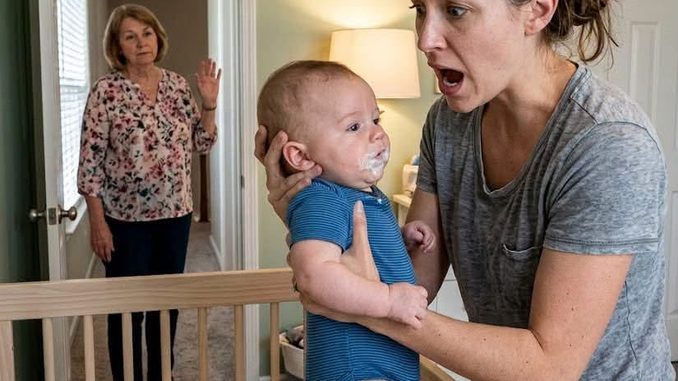
Diane twisted the brass key free from her ring and let it fall into Mark’s waiting hand.
He closed his fingers around it.
I watched him do it.
I watched Diane look at the floor.
I watched Dr. Patel take the medicine bottle away from her and set it beside the toxicology report.
Nobody raised their voice.
That made it worse.
The examination room was cold enough that I kept rubbing my palms over my jeans, and Noah’s empty diaper bag sat under the chair with one tiny sock hanging out of the side pocket.
I picked up the sock.
Then I put it back.
Dr. Patel asked Diane when she had last given Noah the antihistamine.
She said tonight.
He asked whether she had done it on another night.
Diane looked at Mark.
Not me.
Mark opened his hand again, stared at the key in his palm, and said, “Answer him.”
She sighed as though we were exhausting her.
“Maybe twice before.”
I stopped rubbing my hands.
Dr. Patel asked what she meant by maybe.
Diane said she did not keep a diary of every little thing she did while helping us.
I pulled my phone from my pocket and opened the calendar instead of arguing with her.
There were only a handful of evenings when Diane had put Noah to bed without one of us in the room, and I could remember them because I had been grateful for every single one.
One was the night Mark and I ate dinner together downstairs while she insisted we take an hour to ourselves.
One was the afternoon I had a migraine and slept on the couch.
One was three weeks earlier, when she told me Noah had gone down unusually fast and I had laughed because I thought she possessed some grandmother trick I had not figured out yet.
I read the dates.
I read them again.
I read each one aloud.
Diane folded her arms.
“It wasn’t every time.”
That was her defense.
Mark sat down so suddenly that the chair legs scraped against the floor.
For a few seconds, he pressed both hands over his mouth while I kept scrolling through old messages.
There were texts from Diane after those evenings.
He’s out like a light.
Finally got that boy to settle.
See? Grandma knows a few things.
I turned the screen toward Mark.
He looked once.
Then he pushed the phone gently back toward me.
Before I could say anything else, a nurse stepped in and told us Noah’s numbers were improving and that the team wanted to keep watching him for a while longer.
I went to him.
Nothing Diane had to say mattered more than that.
Noah was awake when I reached the bedside, irritated by the sensor wrapped around his foot and trying weakly to pull at the tape with his toes.
I bent over him and let him grab one of my fingers.
He squeezed.
Not hard.
Enough.
I stayed there until my shoulders started aching from the angle, because every time I thought about sitting down, I remembered how heavy he had felt in my arms at home.
Sometime later, Mark came in alone.
He had left his work badge in the other room, and there was a red mark across his palm where he had been gripping our house key.
I asked where Diane was.
“She went to the waiting area.”
I looked at him.
He added, “Security asked her to stay away from this room.”
I nodded and adjusted Noah’s blanket.
Mark stood beside the bed without touching me.
“She used to give me stuff when I was little,” he said.
I looked up.
He stared at the floor.
“Not like this. I don’t know. She always joked that I was a terrible sleeper and she knew how to knock me out.”
I waited.
He swallowed.
“I thought she meant rocking me. Driving me around. Something normal.”
I did not tell him what to think about his childhood.
I asked what he planned to do about our son.
Mark looked at Noah.
“She’s done.”
I needed something more precise.
“Done with what?”
He understood.
“No babysitting. No taking him anywhere. No being alone with him. No key. No coming into the house unless we invite her.”
I nodded once.
Then I asked him to say it to her before we left the hospital.
He did.
When Diane came back into the consultation room, she carried her purse against her ribs and spoke to Mark in the gentle voice she had used in our kitchen while I was calling 911.
“Honey, you’re upset.”
Mark put the brass key on the table between them.
“I’m not giving this back.”
Diane smiled at him.
Not kindly.
Patiently.
As if he were six.
“You’re letting panic make decisions for your family.”
I pulled a chair closer to the wall and sat because my legs had started shaking again.
Diane continued speaking only to Mark.
“She hasn’t slept properly in months. She worries about every sound that baby makes. You know that.”
Mark glanced at me.
For one terrible second, I thought she had found the door she wanted.
Then he turned back to her.
“You gave our eight-month-old medicine without asking us.”
“I helped him sleep.”
“You hid it.”
“I didn’t hide anything.”
“You brought the bottle in your purse.”
“Because I carry medicine.”
“For yourself?”
Diane hesitated.
I rubbed my thumb over a loose thread on my jeans and said nothing.
Mark asked her again.
She changed direction.
“You left him with me.”
There it was.
I lifted my head.
Diane finally looked at me.
“If you believed I was so dangerous, why did you hand me your baby and go downstairs?”
My mouth went dry.
I could have defended myself.
I could have listed every reason I had trusted her.
Instead, I picked up the medicine bottle from the table and moved it beside the printed report.
“I trusted you because you were his grandmother.”
Diane opened her mouth.
I stopped her.
“You used that trust to give him something we never approved.”
She turned to Mark again.
He did not rescue her.
That was the first real shift.
Until then, Diane had treated the hospital like an embarrassing family disagreement that could still be managed if she kept her tone softer than mine.
Now Mark was standing on my side of the table.
Literally.
He moved his chair next to mine.
Diane noticed.
Her face changed before her words did.
She asked whether we were really going to destroy a family over one mistake.
I looked at the calendar on my phone.
“Which one?”
She went quiet.
A hospital social worker came in sometime after that and explained that, because an infant had been given medication without parental permission and required emergency care, the event had to be documented and passed through the hospital’s child-safety process.
I listened.
I answered questions.
I gave the timeline from dinner to the ambulance without adding guesses, because I no longer wanted anyone in that room debating whether my fear had been reasonable.
The report could carry the facts.
Diane tried to interrupt twice.
I kept talking.
When the social worker asked whether Diane lived with us, I said no.
When she asked whether Diane had access to our home, I looked at the key on the table.
“Not anymore.”
Mark picked it up and put it in his pocket.
Diane leaned back.
The chair squeaked.
Then she said something I still remember because of how ordinary she made it sound.
“You’re going to regret humiliating me over this.”
I asked the social worker to note that sentence too.
Diane laughed once.
Mark did not.
By then, Noah was improving enough that the fear in the room changed shape rather than disappearing, and I found myself concentrating on practical instructions while my brain kept trying to drag me back to the sight of white foam at the corners of his mouth.
Dr. Patel told us they wanted continued observation before making any decision about discharge.
I stayed beside Noah.
Mark went downstairs to move the car closer.
Diane was told to leave the treatment area.
For the first time all evening, I was alone with my son and no argument happening within earshot.
I should have felt calmer.
Instead, I noticed everything.
The soft hiss of the vent.
The blinking monitor.
A paper cup someone had left on the windowsill.
Noah’s fingers opening and closing against the blanket.
I counted each movement until I realized what I was doing.
Then I stopped counting.
A little while later, Mark returned carrying a granola bar and a bottle of water.
I ate half the bar because he stood there until I did.
Neither of us mentioned Diane.
For several minutes, we talked only about diapers, feeding, and whether Noah would sleep once we got home.
It was the first ordinary conversation we had managed all night.
Then Mark said, “She’ll leave us alone now.”
I looked at him.
He believed it.
I didn’t answer.
Around midnight, my phone began vibrating on the tray table.
Diane had started a family group message.
She did not mention the antihistamine.
She wrote that there had been a misunderstanding, that I had panicked after Noah became unusually sleepy, and that the hospital was being cautious because I could not remember everything he had been given that day.
I read the message once.
Then I took screenshots.
Mark read it over my shoulder.
His jaw tightened.
Another message appeared.
Diane wrote that she had spent months supporting us and was now being treated like a criminal for trying to soothe her grandson.
Mark reached for my phone.
I handed it to him.
He typed slowly.
Mom gave Noah antihistamine without our knowledge. She has now admitted doing it before. The hospital documented it. She no longer has access to our home or unsupervised access to Noah.
He stopped.
I expected him to soften it.
He didn’t.
He pressed send.
The replies came quickly.
One relative asked whether this was really necessary in a family chat.
Another said Diane had always been wonderful with children.
Someone sent a question mark.
I put the phone facedown.
I had spent enough of the night proving what I had seen.
Mark left it there too.
That was our sideways step.
No new medical crisis appeared.
No dramatic stranger arrived with another secret.
Noah kept getting better.
But the argument moved out of the hospital and into the family, where Diane knew exactly which version of herself everyone had known for years.
I could not control that.
I could control our door.
Before dawn, I used Mark’s phone to schedule the earliest rekeying appointment we could get for the house.
He gave me the address confirmation to check.
I checked it twice.
Then I put his phone down and rested my head against the chair for a few minutes without sleeping.
By morning, Noah was alert enough to protest when a nurse touched his foot.
The sound nearly made me laugh.
I let him complain.
I wanted every bit of it.
Dr. Patel reviewed the discharge plan with us later that morning after Noah had remained stable through the rest of the observation period.
He told us what signs required immediate medical attention and made sure we had follow-up arranged with Noah’s pediatrician.
I repeated the instructions back.
Mark wrote them down.
Neither of us asked Diane to come.
When we finally carried Noah out of the hospital, the automatic doors opened onto cool morning air and a parking lot shining from an earlier rain.
I buckled Noah into his car seat myself.
My hands were clumsy from exhaustion.
I checked the chest clip.
I checked it again.
Then I made myself stop.
Mark drove.
I sat in the back beside Noah.
Halfway home, Diane called him.
He let it ring.
She called again.
He let it ring.
She called a third time.
Mark pulled into a grocery-store parking lot, put the car in park, and blocked her number while I watched Noah sleep.
The parking lot smelled faintly of wet asphalt through the cracked window, and an employee pushed a row of carts past us without looking over.
Mark set the phone in the cup holder.
“That’s it,” he said.
I wanted to believe him.
At home, the sweet-potato bowl was still soaking in the sink.
The sight of it stopped me in the kitchen doorway.
Nothing had moved since I had run upstairs.
A dish towel lay on the floor where I had dropped it.
One cabinet door was open.
The monitor receiver was still on the counter.
I carried Noah straight to the living room and sat with him against my chest while Mark walked through the house.
He checked the nursery.
He checked the back door.
He checked the side entrance.
Then he came downstairs holding something small between two fingers.
For one second, my stomach turned.
It was only Diane’s grocery-store loyalty card.
It must have fallen from her purse.
Mark dropped it in the trash.
We both laughed once, because the alternative was not laughing at all.
By late morning, the locks had been changed.
I stood inside the front door while the old cylinder came out and the new one went in.
The work itself was boring.
Metal parts.
A screwdriver.
A folded receipt.
I was grateful for boring.
When it was finished, Mark tested the new key from outside.
The deadbolt turned.
Then he handed the new key to me first.
I took it.
For about six hours, I thought that was the end of the immediate crisis.
Noah was home.
Diane could not walk through our front door.
The medicine bottle was with the hospital documentation.
Mark had told the family exactly what happened.
We had a follow-up plan.
I even managed to shower while Mark held Noah downstairs.
Then the doorbell rang.
I froze with a towel around my wet hair.
Mark looked through the front window.
Diane was standing on the porch.
She had no key.
That mattered.
She had to wait outside.
Mark went to the door but did not open it.
I came down the stairs and stopped halfway.
Diane could see me through the narrow window beside the frame.
She held a paper shopping bag in one hand.
In the other, she had Noah’s blue sleep sack.
I had not realized she had taken it from the hospital bag the night before.
She lifted it toward the glass.
“I brought his things back.”
Mark spoke through the closed door.
“Leave them.”
Diane stared at him.
“I need to talk to you without her controlling the conversation.”
I kept one hand on the stair rail.
Mark did not look back at me.
“No.”
Diane’s face hardened.
She told him I was separating him from his mother.
She told him I had always been uncomfortable with how close they were.
She told him I had turned one mistake into an excuse to punish her.
Mark listened until she stopped.
Then he said, “You gave my son medicine without telling us. More than once.”
Diane lowered the sleep sack.
“You don’t know what raising a difficult sleeper is like.”
Mark put his hand flat against the door.
“I know what being his father is like.”
He stepped away.
Diane knocked harder.
He did not return.
I walked downstairs and picked up Noah from the bassinet.
The knocking continued for another minute or two.
Then it stopped.
I did not go to the window.
After she left, Mark brought the bag inside.
There were diapers, the sleep sack, two pacifiers, and a small container of baby lotion.
Nothing else.
I washed the sleep sack anyway.
It did not need washing.
I did it because my hands needed a task.
That afternoon, the family messages started again.
This time, Mark answered only one.
His aunt had asked whether Diane could apologize and move forward.
Mark typed, She can apologize. That does not restore access.
He showed it to me before sending it.
I nodded.
He sent it.
That distinction became the part Diane hated most.
She could say she was sorry.
She could say she meant well.
She could say older generations did things differently.
None of those sentences opened our door.
None put her alone with Noah.
None erased the hospital record.
Over the next several days, I followed the pediatrician’s instructions, watched Noah return to his normal feeding and sleep patterns, and wrote down anything that worried me instead of calling Diane for reassurance the way I sometimes had before.
My body seemed to remember the hospital even when my mind was trying to do ordinary things.
I would hear Noah cough once and find myself already moving.
I would see him sleeping deeply and touch his back.
Then I would take my hand away.
I kept choosing the next normal task.
Feed him.
Change him.
Wash the bottle.
Sit down.
Eat something.
A week later, Mark found the old brass key in the pocket of the pants he had worn to the hospital.
He placed it on the kitchen counter beside the new keys.
For a moment, neither of us touched it.
Then he asked what I wanted to do with it.
I picked it up.
The teeth were worn shiny at the edges from months of use.
I remembered every package Diane had brought inside for us, every time she had let the dog out, every evening I had heard the lock turn and felt relieved because someone had arrived to help.
The key had never been dangerous by itself.
Access was the thing we had misunderstood.
I opened the junk drawer under the phone charger and put the old key in the back beside a dead battery, two takeout menus, and a pen that no longer worked.
Then I closed the drawer.
Mark kept the new keys.
I kept one too.
Diane did not get another.
Months later, Noah still fussed at bedtime.
Sometimes he fought sleep so hard that Mark and I took turns walking the hallway with him while dinner went cold downstairs.
Sometimes nothing worked.
We let nothing work.
If he was safe, fed, dry, and angry about being tired, then he was allowed to be angry about being tired.
Nobody needed to make him easier.
Nobody needed to make him quiet for our convenience.
And when Diane eventually sent a written apology, I read it once at the kitchen table and put it away without answering that day.
She said she understood that she had crossed a line.
She said she missed Noah.
She said she hoped trust could be rebuilt.
I did not promise that.
Mark did not promise it either.
We agreed that any future contact would happen only under conditions we chose, with both of us present, and that access to our home would remain ours to give or withhold.
That closed the part I could close.
I could not rewrite the nights when I had thanked Diane for getting Noah to sleep.
I could not know exactly what she had told herself each time she reached into her purse.
I could stop handing her authority simply because she called it help.
So I did.
The old brass key is still in the back of our junk drawer, and it no longer opens our front door.
Leave a Reply