PART 1: THE $300,000 GIFT THAT COST ME MY FAMILY
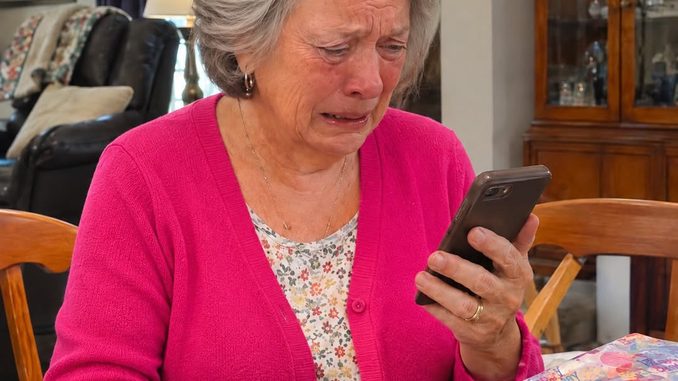
The afternoon my daughter-in-law told me I was no longer welcome in my grandchildren’s lives, I was sitting at my kitchen table wrapping their birthday presents. I had recently contributed $300,000 toward my son’s new home, and I never imagined that the family I had sacrificed so much for would suddenly decide to shut me out.
“Mark and I have decided that you’re no longer welcome in our lives. Don’t call, don’t visit, and don’t try to see the children. We need to protect them from your toxic behavior.”
I read Stephanie’s message several times, struggling to understand what could have prompted such a cruel announcement. My son, Mark, was included in the conversation, yet he hadn’t offered a single word of objection.
My name is Barbara Hayes, and I was sixty-eight years old when this happened. After losing my husband, David, I had devoted much of my time to helping Mark’s family and being a loving grandmother to Emma and Lucas.
Emma had recently asked me to attend her school concert, while five-year-old Lucas loved having me read him bedtime stories. Now I was staring at their unfinished presents, wondering whether I would ever be allowed to celebrate another birthday with them.
I privately messaged Mark, asking whether he had known Stephanie intended to cut me out of their lives. He read my question but waited several minutes before responding.
“Mom, please don’t make this more difficult than it already is. Stephanie just needs some space.”
His response devastated me because I had raised him, supported him through difficult years, and paid for his college education. When David passed away, Mark had held my hand through the funeral, and I believed our bond would survive anything.
For months, Mark and Stephanie had been preparing to purchase a luxurious $1.5 million home in an expensive suburb outside Charlotte, North Carolina. Stephanie adored its enormous kitchen, beautifully landscaped backyard, excellent school district, and separate guest suite.
Unfortunately, they couldn’t qualify for the financing they wanted without assistance. One evening, Mark visited me with a folder of mortgage estimates and explained that they needed a substantial contribution to complete the purchase.
“Mom, we need some financial help to get us across the finish line.”
“Three hundred thousand dollars? Mark, that’s an enormous amount of money.”
Stephanie quickly reminded me that I had always wanted Emma and Lucas to enjoy opportunities their parents hadn’t experienced. Looking at my grandchildren’s photographs, I convinced myself that helping them secure a beautiful home was worth the sacrifice.
David and I had spent forty-one years building our savings through careful budgeting, long working hours, and countless postponed luxuries. We had never inherited wealth, and after his death, I became especially protective of the retirement security we had worked so hard to establish.
Nevertheless, I agreed to contribute $300,000 and participate in a lender-approved guarantee arrangement. Having worked thirty-five years in banking compliance and risk management, I understood the risks and insisted that the necessary documents be reviewed properly.
I transferred the money into the closing attorney’s escrow account on Tuesday. Two days later, Stephanie informed me that I was too toxic to have any contact with the very grandchildren I was supposedly helping.
I glanced at the calendar and remembered that their closing was scheduled for the following afternoon. Although my money was already in escrow, the lender still required my final signature on outstanding guarantee documents.
I opened my laptop and sent Mark another message, explaining that I needed independent legal advice before accepting any further financial obligations. Within thirty seconds, my phone rang.
“Mom, what are you doing? We’re supposed to close tomorrow!”
“Your wife just told me I’m no longer part of your family, Mark. I need to understand exactly what I’m agreeing to.”
His irritation grew as he warned me that the children were counting on the house. Instead of asking how I felt about being rejected, he seemed concerned only that I might interfere with the purchase.
That was when I realized something painful: my family might no longer want me in their lives, but they still expected me to finance the life they wanted.
PART 2: THE SECRET THEY PLANNED TO HIDE UNTIL AFTER CLOSING
The following morning, I arrived at my bank shortly after eight, determined to understand my financial position before making another decision. Sarah Jenkins, a bank manager I had mentored years earlier, welcomed me into her office and carefully examined the paperwork connected to Mark and Stephanie’s mortgage.
When I showed her Stephanie’s message, she immediately understood why I was reconsidering my involvement. Sarah explained that my $300,000 had already reached the closing attorney’s escrow account, meaning the bank couldn’t simply reverse the transfer at my request.
However, the lender was still waiting for documents connected to my proposed guarantee. Sarah strongly recommended that I consult an independent attorney before signing anything else.
By ten o’clock, I was meeting Rebecca Collins, an attorney Sarah had recommended. Rebecca reviewed the agreement and asked whether I had been promised any ownership interest in the property.
“No. I was simply trying to help my son and grandchildren have a better home.”
“Are you still comfortable accepting the financial obligations associated with this guarantee?”
I thought about David and the retirement savings we had spent decades accumulating. Then I remembered Stephanie’s message and Mark’s complete unwillingness to defend me.
“Not under these circumstances.”
Rebecca explained that I wasn’t required to sign additional documents merely because the closing was approaching. Nevertheless, she warned that recovering my contribution would depend on the escrow instructions and the outcome of the purchase agreement.
With my authorization, she contacted the lender and closing attorney to confirm that I would not execute the outstanding guarantee documents. She also requested that my contribution be reviewed before any funds were disbursed.
Shortly afterward, Mark and Stephanie began calling repeatedly. Rebecca offered to handle communications, which was a relief because my hands were trembling too badly to hold the phone comfortably.
At 12:30, the closing attorney confirmed that the lender couldn’t proceed under the anticipated financing terms. Their three o’clock closing was postponed, and I felt more heartbroken than victorious.
When I finally answered Mark’s call, he immediately demanded that I fix the problem. He warned that Stephanie was devastated and the seller might refuse to wait.
“Mom, why are you doing this to us?”
“Mark, did you read the message your wife sent me?”
“Yes, but Stephanie was angry.”
“And you said nothing while she told me I could never see my grandchildren again.”
Mark complained that my financial assistance sometimes made people feel indebted to me. His accusation hurt deeply because I had never wanted my generosity to become a source of resentment.
“If helping you makes you feel that way, perhaps I shouldn’t be financing this house.”
After a long silence, Mark admitted there was something about the property he hadn’t told me. Stephanie had apparently insisted that the information remain secret until after they moved in.
“Her parents are going to live with us, Mom. They’re taking the guest suite.”
I remembered Stephanie describing that beautiful private wing as a playroom for the children and occasional accommodation for visiting relatives. When I asked how long her parents intended to stay, Mark reluctantly admitted that the arrangement was permanent.
“Did you know about this before I transferred the money?”
“Yes.”
I struggled to comprehend what he was telling me. Stephanie’s parents would enjoy their own rooms, private entrance, and permanent place in the household, while I was being forbidden from visiting the grandchildren whose future I was helping finance.
Mark admitted that they had concealed the arrangement because they knew I would ask questions. Stephanie hadn’t wanted another disagreement before securing the house.
“You let me risk the savings your father and I worked our entire lives to build, and you deliberately kept this from me.”
He insisted that the purchase was still about providing a better life for the children. But when I asked why I was the only grandparent being excluded, he had no explanation.
I ended the call with a painful realization. My son hadn’t merely remained silent when his wife rejected me; he had knowingly allowed me to make an enormous financial commitment while hiding something he knew would matter to me.
PART 3: THE DAY I REFUSED TO BUY MY PLACE IN THE FAMILY
Stephanie arrived at my house the next morning without warning, driving her expensive SUV and carrying the designer handbag she had brought to our last family dinner. She looked furious when I opened the front door, and for a moment, I felt the familiar urge to apologize simply to avoid another argument.
“Barbara, do you have any idea what you’ve done? You’ve ruined our closing!”
“I declined to accept additional financial obligations. Your lender made the decision to postpone the purchase.”
Stephanie accused me of deliberately waiting until the last moment to punish her and Mark. I reminded her that I had reconsidered my involvement only after she told me I was no longer permitted to see my grandchildren.
She immediately claimed that I believed financial assistance entitled me to unlimited access to Emma and Lucas. I explained that I had never demanded control over their family, only the ordinary opportunity to maintain a relationship with the children I loved.
Stephanie complained that my questions about their spending, parenting, and financial decisions made her feel constantly judged. I acknowledged that some of my advice might have been unwelcome, but I also reminded her that they had asked me to assume substantial financial risks.
“If I’ve made you uncomfortable, we could have discussed it. Instead, you told me to stay away from the children.”
“We needed boundaries, Barbara.”
“Then why did those boundaries appear immediately after I transferred the money?”
She avoided answering and insisted that I had already promised to help them. When I explained that I was protecting my remaining retirement security, she dismissed my concerns by claiming I had plenty of money.
“You don’t know what I have, Stephanie. You only know what I’ve been willing to give.”
I then confronted her about the secret arrangement involving her parents. Her expression changed immediately when I mentioned that they intended to occupy the guest suite permanently.
Stephanie explained that her parents were getting older and deserved a comfortable place to live. I didn’t object to her wanting to care for them, but I couldn’t understand why their place in the family had been carefully protected while mine was being erased.
“I understand wanting to look after your parents. I only wish you’d remembered that Mark has a mother, too.”
Stephanie accused me of making everything about myself, then warned that the children would be devastated if they lost the house. I reminded her that Emma and Lucas hadn’t chosen the property, nor had they decided to exclude their grandmother.
I ended the conversation and instructed her to direct future questions about the purchase to our attorneys. After she drove away, I sat beside the birthday presents in my spare bedroom and cried.
I missed David terribly and wished he were there to help me decide whether I was doing the right thing. Looking at his photograph, I remembered how he had once refused to buy Mark an expensive car when our son was sixteen.
“Barb, we can’t give him everything he wants just because we’re afraid he’ll be disappointed. Eventually, he’ll have to learn to stand on his own.”
Over the following week, Mark sent messages ranging from angry accusations to desperate requests that I reconsider. Rebecca continued handling the legal questions while the seller waited for Mark and Stephanie to arrange alternative financing.
Eventually, the seller refused to extend the closing any further, and the purchase fell through. Once the applicable escrow conditions were resolved, the title company returned my entire $300,000 contribution.
Sarah called to confirm that the money had reached my account. I thanked her, but when she asked whether I was all right, I could only say that I believed I would be financially secure.
Emma’s birthday passed without a visit, and Lucas’s followed two weeks later. I respected Stephanie’s instruction not to contact the children, leaving their wrapped presents untouched in the spare bedroom.
My friend Eleanor eventually visited with homemade soup and reminded me that missing my family didn’t mean I had to sacrifice my security. She encouraged me to stop trying to solve every problem for Mark and allow him to decide what kind of son he wanted to become.
Her advice stayed with me, although I continued worrying that my relationship with my grandchildren might never recover. Then, about a month later, Mark called while I was tending the roses David had planted along our back fence.
PART 4: THE APOLOGY I HAD WAITED SO LONG TO HEAR
When Mark’s name appeared on my phone, I stood in the garden for several moments before answering. I was afraid he might be calling to demand more money, but his tired voice sounded different from the angry conversations we’d had during the failed house purchase.
“Hello, Mom.”
“Hello, Mark. How are Emma and Lucas?”
“They’re doing okay. They miss you.”
Hearing that my grandchildren still thought about me brought tears to my eyes. I told Mark how much I missed them, and after a brief silence, he said something I had almost stopped expecting.
“Mom, I’m sorry.”
I sat down on the garden bench, struggling to find the right response. Rather than immediately accepting his apology, I asked him to explain exactly what he regretted.
Mark admitted that he should never have allowed Stephanie to send such a hurtful message without speaking up. He also acknowledged that asking me to contribute $300,000 toward a house they couldn’t independently afford had been unfair.
“You knew Stephanie’s parents were going to live there permanently, didn’t you?”
“Yes, Mom. I knew.”
“And you deliberately let me believe the guest suite was meant for the children and occasional visitors.”
Mark admitted that he had hidden the truth because Stephanie loved the house and he desperately wanted to make her happy. He had convinced himself that once they moved in, the family disagreements would somehow disappear.
I reminded him that he had remained silent when Stephanie forbade me from seeing Emma and Lucas. Instead of asking whether I was hurt, he had immediately focused on saving the mortgage closing.
“I kept waiting for you to call and defend me. I couldn’t believe my own son would let that happen.”
“I know, Mom. I should have called you.”
For several moments, neither of us spoke, and I could hear him quietly crying. Then he explained that he wasn’t calling to ask me to solve another problem, but simply to acknowledge that he had been wrong.
It was the first conversation we’d had in months that didn’t involve a request for financial assistance. When Mark asked whether we could start rebuilding our relationship, I wanted to agree immediately.
However, I had learned that apologies meant little unless they were followed by genuine changes. I told him that I was willing to try, provided he respected my boundaries and never allowed the children to feel responsible for our disagreements.
“We can work toward that, Mark, but I need to see things change. I can’t go back to pretending nothing happened.”
“I understand, Mom.”
He then asked whether I would like to see Emma and Lucas the following weekend. He explained that he and Stephanie had discussed the visit, and I agreed without hesitation.
That Saturday, I watched Mark’s car pull into my driveway, feeling almost too nervous to open the door. Emma spotted me through the window and immediately ran toward the porch, with Lucas following close behind.
“Grandma!”
I knelt to embrace them, holding both children as tightly as I dared. Emma looked up at me and explained that her mother had told her I had been busy.
“I had some things to take care of, sweetheart, but I never stopped thinking about you.”
Lucas proudly showed me a plastic stegosaurus he had saved to share with me. We spent the afternoon baking cookies, drawing pictures, and listening to his elaborate theories about prehistoric animals.
I deliberately avoided discussing their parents’ disagreement or the expensive house they had lost. Emma and Lucas deserved to enjoy time with their grandmother without being burdened by adult conflicts.
Before they left, I brought out the birthday presents that had remained untouched for weeks. Emma immediately noticed the loose pink ribbon on her package and asked whether I had wrapped it myself.
“You always make the prettiest bows, Grandma.”
“Well, this particular bow gave me a little trouble.”
She hugged the present and assured me that it was perfect. I turned away briefly to hide my tears, overwhelmed by how much I had missed those simple moments.
For the first time since Stephanie’s message, I began to believe that our family might eventually heal. I knew the process would take time, but seeing my grandchildren again reminded me that protecting myself hadn’t required giving up my love for them.
PART 5: THE SEAT AT THE TABLE I NO LONGER HAD TO PAY FOR
Over the following months, Mark and Stephanie found a smaller house that they could afford without my financial assistance. It lacked the grand staircase, enormous kitchen, and luxurious guest suite of their original choice, but it offered something more important: a home they could maintain without risking my retirement.
Stephanie eventually apologized for the message that had caused so much pain. Although I appreciated her acknowledgment, our relationship remained cautious, and I stopped pretending that one pleasant family dinner could erase everything that had happened.
I also began noticing meaningful changes in Mark’s behavior. He no longer called whenever he needed money, and he started taking responsibility for his own household expenses and decisions.
When he wanted the children to visit me, he arranged those plans directly rather than leaving everything to Stephanie. Most importantly, he began treating my assistance as something I could freely offer instead of an obligation he was entitled to expect.
I loved my son as deeply as ever, but I finally understood that protecting him from every disappointment had prevented him from accepting responsibility for his choices. David had recognized that truth years earlier, and I wished I had remembered his advice sooner.
With my financial security restored, I began making plans that had nothing to do with solving someone else’s problems. Eleanor and I finally took a short trip to the coast, something we’d discussed for years but always postponed because my family seemed to need me.
We walked along the beach, enjoyed leisurely meals, and spent hours talking without worrying about anyone else’s schedule. I bought an absurdly large sunhat and spent an entire afternoon reading, discovering how peaceful life could feel when I wasn’t constantly checking my phone.
When I returned home, Mark visited with flowers and asked about my trip. He listened as I described the coastline and the places Eleanor and I had explored, without interrupting to discuss his own difficulties.
“How was your vacation, Mom?”
“Wonderful. Your father would have loved it.”
“I’m glad you finally went.”
His words meant more to me than he probably realized because he seemed genuinely interested in my happiness. For once, our conversation wasn’t about what I could provide for him, but about the life I was still entitled to enjoy.
That Christmas, Mark invited me to dinner at their smaller home. Emma had decorated the windows with handmade paper snowflakes, while Lucas proudly showed me a toy dinosaur he had named after his grandfather.
The house was crowded, and the kitchen was considerably noisier than the one Stephanie had dreamed of owning. Yet the atmosphere felt warmer than any gathering I could remember from the previous year.
When Mark opened the front door, he stepped aside and welcomed me with a smile.
“Come in, Mom. We’ve saved you a seat.”
I looked toward the dining room, where Emma and Lucas were already calling for me. There was no grand staircase, private guest suite, or beautifully landscaped courtyard, but there was a chair waiting beside my son.
Later that evening, Emma asked me to help tie a pink ribbon around a present she had made for her teacher. As I worked, she carefully instructed me to make both sides of the bow the same size.
“Grandma, you have to make the loops match.”
“I know, sweetheart. Your grandfather always said I was terrible at tying bows.”
Emma giggled and leaned against my shoulder, confidently assuring me that I was good at everything. I kissed the top of her head and finished the ribbon, which wasn’t quite symmetrical but seemed to delight her.
Across the room, Mark was helping Lucas assemble a new toy. He glanced toward us and smiled, and I returned the gesture without feeling that either of us needed to say anything more.
I still remembered the Thursday afternoon when Stephanie’s message had arrived while I was wrapping birthday presents. I remembered the loose ribbon falling from my fingers and the terrible fear that I might never hold my grandchildren again.
Those memories hadn’t disappeared, and I knew that some of the hurt would remain with me for a long time. Nevertheless, I no longer believed I needed to keep giving away my savings to prove that I deserved a place in my family’s life.
I had protected the retirement David and I spent decades building, and I had finally learned that loving my family didn’t require surrendering my independence. My son had also begun understanding that respect and responsibility mattered more than the size of the house he could afford.
When Emma ran to show her father the finished present, I watched her go with a quiet sense of gratitude. Mark soon called everyone to dinner, and I took my place beside him at the crowded table.
There was a seat waiting for me, surrounded by the people I loved.
And this time, I hadn’t paid $300,000 to belong there.
Leave a Reply