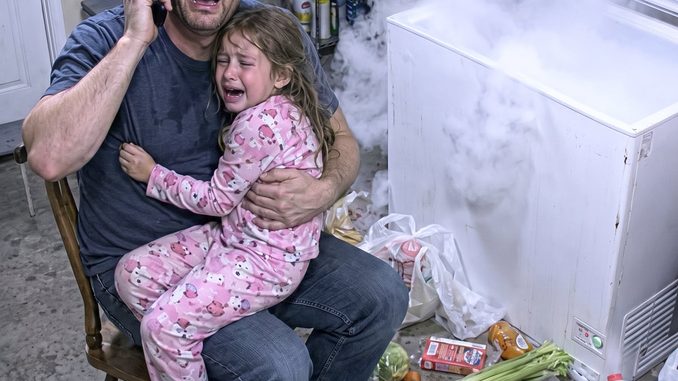
PART 1: I CAME FOR MY BELONGINGS AND FOUND MY DAUGHTER IN A FREEZER
The divorce had only been finalized three weeks earlier when Taylor sent me a message telling me to collect the rest of my belongings by Friday. There was no greeting or explanation, just another cold reminder that the woman I once planned to grow old with wanted the remaining pieces of our marriage removed from her life.
“Pick up your stuff by Friday.”
Instead of waiting until Friday, I drove to the house on Thursday night, hoping I could collect everything quietly and avoid another confrontation. It was nearly ten when I reached Aspen Ridge Lane, and although Taylor’s car was gone, the garage door had been left wide open.
Another vehicle was parked nearby, and I recognized it immediately as belonging to Evelyn, my former mother-in-law. She had always found excuses to spend time at the house, claiming she was only helping Taylor with Lily, but her constant involvement had bothered me even before the divorce.
I walked into the garage and found myself surrounded by moving boxes, old furniture, and everything else left behind from the life Taylor and I had shared. Then, from somewhere nearby, I heard a muffled scream.
“Daddy!”
For a second, I froze because the voice sounded distant and distorted. Then it came again, louder and more desperate.
“Daddy! Help!”
I rushed toward the large chest freezer against the garage wall and yanked open the lid. A blast of freezing air hit my face, and inside, curled among packages of frozen food, was my daughter Lily.
Her lips had turned blue, and her entire body was trembling uncontrollably. I immediately lifted her out, wrapped my jacket around her, and held her against my chest while rubbing her back and trying to warm her.
“I’ve got you. You’re safe now.”
She clung tightly to me despite how weak she seemed. Once I could see that she was breathing, I asked the question I was almost afraid to hear answered.
“How long were you in there?”
Lily shook her head.
“I don’t know.”
Then she whispered something that changed the entire situation.
“Grandma put me in.”
I stared at her, wondering whether I had somehow misunderstood.
“What did you say?”
“She puts me in there when I’m bad. She says the cold helps me think.”
Anger immediately took over, and my first instinct was to carry Lily into the house and confront Evelyn. Before I could move, however, Lily grabbed my sleeve and stopped me.
“Daddy… wait.”
Across the garage was another chest freezer, smaller and much older than the one I’d just opened. It wasn’t connected to power, but a thick silver padlock had been fastened around its lid.
Something about it immediately filled me with dread. I started walking toward it, but Lily’s frightened voice stopped me again.
“Don’t open that one.”
I turned toward her.
“Why?”
She lowered her eyes.
“That’s where the bad ones go.”
I didn’t understand.
“What do you mean?”
Her answer was barely louder than a whisper.
“The ones who don’t come back.”
I didn’t touch the second freezer. Instead, I carried Lily outside, placed her inside my truck, turned the heater as high as possible, and wrapped her in every blanket I could find.
“Stay here. Don’t open the door for anyone except me.”
Once she was safely inside, I called 911 and explained everything Lily had told me. I also described the second freezer and made it clear that I hadn’t opened or disturbed it.
“My daughter was locked inside a running freezer. She says her grandmother put her there as punishment. There’s another freezer in the garage, it’s unplugged, locked with a heavy padlock, and my daughter says that’s where ‘the bad ones go.’ Please send police and an ambulance immediately.”
The dispatcher instructed me not to touch the locked freezer unless there was an immediate threat to someone’s life. I returned to Lily and found her huddled beneath the blankets, still pale and trembling.
“You did the right thing. You told me.”
Lily looked up at me.
“I thought maybe you wouldn’t believe me.”
That hurt almost as much as finding her inside the freezer. I gently asked how many times Evelyn had done this to her.
“I don’t know. If I count wrong… she starts over.”
I suddenly understood that this hadn’t been one terrible moment or some punishment that had gone too far. Someone had repeatedly taught my little girl to sit inside a freezer until she could no longer keep track of how much time had passed.
I asked what she had supposedly done to deserve these punishments. Lily’s answers were painfully ordinary.
“When I spill something. When I cry. When I ask for you. When I tell Mommy I don’t want Grandma here.”
Her words made months of strange behavior suddenly fit together. Lily had developed nightmares, become terrified of closed doors, panicked around grocery-store freezers, and even reacted fearfully to ice cream trucks, but whenever I raised those concerns, Taylor dismissed them as normal childhood behavior or blamed the emotional strain of our divorce.
Sirens finally approached, and within minutes police cruisers and an ambulance filled the driveway. Paramedics immediately began examining Lily while officers secured the garage and inspected both freezers without disturbing anything unnecessarily.
One officer looked toward the locked freezer before asking me exactly what Lily had said about it. I repeated her words without changing anything.
“That’s where the bad ones go. The ones who don’t come back.”
The officer stared at the freezer for several seconds before speaking into his radio. Within minutes, crime-scene tape surrounded the garage, and additional investigators were called to the property.
At that point, everyone understood that this was no longer simply a disturbing incident between a grandmother and her granddaughter. Whatever investigators were about to discover inside that second freezer could reveal something that had been happening inside this family for far longer than anyone realized.
PART 2: THE FREEZER WAS ONLY PART OF THE HORROR
Within minutes, the garage had become a full crime scene. Officers sealed off the driveway while investigators and forensic technicians arrived, and paramedics wrapped Lily in heated blankets as I repeatedly answered questions about what I had found and what my daughter had told me.
Sergeant Perez approached the second freezer but didn’t touch it. He wanted Lily’s exact words before anyone disturbed what might be evidence.
“What exactly did your daughter say?”
“She called it the place where the bad ones go. She said they’re the ones who never come back.”
Perez immediately called for additional investigators and ordered everyone to leave the garage untouched. I rode with Lily to the hospital, holding her hand while she slowly regained some color, although she still became frightened whenever anyone mentioned the house.
“I thought maybe you wouldn’t come.”
“Why would you think that?”
Lily stared down at the blanket covering her legs.
“Mommy said you forget important things now.”
That answer crushed me because someone hadn’t merely been frightening my daughter. They had also been teaching her that the father she trusted might not come when she needed him.
While we waited in the emergency department, officers returned to the garage with equipment to open the locked freezer. I wanted desperately to know what was inside, but one of the paramedics reminded me where I was needed most.
“She needs you more than you need that freezer.”
Several minutes later, Sergeant Perez entered the hospital hallway. He told me there was no body inside, and relief almost dropped me to my knees, but his expression made it clear that the news wasn’t good.
“There were restraints. Child-sized restraints. Duct tape residue. Scratches covering the inside of the lid. A small amount of old blood. And children’s drawings taped to the wall.”
I struggled to process what he was telling me.
“What kind of drawings?”
Perez hesitated before answering.
“One says, ‘I will be good now.’ Another says, ‘I won’t tell Daddy anymore.’”
That was when I understood the second freezer hadn’t been used for ordinary storage. Someone had deliberately turned it into part of a punishment system designed around confinement and fear.
“How long has this been happening?”
“We don’t know yet. But this wasn’t a one-time incident.”
Investigators expanded their search throughout the house while Lily remained at the hospital. Every familiar room where we’d once celebrated birthdays and Christmases was now being examined as potential evidence.
Later that night, Detective Rachel Monroe interviewed Lily in a quiet hospital room. Instead of overwhelming her with questions, Monroe sat on the floor with crayons, paper, and toys, allowing Lily to explain things at her own pace.
Slowly, a pattern emerged. Whenever Evelyn decided Lily had misbehaved, she ordered her into the freezer, sometimes for only a few minutes and sometimes much longer, and crying or asking for me could extend the punishment.
“The other freezer, did Grandma ever put you inside that one?”
Lily immediately shook her head.
“No. She only opens it when she’s really mad.”
Monroe then asked the question I had been dreading.
“What does Mommy do?”
Lily hesitated before answering.
“She stands by the door. She tells me to listen to Grandma. She says it’ll be over faster.”
That revelation destroyed the last excuse I could have made for Taylor. She might not have physically placed Lily inside the freezer, but according to our daughter, she knew what Evelyn was doing, remained nearby, and told Lily to cooperate rather than stopping it.
Detective Monroe continued carefully.
“Did Grandma ever tell you why she did this?”
Lily nodded.
“She said Mommy had to learn the same way.”
The room fell silent because those few words revealed that the pattern hadn’t begun with my daughter. Taylor herself had apparently grown up under similar treatment from Evelyn, which suddenly explained her obedience to her mother and her insistence that harsh punishment was simply a way of raising stronger children.
Taylor had once been the child trapped inside that system. But instead of ending it when she became a mother, she had allowed Evelyn to pass it down to Lily.
Medical examinations confirmed that Lily had suffered mild hypothermia and other effects consistent with repeated exposure to extreme cold. Doctors believed what they were seeing couldn’t be explained by a single incident, which meant the confinement had likely been happening over an extended period.
The word repeated stayed with me. Suddenly I understood why Lily had become afraid of popsicles, grocery-store freezer aisles, and nightmares about being trapped somewhere dark and cold.
Around two that morning, police finally located Taylor and Evelyn and brought them in separately for questioning. I asked Detective Monroe only one thing.
“Did Taylor ask how Lily was?”
Monroe paused before answering.
“No. She asked whether Lily had said anything.”
That sentence erased whatever trust remained between us. Our divorce might already have been legally complete, but in that hospital hallway, I finally understood that Taylor’s first concern wasn’t whether our daughter was safe.
It was whether Lily had talked.
By sunrise, emergency custody had been transferred to me, no-contact recommendations were being prepared, and investigators had expanded their search of the property. What they discovered among Evelyn’s belongings showed just how organized the punishment had become.
Officers recovered a handwritten notebook containing dates, lengths of confinement, and behaviors Evelyn classified as “defiance.” They also found photographs of Lily after punishments and instruction cards claiming that caregivers shouldn’t interrupt “correction” because temporary suffering supposedly produced stronger children.
The material stretched back years, and investigators soon found evidence suggesting Taylor had endured similar treatment during her own childhood. For the first time, I could see the full shape of what had happened.
My ex-wife had once been a victim.
But eventually, she had become an adult willing to stand beside the door while the same nightmare was inflicted on her daughter.
And investigators were about to discover that the blood inside the second freezer didn’t belong to Lily at all.
PART 3: THE DAY I FINALLY BROKE THE CYCLE
By the following morning, investigators understood that Lily’s confinement wasn’t an isolated incident. Search warrants expanded across the property, and detectives uncovered evidence showing that Evelyn had maintained a carefully organized system of punishment for years.
Among her belongings were handwritten journals documenting what she considered “defiance,” how long children were confined, and whether they became sufficiently obedient afterward. Officers also discovered photographs of Lily crying or sitting alone after punishments, with notes underneath describing her as “calmer” or “more respectful.”
Some of the materials led investigators back to Taylor’s own childhood. Evelyn had once taken her to a counselor whose methods reportedly involved confinement, humiliation, sensory deprivation, and fear presented as forms of discipline, and suddenly much of Taylor’s behavior began to make terrible sense.
My ex-wife hadn’t invented this cruelty. She had grown up inside it, but somewhere between surviving it and becoming a mother herself, she had accepted enough of Evelyn’s beliefs to allow the same pattern to reach our daughter.
That realization left me with conflicting emotions. I could understand why Taylor feared her mother while still refusing to excuse the fact that, when Lily needed protection, Taylor had chosen obedience to Evelyn instead.
Looking back, I also realized how many warning signs I’d missed. Lily had suddenly stopped eating popsicles, cried when cold air rushed from grocery-store freezer doors, and sometimes woke from nightmares asking whether someone could still breathe after a lid was closed over them.
Whenever I raised those concerns, Taylor insisted the divorce was making me overprotective and said Lily simply needed stability. I wanted to believe her, and that meant I accepted explanations I should have questioned much sooner.
Three days later, Detective Monroe came to my apartment with the forensic results from the locked freezer. The traces of blood investigators had discovered inside didn’t belong to Lily.
Instead, they appeared to be many years old and were believed to belong to Taylor from her childhood. There was no hidden body and no evidence that anyone had died inside that garage, but somehow the truth wasn’t particularly comforting.
The second freezer hadn’t been used to hide death.
It had been used to create obedience.
Taylor’s attorney tried to characterize everything as a generational misunderstanding involving outdated parenting practices, but the physical evidence, Lily’s medical examination, her statements, and the condition of both freezers made that explanation impossible to sustain.
Criminal charges followed. Evelyn faced charges involving child abuse, unlawful confinement, and aggravated child endangerment, while Taylor faced allegations connected to child endangerment, failure to protect, and obstructing investigators after inconsistencies emerged in her interviews.
As news spread, people who had remained silent during our divorce suddenly contacted me. Some claimed they had always suspected something was wrong with Evelyn, while others admitted they’d heard disturbing stories years earlier but dismissed them because they seemed too extreme to believe.
One message came from Taylor’s cousin Rachel.
“She used to lock Taylor in a storage closet when they lived in Kansas. Everyone knew pieces of it. Nobody wanted to believe the whole story.”
That sentence stayed with me because it explained how something terrible could survive inside a family for decades. Everyone knew one small piece, but each piece had been renamed as strict parenting, discipline, or tough love until nobody wanted to put them together and admit what they actually meant.
Lily began therapy the following week. At first, she couldn’t talk comfortably unless freezer packs were placed far enough away for her to control the distance, and one evening while I was making grilled cheese sandwiches, she finally asked the question I’d known would eventually come.
“Did Mommy know?”
I stopped what I was doing before answering as carefully as I could.
“She knew some of it. She should have protected you.”
“She didn’t.”
“And none of that was ever your fault.”
Lily quietly accepted the answer and asked for another bowl of soup. Her ability to continue being a child despite everything that had happened reminded me that healing didn’t always arrive through dramatic moments; sometimes it looked like eating dinner and feeling safe enough to ask difficult questions.
More witnesses eventually came forward. Former babysitters described Evelyn’s unusual punishments, old neighbors remembered hearing Taylor crying inside the garage as a child, and relatives admitted they had noticed disturbing behavior but convinced themselves it was merely harsh parenting.
The pattern stretched back decades.
Lily hadn’t started it.
She became the child who finally interrupted it.
Months later, Taylor requested supervised visitation, but psychological evaluators refused to approve it immediately. She still referred to what happened as “the incident” and continued describing Evelyn’s actions as discipline that had gone too far rather than acknowledging them as abuse.
That distinction mattered because someone who couldn’t honestly identify what had happened couldn’t yet be trusted to prevent it from happening again.
During those months, I began writing letters I never intended to send. Some were addressed to Taylor and others to Evelyn, but the most important one was written for Lily to read someday when she was old enough to understand everything.
I wanted her to know that I regretted not recognizing the signs sooner, but I also wanted her to remember one thing clearly: the moment I heard her scream from inside that freezer, nothing mattered more than reaching her. If she ever wondered whether her father would fight for her, I wanted her to remember the moment that lid opened.
About six months later, Detective Monroe called with one final discovery from Evelyn’s journals. Among pages of notes about punishment was a sentence that explained the philosophy behind everything she had done.
“Cold makes children tell the truth faster than love ever could.”
I stared at those words for a long time. Evelyn hadn’t simply lost control one afternoon; she had convinced herself that fear produced better children than kindness, then passed that belief down until cruelty had become normal enough for Taylor to tolerate it.
Today, Lily still dislikes deep freezers and sometimes flinches when cold air suddenly hits her. She sleeps beneath two blankets even during warm weather, but she also plays soccer, laughs with her friends, complains about homework, and has developed a surprisingly clear understanding of what rules are supposed to mean.
One afternoon, she looked at me with complete seriousness.
“Rules aren’t supposed to hurt people.”
“No. They never are.”
People occasionally ask what saved my daughter that night, and they expect the answer to be courage. Courage mattered, but the real difference was something far simpler: I happened to arrive on Thursday instead of Friday, found the garage door open, and heard one frightened voice calling for me.
I still sometimes wonder what would have happened if I’d waited until the following morning to collect my belongings. That thought occasionally wakes me at night, but it isn’t the ending Lily and I received.
I heard my daughter.
I opened the freezer.
And once Lily finally spoke, every secret that family had protected for years began collapsing under the truth.
For a long time, I believed the divorce had taken my home from me. Then, on that Thursday night, I thought hearing Lily scream from inside a freezer was the worst thing I would ever experience.
Eventually, I realized the most disturbing part was discovering how many people had noticed fragments of the truth over the years and found gentler names for them because the reality was too uncomfortable to confront.
That night, I had driven back expecting to collect some furniture and forgotten boxes.
Instead, I arrived just in time to take home the only thing that had ever truly mattered.
My daughter.
Leave a Reply